|
|
 For all STAR physics focus articles in list form, click HERE
|
|
STAR focus: Imaging shapes of atomic nuclei in high-energy nuclear collisions
|
|
The STAR Collaboration recently published "Imaging Shapes of Atomic Nuclei in High-Energy Nuclear Collisions" in Nature.
This work has been selected in Nature News & Views, highlighted in an interview for Nature Podcast, and has been selected in other Nature NEWS. Atomic nuclei, composed of protons and neutrons, are self-organized, many-body quantum systems bound by strong-nuclear forces within femtometer-scale space. Revealing the shape of nuclei has been a scientific pursuit for over a century, beginning with Rutherford's scattering experiments. Numerous models, including the Fermi gas model, Liquid drop model, Shell model, and Collective model, have been developed to study nuclear structure, with two of these models earning Nobel Prizes. Currently, our understanding of nuclear shape largely comes from low-energy spectroscopic and scattering experiments. Investigating nuclear shape across the nuclear chart has been an important area of research and is crucial for topics such as nucleosynthesis, nuclear fission, and neutrinoless double beta decay ($0 \nu \beta \beta$).
A pertinent question arises: How do shapes observed in high-energy colliders compare to those derived from low-energy experiments? High-energy nuclear collisions, an utterly destructive process, have a much shorter timescale than nuclear rotational degrees of freedom, allowing access to many-body nucleon distribution within each nucleus. Head-on (near-zero impact parameter) collisions of prolate deformed nuclei present two extreme configurations, body-body (top) and tip-tip (bottom) collisions. The collision of two Lorentz-contracted pancake-like shapes of nuclei at high energy can generate a 3D profile of the initially produced quark-gluon plasma. The shape and size of the initial overlap region, as well as those of the final fireball after hydrodynamic expansion, differ significantly between these two collision configurations, as shown in the figure.
|
 |
|
|
In this article, the STAR Collaboration developed a new method, "collective flow assisted nuclear shape imaging" method, which images the nuclear global shape by colliding them at ultrarelativistic speeds and analyzing the collective response of outgoing debris. This technique captures a collision-specific snapshot of the spatial matter distribution within the nuclei, which, through the hydrodynamic expansion, imprints patterns onto the particle momentum distribution observed in detectors. By taking ratios of the nearly equal mass number $^{238}$U+$^{238}$U and $^{197}$Au+$^{197}$Au collisions, final state effects are almost completely canceled, leaving model uncertainties primarily from initial conditions. Comparisons between data and IP-Glasma+MUSIC model delineate preferred $\beta_{2 \mathrm{U}}$ ranges, yielding $\beta_{2 \mathrm{U}}=0.297 \pm 0.015$ and $\gamma_{\mathrm{U}}=8.5^{\circ} \pm 4.8^{\circ}$ (mean and one standard deviation). Corresponding constraints from Trajectum are $\beta_{2{\mathrm{U}}}=0.275 \pm 0.017$ and $\gamma_{\mathrm{U}}=15.5^{\circ} \pm 7.8^{\circ}$. Combining constraints from both models yields $\beta_{2 \mathrm{U}}=0.286 \pm 0.025$ and $\gamma_{\mathrm{U}}=8.7^{\circ} \pm 4.5^{\circ}$. These values are broadly consistent with previous extractions based on low energy data.
Our approach offers a novel method for imaging nuclear shapes, enhances understanding of the initial conditions in high-energy collisions, and addresses the critical issue of nuclear structure evolution across energy scales. Future research could leverage colliders to conduct experiments with selected isobaric or isobar-like pairs, further enabling interdisciplinary research in nuclear physics.
|
|
Posted Nov. 6, 2024
|
|
|
|
STAR focus: Exclusive J/ψ, ψ(2s), and e+e− pair production in Au+Au ultra-peripheral collisions at RHIC
|
|
Recently, we measured exclusive J/ψ, ψ(2s), and di-electron pair photoproduction in Au+Au ultra-peripheral collisions at RHIC using the STAR detector. For J/ψ production, both coherent (nucleus remains intact) and incoherent (nucleus breaks up) processes were observed. For the first time, it was found that both coherent and incoherent J/ψ production are suppressed in gold nuclei compared to a free proton, with the suppression being even stronger for the incoherent process. Given the RHIC kinematics, gluon saturation is not expected to play a significant role, so the observed large nuclear suppression suggests additional effects, such as nuclear shadowing. Indeed, the Leading Twist Approximation nuclear shadowing model provides a better fit to the data, particularly for coherent J/ψ production. This research is focused on the intermediate energy range in heavy-ion UPCs, which is sensitive to the transition between regions dominated by dense gluons and those by valence quarks.
|
 |
|
|
Figure:Nuclear suppression factor of coherent and incoherent J/ψ photoproduction in Au+Au UPCs. The data are compared with the nuclear shadowing model and the CGC model.
Additionally, we have made the first cross-section measurement of ψ(2s) photoproduction at RHIC and found that the ratio between ψ(2S) and J/ψ is consistent with free proton data, indicating that the nuclear suppression does not significantly differ between these two vector mesons. Finally, we reported di-electron photoproduction via the Breit-Wheeler process, extending to high invariant mass regions up to 6 GeV, which supports the nuclear breakup model involving forward neutron emission and associated photon fluxes.
In summary, these UPC measurements of vector mesons and dileptons provide valuable insights into the inner structure of nucleons and nuclei, helping to pave the way for the upcoming electron-ion collider.
|
|
Posted Oct 30, 2024
|
|
|
STAR focus: Measurements of charged-particle multiplicity dependence of higher-order net-proton cumulants in p + p collisions at $\sqrt{s} = 200$ GeV from STAR at RHIC
|
|
One of the ultimate goals of heavy-ion collision experiments is to map the phase diagram of nuclear matter, the so-called QCD phase diagram, with respect to temperature (T) and baryon chemical potential ($µ_{B}$). Higher-order cumulants of net-baryon multiplicity distributions are expected to be sensitive to the QCD phase structure. The STAR experiment observed that the $6^{th}$-order fluctuation of the net-proton multiplicity distribution becomes progressively negative systematically from peripheral to central Au+Au 200 GeV collisions, which hints at a smooth crossover transition at $µ_{B}$=25 MeV.
Recently, the STAR experiment published the net-proton higher-order cumulants from p+p 200 GeV collisions. Experimental results from the LHC, such as collectivity and strangeness enhancement, suggest that the Quark Gluon Plasma (QGP) could be formed in high-multiplicity p+p collisions, although it does not necessarily indicate that thermalized QCD drops of matter have been created. This can be tested by higher-order correlations in p+p collisions at top RHIC energy and LHC energies.
The figure below (Phys.Lett.B 857 (2024) 138966 ) shows the charged-particle multiplicity dependence of the cumulant ratios, (a) $C_4$/$C_2$, (b) $C_5$/$C_1$, and (c) $C_6$/$C_2$ of net-proton multiplicity distributions. Results from p+p 200 GeV minimum bias collisions are close to those from peripheral Au+Au 200 GeV collisions. On the other hand, the ratios measured at each charged-particle multiplicity bin in p+p collisions decrease with increasing the multiplicity more rapidly than Au+Au collisions, and $C_5$/$C_1$ and $C_6$/$C_2$ values reach zero at the highest multiplicity bin. The results favor the negative values of the ratios at higher multiplicity events. Although part of the decrease as a function of the charged particle multiplicity in a given event is due to baryon conservation, the negative ratios in the context of lattice QCD calculations imply that even in the small 𝑝+𝑝 system, thermalized QCD matter may be created in the highest-multiplicity collisions. Further, the steeper slope indicates that thermalized QCD matter is created more efficiently in high multiplicity 𝑝+𝑝 collisions than that in heavy-ion collisions. Systematic measurements of the cumulant ratios from higher collision energies and in larger colliding systems will provide important information on the underlying dynamics of thermalization in high-energy collisions.
|

|
|
Figure: Net-proton cumulant ratios, (a) $𝐶_{4}$∕$𝐶_{2}$, (b) $𝐶_{5}$∕$𝐶_{1}$, and (c) $𝐶_{6}$∕$𝐶_{2}$ as a function of charged-particle multiplicity for 𝑝+𝑝 collisions and Au+Au collisions at 200GeV. Cyan markers represent event averages from the 𝑝+𝑝 collisions. Results from Au+Au collisions are shown as triangles. Red and grey bands show the systematic uncertainties for 𝑝+𝑝 collisions and Au+Au collisions, respectively. The Skellam baselines are shown in dotted lines. The purple bands show corresponding susceptibility ratios of baryon number from lattice QCD calculations.
|
|
Posted Oct 22, 2024
|
|
|
STAR focus: Observation of the Antimatter Hypernucleus $^4_{\bar{\Lambda}}\overline{\hbox{H}}$
|
|
Matter-antimatter asymmetry is a research topic of fundamental interest, as it is the basis for the observed dominance of matter over antimatter in the universe. High energy nuclear collisions create conditions similar to the Universe microseconds after the Big Bang, with comparable amounts of matter and antimatter. Much of the antimatter created escapes the rapidly expanding fireball without annihilation, making such collisions an effective experimental tool to create heavy antimatter nuclear objects and study their properties.
In this work, we report the first observation of the antimatter hypernucleus $^4_{\bar{\Lambda}}\overline{\hbox{H}}$, composed of a Λ, an antiproton and two antineutrons. This discovery was made through its two-body decay channel $^4_{\bar{\Lambda}}\overline{\hbox{H}} {\rightarrow}^4\overline{\hbox{He}}+\pi^+$ in the STAR experiment at the Relativistic Heavy Ion Collider.
We use Kalman Filter algorithm to analyse the data totaling 6.6 billion collision events in the Au+Au, Ru+Ru, and Zr+Zr collisions with the collision energy $\sqrt{s_{NN}}=200$GeV, as well as U+U collisions with the collision energy of $\sqrt{s_{NN}}=193$GeV. We obtained 15.6 signal candidates for the antimatter hypernucleus ${}^{4}_{\bar{\Lambda}}\overline{\hbox{H}}$, with the estimated background counts 6.4 and significance of 4.7.
We also obtained 941 ${}^{3}_{\Lambda}\hbox{H}$ signal candidates, 637 ${}^{3}_{\bar{\Lambda}}\overline{\hbox{H}}$ signal candidates and 24.4 $^4_\Lambda\hbox{H}$ signal candidates using the same method.
|
 |
Figure: Invariant-mass distributions of $^3\hbox{He}+\pi^-$ (A), $^3\overline{\hbox{He}}+\pi^+$ (B), $^4\hbox{He}+\pi^-$ (C) and $^4\overline{\hbox{He}}+\pi^+$ (D).} The solid bands mark the signal invariant-mass regions. The obtained signal count ($N_{\rm Sig}$), background count ($N_{\rm Bg}$), and signal significances ($Z_{\rm count}$ and $Z_{\rm shape}$) are listed in each panel.
|
|
Comparing lifetimes between a particle and its corrsponding antiparticle is an important experimental way to test the $CPT$ symmetry and to search for new mechanisms that cause this matter and antimatter asymmetry. In this work, we measured the lifetimes of ${}^{3}_{\Lambda}\hbox{H}$, ${}^{3}_{\bar{\Lambda}}\overline{\hbox{H}}$, ${}^{4}_{\Lambda}\hbox{H}$, and ${}^{4}_{\bar{\Lambda}}\overline{\hbox{H}}$. The lifetime difference between the hypernuclei and antihypernuclei was compared and we haven't found the CPT symmetry broken within the measurement uncertainty.
Various production yield ratios among (anti)hypernuclei and (anti)nuclei are measured. We found $\left(^3\overline{\hbox{He}}/^3\hbox{He}\right)\times\left(\bar{p}/p\right)\approx ^4\overline{\hbox{He}}/^4\hbox{He}$ and $\left(^3_{\bar{\Lambda}}\overline{\hbox{H}}/^3_{\Lambda}\hbox{H}\right)\times\left(\bar{p}/p\right) \approx ^4_{\bar{\Lambda}}\overline{\hbox{H}}/^4_{\Lambda}\hbox{H}$, these agree with the thermal model and coalescence picture predictions. And $^4_{\Lambda}\hbox{H}/^4\hbox{He}$ and $^4_{\bar{\Lambda}}\overline{\hbox{H}}/^4\overline{\hbox{He}}$ is expected to be about 4 times higher than $^3_{\Lambda}\hbox{H}/^3\hbox{He}$ and $^3_{\bar{\Lambda}}\overline{\hbox{H}}/^3\overline{\hbox{He}}$, respectively, hinting that $^4_{\Lambda}\hbox{H}$ has an excited state with spin 1. These measurements shed light on their production mechanism.
This work has been published by NATURE in August 2024.
Posted Aug 26, 2024
Previous STAR Focus Features
|
|
|
STAR focus: Cross Section and Transverse Single Spin Asymmetry of Z Boson from 510 GeV p+p Collisions
|
|
Nuclear science focuses on the origin and structure of the nucleus and the nucleons within it, which
account for essentially all the mass of the visible universe. Half a century of investigations has revealed
that nucleons themselves are composed of quarks, bound together by gluons, and have led to the
development of the fundamental theory of Quantum Chromo-Dynamics (QCD). Recent-generation
colliders have precisely measured the collinear parton distributions (1 dimension) inside the nucleon
along the longitudinal direction, while the investigation of nucleon structure in transverse momentum and
space has been limited. From transverse momentum dependent parton distributions (TMDs) we can obtain
an “image” of the proton structure in transverse as well as in longitudinal momentum space (2+1
dimensions).
|
 |
Figure:Differential cross section of the Z boson as a function of its transverse momentum (left) and
transverse single spin asymmetry of the Z boson (right).
|
|
The STAR Collaboration has recently published “Measurements of the Z boson cross section and
transverse single spin asymmetry in 510 GeV p+p collisions” in Phys. Lett. B 854 (2024) 138715 . In this
Letter, we report the first measurement of the Z boson differential cross section as a function of its
transverse momentum in p+p collisions at a center-of-mass energy of 510 GeV, shown in the left panel of
the above figure. It provides important constraints on the evolution of the TMDs in phase space. We also
report the precision measurement of the Z boson transverse single spin asymmetry (TSSA) in transversely
polarized p+p collisions at 510 GeV, shown in the right panel of the above figure. The TSSA of the Z
boson is sensitive to one of the polarized TMDs, the Sivers function, which is predicted to have the
opposite sign in p+p → W/Z + X compared to that which enters in semi-inclusive deep inelastic
scattering. This non-universality of the Sivers function is a fundamental prediction from the gauge
invariance of QCD. The experimental verification of this sign change hypothesis is a crucial measurement
in hadronic physics and provides an important test of QCD factorization. So far, the STAR result cannot
conclusively verify the prediction with the current statistics (340 $pb^{-1}$ ). The precision of the TSSA
measurement will be improved using an additional 400 $pb^{−1}$ sample of p+p data at 508 GeV that STAR
collected in 2022.
|
|
Posted May 24, 2024
|
|
|
STAR focus: Reaction plane correlated triangular flow in Au + Au Collisions at $\sqrt{s_{\mathrm{NN}}}$ = 3 GeV
|
|
One of the primary objectives of the Beam Energy Scan II (BES II), undertaken by the STAR collaboration, is to identify and study the transition from hadronic matter to the Quark Gluon Plasma (QGP). A critical aspect of this research is to discern how nuclear matter transforms from a state of high baryon density nucleons in low-energy heavy ion collisions to a QGP in higher energy collisions. BES II allows us to study this transition by measuring anisotropic flow at various collision energies and observing how the expansion of the medium produced by the collisions changes. Anisotropic flow describes the shape and direction of expansion of the medium produced in heavy-ion collisions, and triangular flow ($v_{3}$) describes the strength of a triangular component during that expansion. In past reports from energies above $\sqrt{s_{\mathrm{NN}}}=27$ GeV, $v_3$ was determined to arise from a random triangular arrangement during some collisions. This description implies that $v_3$ will have no correlation to the reaction plane of collisions as the orientation of the triangle fluctuates with no preferred angle.
|
 |
|
|
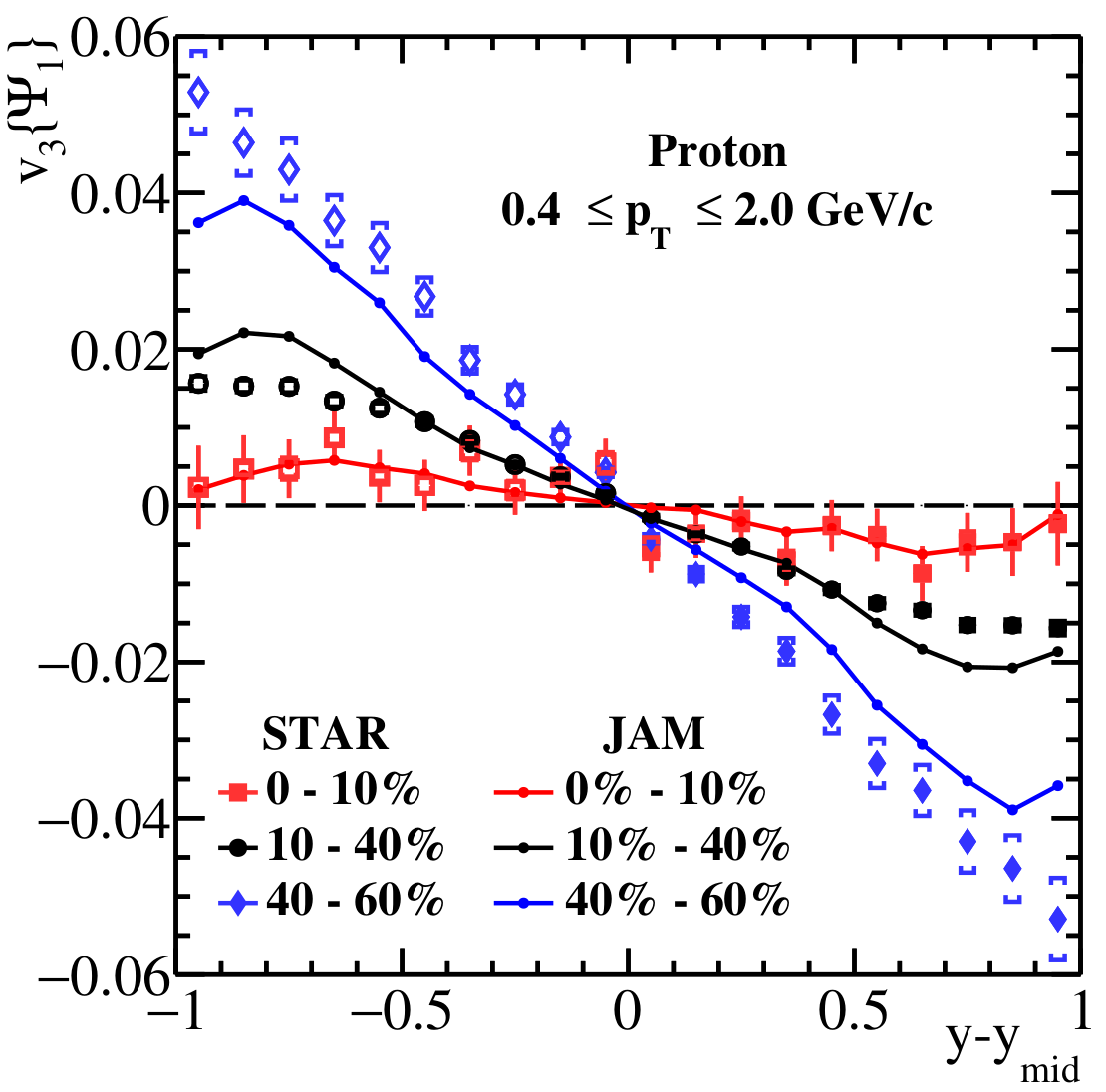
Figure: Measurement of triangular flow as a function of center of mass rapidity for protons in 3 GeV Au+Au collisions at RHIC. The solid markers show the measurements from data in three centrality bins and the open markers are a mirror image of the measrements to showcase the likely behavior in a larger rapidity range. The solid lines show predictions from an identical measurement using the JAM simulation when including a baryon density dependent potential in the equation of state.
STAR has recently published measurements of $v_3$ from Au+Au collisions at the lowest STAR energy of $\sqrt{s_{\mathrm{NN}}}=3.0$ GeV. It was found that protons exhibit a non-zero $v_3$ signal that is correlated to the reaction plane, revealing a stark difference between $v_3$ at low and high energies. This report also includes comparisons to predictions of $v_3$ by the JAM simulation in order to explain the source of this signal. A new triangular arrangement was found at this low energy, and it was discovered that there is a strong connection between this low energy $v_3$ and the equation of state for the medium produced in collisions. This new form of $v_3$ could be a useful tool for studying the equation of state and the transition between hadronic matter and the QGP.
|
|
Posted April 22, 2024
|
|
|
STAR focus: Hyperon polarization along the beam direction relative to the second and third harmonics event planes in isobar collisions at √sNN = 200 GeV
|
|
Polarization phenomena in heavy-ion collisions has drawn great attention since the observation of hyperon global polarization,
the non-zero average spin polarization of produced particles along the orbital angular momentum of colliding nuclei.
The STAR Collaboration measurement of the polarization along the beam direction relative to the second harmonic event plane,
indicated the local vorticity due to the elliptic flow (stronger collective expansion in in-plane than in out-of-plane directions).
These experimental results being in contradiction to the hydrodynamical and transport model predictions based on thermal vorticity,
posed the "spin sign puzzle" in heavy-ion collisions. The contribution from thermal shear is recently found to be important
to explain the data but the intense discussion is still ongoing to solve the puzzle.
Recently, the STAR Collaboration published a paper entitled "Hyperon polarization along the beam direction
relative to the second and third harmonics event planes in isobar collisions
at √sNN = 200 GeV"
in Physical Review Letter131, 202301 (2023).
Our new study extended the polarization measurements due to vorticity originating in the triangular flow, thus providing new independent information.
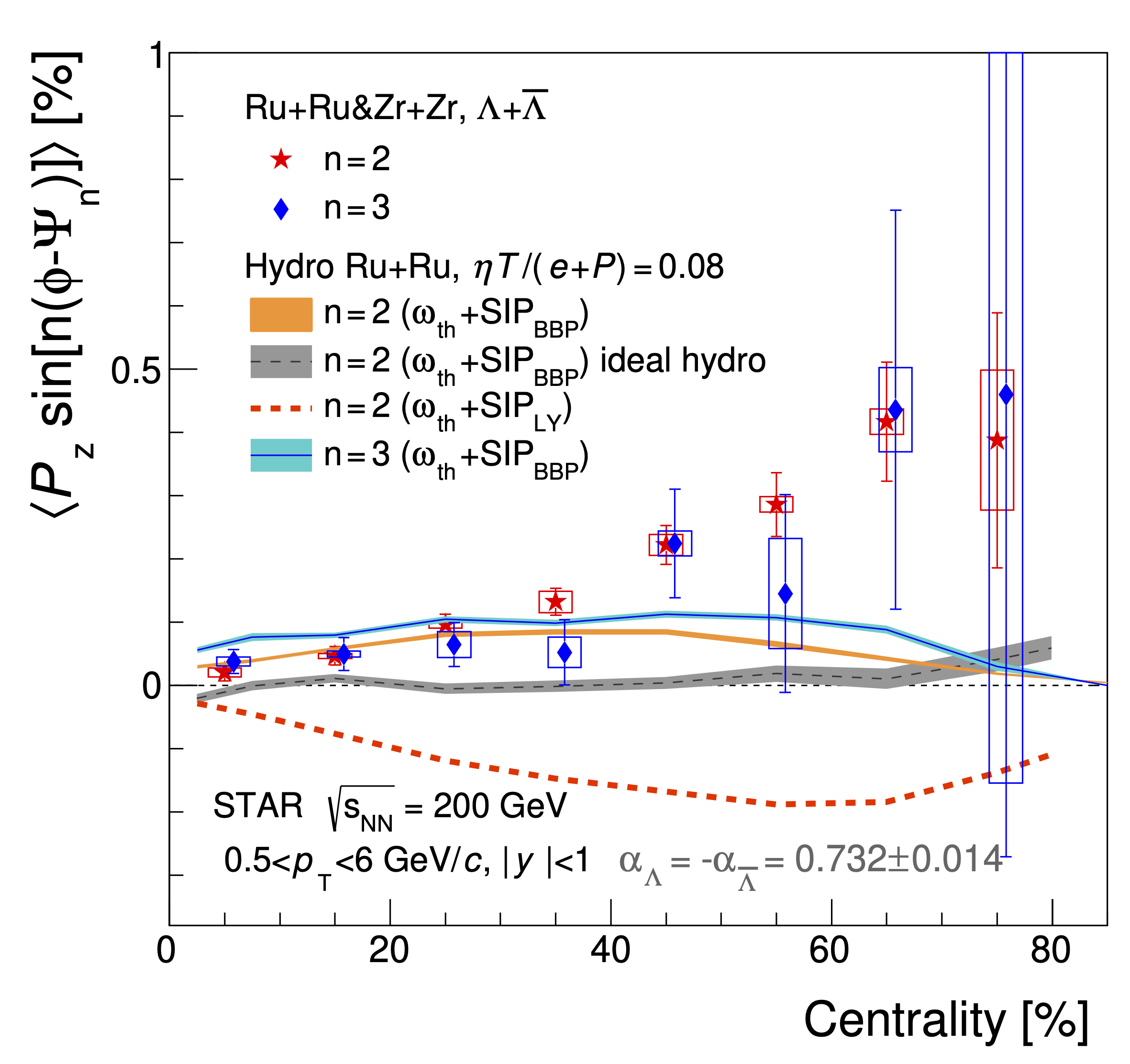
As shown in the figure below, Λ polarization along the beam direction relative to the triangluar flow plane (third harmonic event plane)
is found to be similar in phase to the result with the second harmonic event plane, with magnitude exhibiting increasing trend towards peripheral collisions.
These results indicate that complex vortical structures are created in heavy-ion collisions. Our results are compared with hydrodynamic model calculations
with two different implementations of the thermal shear leading to the opposite sign of polarization and require further investigation.
Our new data provide important inputs for resolving the spin puzzle and better understanding of the spin dynamics.
|
|
|
Figure:
Centrality dependence of Λ hyperon polarization along the beam direction relative to the second and third harmonic
event planes in isobar Ru+Ru and Zr+Zr collisions at 200 GeV.
Solid bands show hydrodynamic model calculations with contribution from the shear-induced-polarization
in two different implementations (SIPBBP and SIPLY).
|
|
Posted Jan 7, 2024
|
|
|
STAR focus: Energy Dependence of Intermittency for Charged Hadrons in Au+Au
Collisions at RHIC
|
|
Relativistic heavy-ion collision experiments serve as one of the primary avenues for studying strong
interactions, aiming to explore the properties of Quark-Gluon Plasma (QGP) and the phase structure of Quantum
Chromodynamics (QCD), including the search for first-order phase transitions in nuclear matter and the QCD
critical point. Based on the 3D Ising-QCD calculations, large density fluctuations are developed near the QCD
critical point in the heavy-ion collisions due to the power-law or self-similar structure of the density-density
correlation function. Such fluctuations manifest itself as critical intermittency and can be probed via the framework
of intermittency analysis by utilizing the scaled factorial moments (SFMs). The energy dependence of intermittency
index and scaling exponent, extracted from the power-law scaling of SFMs, is proposed for the search of the QCD
critical point.
Recently, the STAR Collaboration published significant results titled “Energy Dependence of Intermittency for
Charged Hadrons in Au+Au Collisions at RHIC” in Physics Letters B 845, 138165 (2023). The paper report the first
measurement of intermittency in Au$+$Au collisions at $\sqrt{s_\mathrm{_{NN}}}$ = 7.7-200 GeV measured by the
STAR experiment at the Relativistic Heavy Ion Collider (RHIC). We observe a power-law behavior of scaled factorial
moments in Au$+$Au collisions and a decrease in the extracted scaling exponent ($\nu$) from peripheral to central
collisions. The $\nu$ is consistent with a constant for different collisions energies in the mid-central (10-40$\%$)
collisions. Moreover, the $\nu$ in the 0-5$\%$ most central Au$+$Au collisions exhibits a non-monotonic energy
dependence that reaches a minimum around $\sqrt{s_\mathrm{_{NN}}}$ = 27 GeV. The observed non-monotonic
energy dependence of $\nu$ in the most central collisions may be due to the signal of density fluctuations induced by
the QCD critical point. These systematic measurements of intermittency for charged hadrons over a broad energy
range provide important insights into our understanding of the QCD phase diagram.
|
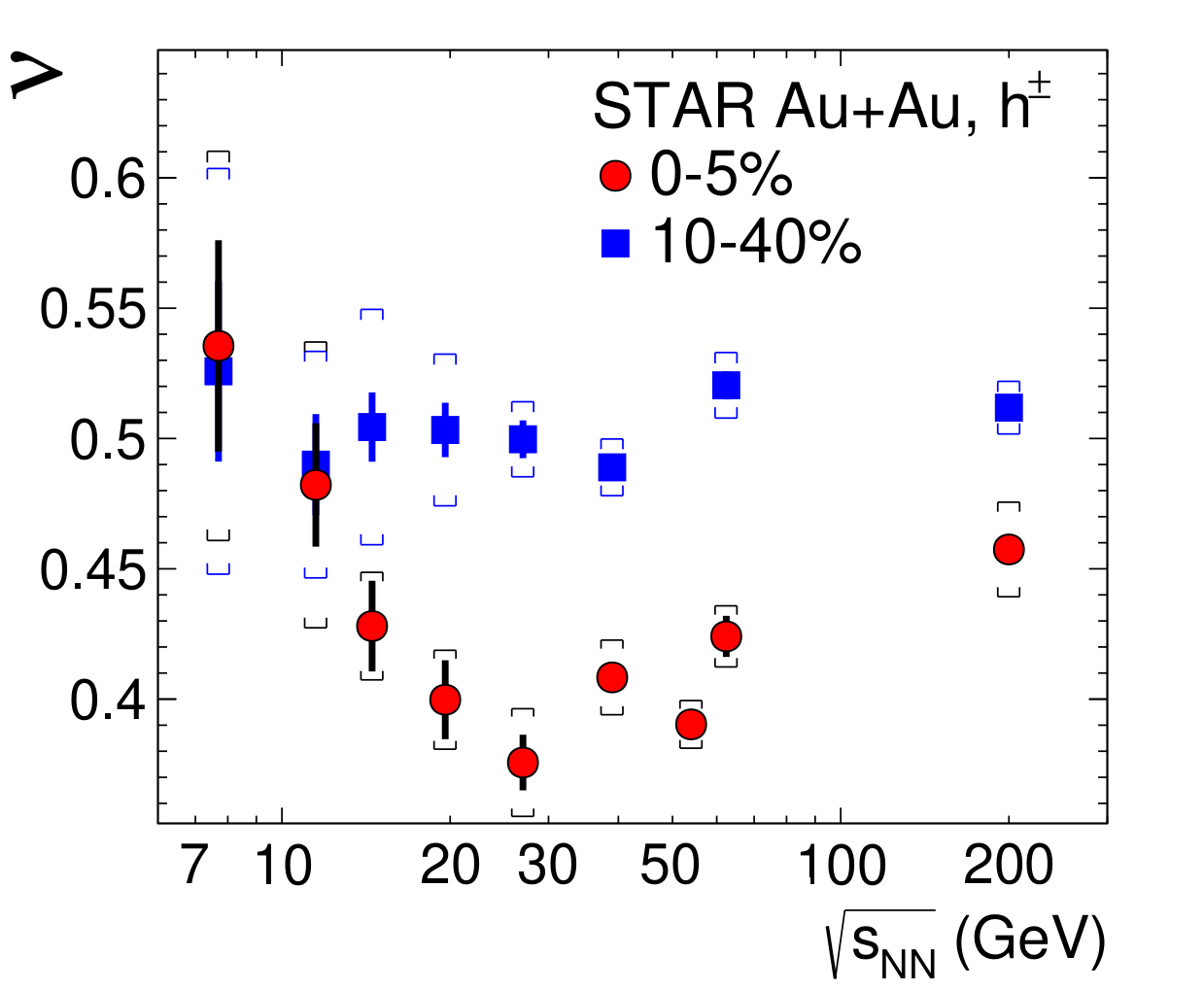 |
FIG. 1. Energy dependence of the scaling exponent ($\nu$) for identified charged hadrons ($h^{\pm}$ in Au$+$Au
collisions at $\sqrt{s_\mathrm{_{NN}}}$ = 7.7-200 GeV. Red circles and blue squares represent $\nu$ in the most
central collisions (0-5$\%$) and the mid-central collisions (10-40$\%$), respectively. The statistical and systematic errors
are shown in bars and brackets, respectively.
|
|
Posted Nov 13, 2023
|
|
|
STAR focus: Measurement of electrons from open heavy-flavor hadron decays in Au+Au collisions at $\sqrt{s_{\mathrm{NN}}}$ = 200 GeV with the STAR detector
|
|
Studying the properties of the Quark Gluon Plasma (QGP) created in heavy-ion collisions is a main goal of the RHIC physics program. Heavy quarks, i.e., charm and bottom quarks, have emerged as essential probes of the QGP as they are produced predominantly at the initial stage of the heavy-ion collisions and subsequently experience the entire evolution of the QGP. In particular, heavy quarks lose energy through interactions with the QGP via both collisional and radiative processes. These interactions modify the momentum distributions of heavy quarks in heavy-ion collisions compared to that in p+p collisions, and measurements of such modifications provide important insights into the properties of the QGP. Experimentally, nuclear modification factor, $R_{\rm{AA}}$, is measured to study the parton energy loss.
|
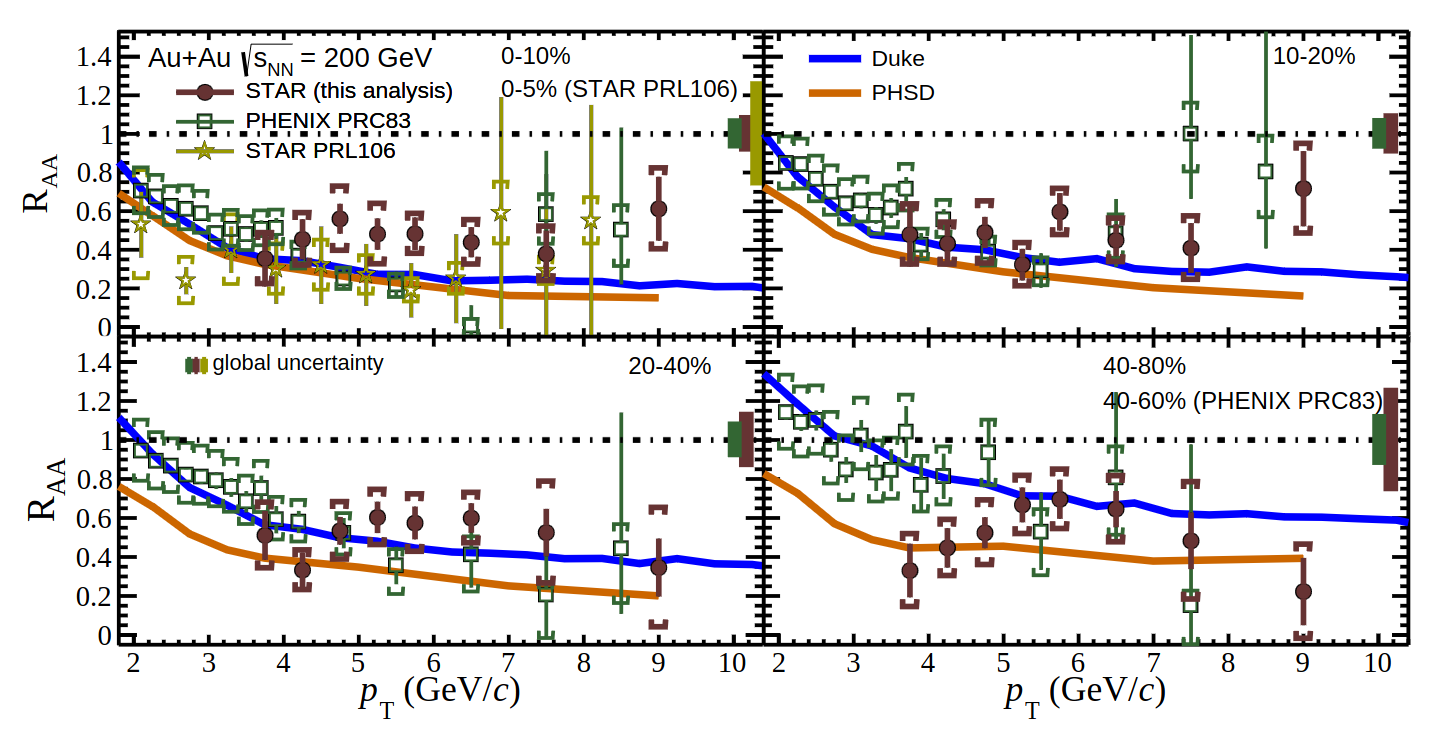 |
Figure: HFE $R_{\rm{AA}}$ (red circles) as a function of $p_{\rm{T}}$ in different centrality intervals of Au+Au collisions at $\sqrt{s_{\mathrm{NN}}}$ = 200 GeV, compared with STAR (yellow stars) and PHENIX (green squares) published results, and Duke (blue line) and PHSD (orange line) model calculations. Vertical bars and boxes around data points represent combined statistical and systematic uncertainties from both Au+Au and p+p measurements, respectively. Boxes at unity show the global uncertainties, which for this analysis include the 8% global uncertainty on p+p reference and the $N_{coll.}$ uncertainties. The left box is for PHENIX and the right one for STAR.
|
|
Recently, the STAR Collaboration published "Measurement of electrons from open heavy-flavor hadron decays in Au+Au collisions at $\sqrt{s_{\mathrm{NN}}}$ = 200 GeV with the STAR detector " in JHEP 06 (2023) 176. In this publication, the new measurements of $R_{\rm AA}$ for inclusive heavy flavor-decay electrons in Au+Au collisions at $\sqrt{s_{\mathrm{NN}}}$ = 200 GeV are reported. We find the HFE yields in head-on Au+Au collisions are suppressed by approximately a factor of 2 compared to that in p + p collisions scaled by the average number of binary collisions ($N_{coll.}$), indicating strong interactions between heavy quarks and the hot and dense medium created in heavy-ion collisions. Comparison of these results with models provides additional tests of theoretical calculations of heavy quark energy loss in the QGP. Furthermore, these results provide an improved reference for $R_{\rm{AA}}$ measurements of charm- and bottom-hadron decayed electrons in heavy-ion collisions.
|
|
Posted Jul 7, 2023
|
|
|
STAR focus: Beam Energy Dependence of Triton Production and Yield Ratio (Nt × Np/Nd2) in Au + Au Collisions at RHIC
|
|
Relativistic heavy-ion collision experiments serve as one of the primary avenues for
studying strong interactions, aiming to explore the properties of Quark-Gluon Plasma
(QGP) and the phase structure of Quantum Chromodynamics (QCD), including the
search for first-order phase transitions in nuclear matter and the QCD critical point,
which marks the endpoint of the phase boundary. Light nuclei are among the main
products in the final stages of heavy-ion collision experiments, characterized by a
small binding energy and finite radius, making them effective probes for exploring
phase boundaries and critical points in the QCD phase diagram. Theoretical studies
propose that the compound yield ratio of light nuclei based on the nucleon
coalescence model (Nt × Np / Nd2) is directly correlated with local neutron density fluctuations in
the system, providing a sensitive measurement for the search of the QCD critical point
and first-order phase transitions.
|
 |
|
|
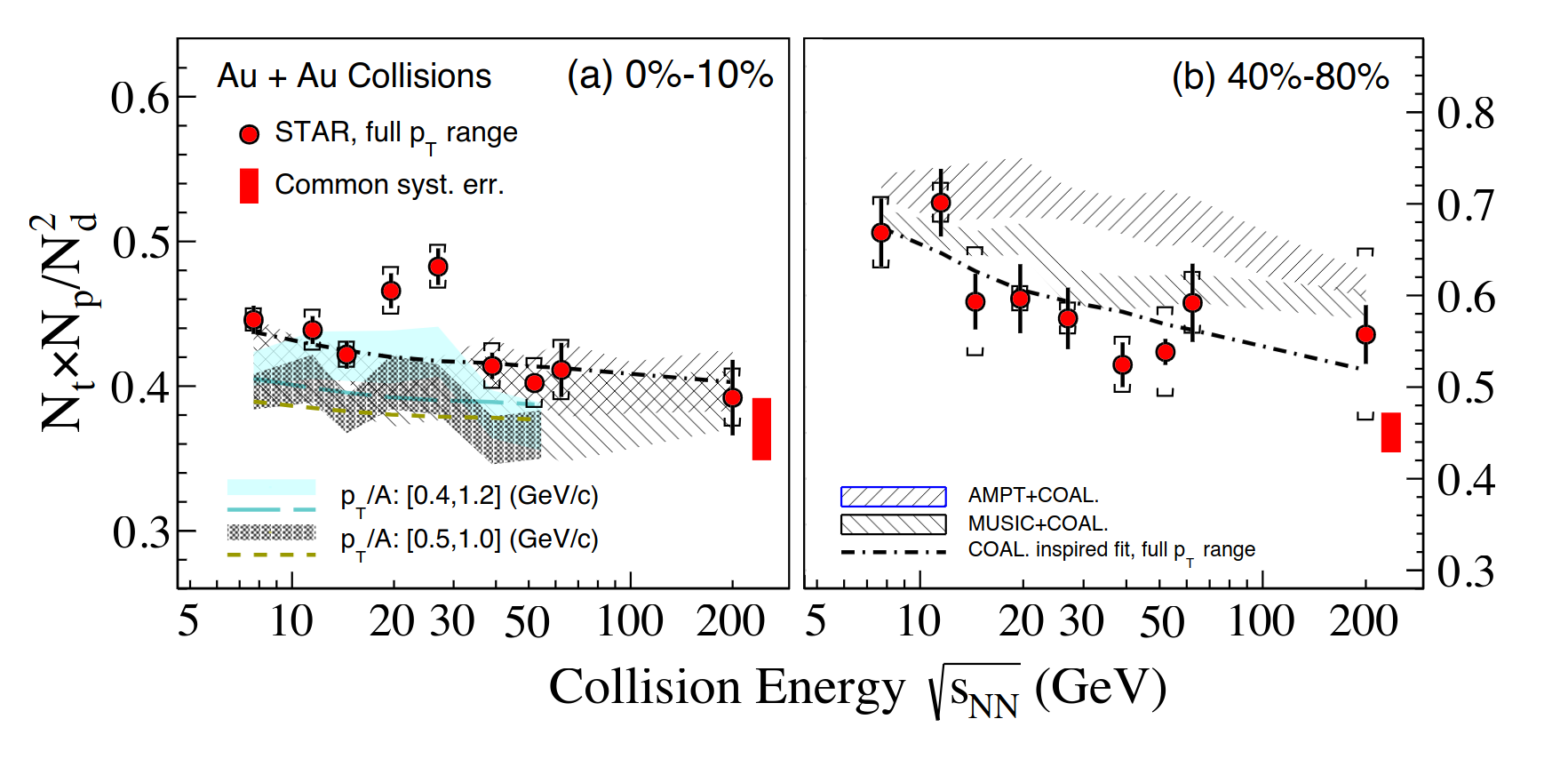
Figure: Collision energy, centrality, and pT dependence of the yield ratio Nt × Np / Nd2 in Au + Au collisions
at RHIC. Solid circles are the results from 0%–10% central (left panel) and 40%–80%
peripheral (right panel) collisions. Colored bands in panel (a) denote pT acceptance
dependence, for which the statistical and systematic uncertainties are added in quadrature.
Red solid circles are the final results with extrapolation to the full pT range. Statistical and
systematic uncertainties are shown as bars and brackets, respectively. Red vertical bands on
the right side of panels represent the common systematic uncertainties. Dashed lines are the
coalescence baselines obtained from the coalescence-inspired fit. Shaded areas denote the
calculations from hadronic transport AMPT and MUSIC + UrQMD hybrid models.
Recently, the STAR Collaboration published significant results titled "Beam Energy
Dependence of Triton Production and Yield Ratio (Nt × Np / Nd2) in Au + Au Collisions at RHIC"
in PHYSICAL REVIEW LETTERS 130, 202301 (2023). The paper focuses on the
measurement of triton yields, the extraction of primordial proton yields, and the
results of light nuclei compound yield ratio in the STAR BES-I. We observed that the Nt × Np / Nd2
ratio exhibits scaling behavior with the system volume, and most importantly, a
significant deviation from the model baseline at 4.1σ was observed in the 0%-10%
central collisions at $\sqrt{s_{\mathrm{NN}}}$ = 19.6 and 27 GeV, which may be due to the enhanced baryon
density fluctuations induced by the critical point or first-order phase transition in
heavy-ion collisions. These systematic measurements of triton yields and yield ratios
over a broad energy range provide important insights into the production dynamics of
light nuclei and our understanding of the QCD phase diagram.
|
|
Posted June 17, 2023
|
|
|
STAR focus: Measurement of sequential Upsilon suppression in Au+Au collisions at $\sqrt{s_{\mathrm{NN}}}$ = 200 GeV with
the STAR experiment
|
|
A primary goal of the RHIC physics program is to study the properties of the Quark-Gluon Plasma (QGP),
a novel state of QCD matter consisting of deconfined quarks and gluons. Among various probes used, Υ mesons,
bound states of bottom and anti-bottom quark pairs, play a unique role as they are believed to be produced before the QGP formation,
and then get destroyed in the QGP due to the color-screening of the potential between the bottom and anti-bottom quarks as well as scatterings
with medium constituents. There are three Υ states (Υ(1S), Υ(2S), Υ(3S)), which possess different
amounts of binding energies, with Υ(1S) being bounded the strongest while Υ(3S) the weakest.
Consequently, they are expected to experience different levels of yield suppression in the QGP depending
on the interplay between the medium temperature and their binding energies. Measurement of such sequential suppression for the three Y
states can be used to study the modification of the QCD force in the medium and the QGP’s thermodynamic properties.
Recently, the STAR experiment published the first measurement of yield suppression for the three Y states separately
in Au+Au collisions at $\sqrt{s_{\mathrm{NN}}}$ = 200 GeV, as shown in the figure below (PRL 130 (2023) 112301).
The level of suppression is quantified using
the nuclear modification factor (RAA), a ratio between the Y yield in Au+Au collisions to that in p+p collisions scaled properly
to account for the trivial geometric difference between nucleon+nucleon and nucleus+nucleus collisions.
In the 0-60% centrality class, RAA for all three Y states are much smaller than 1, indicating large losses of yields in the QGP.
It is worth noting that a large fraction of the measured Y(1S) suppression arises from the decreased Y(2S) and Y(3S) yields that contribute
to the Y(1S) production through decays. Comparing among different Y states, Y(3S) is significantly more suppressed
than Y(1S) while Y(2S) lies in between. The result is consistent with the expected sequential suppression for the Y family in
heavy-ion collisions, and can be used to provide additional constraints to model calculations, a necessary step to infer
QGP properties from these measurements. With the large sample of Au+Au collisions to be collected by the STAR experiment
in 2023 and 2025, a significant improvement in the measurement precision, especially for the excited Y(2S) and Y(3S) states, is foreseen.
|
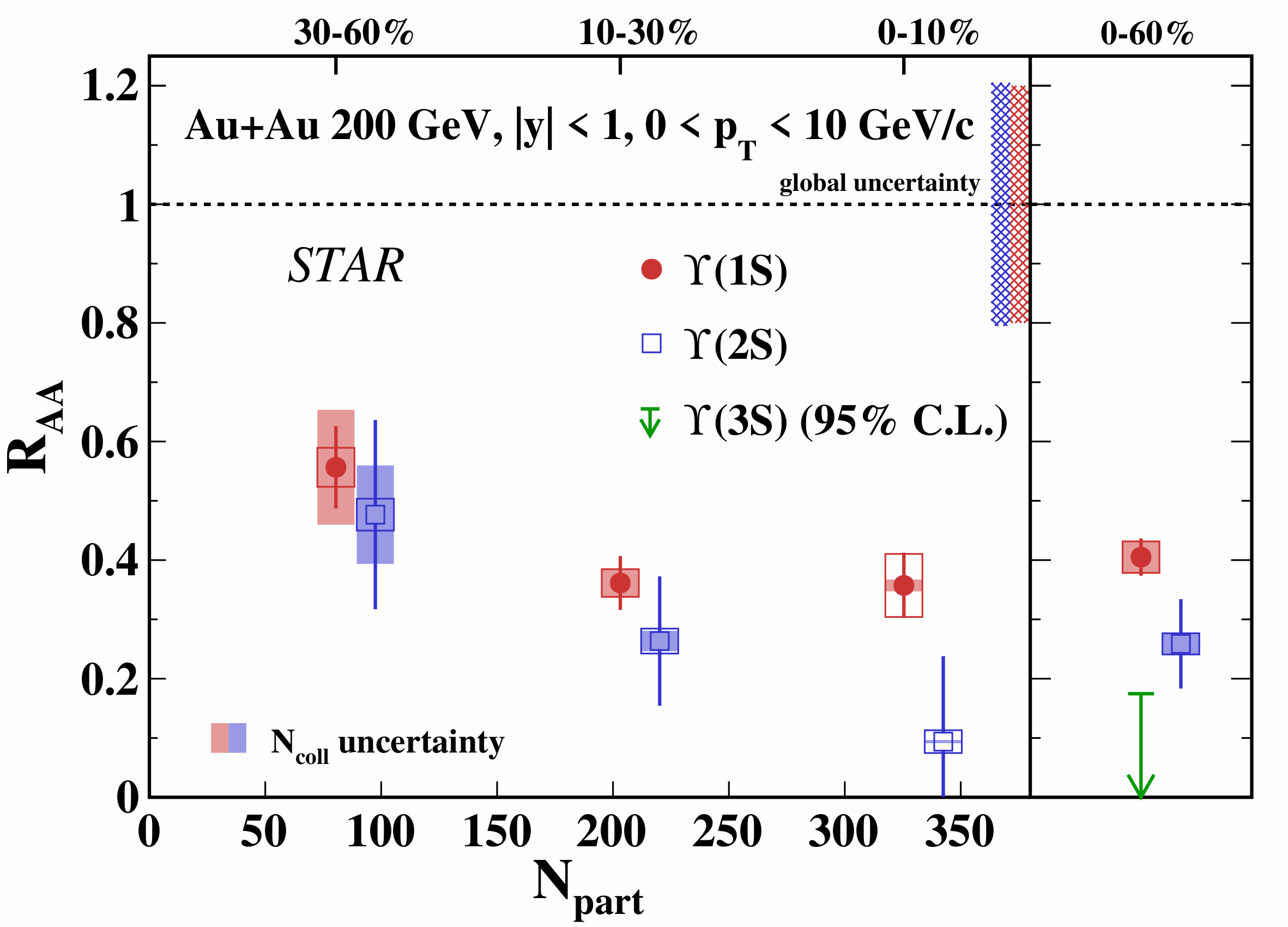 |
Figure: Left: Y(1S) (circles) and Y(2S)
(squares) RAA as a function of Npart for pT < 10
GeV/c. Data points for Y(2S) are displaced
horizontally for better visibility. The vertical
bars on data points indicate statistical errors,
while the systematic uncertainties are shown
as boxes. Shadowed bands around each
marker depict the systematic uncertainties
from Ncoll . The bands at unity indicate the
global uncertainties. Right: RAA for various Y
states, including the 95% upper limit for
Y(3S), in 0-60% Au+Au collisions.
|
|
Posted Mar 15, 2023
|
|
|
STAR focus: Evidence of Mass Ordering of Charm and Bottom Quark Energy Loss in Au+Au Collisions at RHIC
|
|
Studying the properties of the Quark Gluon Plasma (QGP) created in heavy-ion collisions
is a main goal of the RHIC physics program. Heavy quarks, i.e., charm and bottom
quarks, have emerged as essential probes of the QGP as they are produced
predominantly at the initial stage of the heavy-ion collisions and subsequently experience
the entire evolution of the QGP. In particular, heavy quarks are expected lose energy in
the QGP via (quasi-)elastic scatterings with the medium constituents and induced gluon
radiation, and QCD predicts that heavy quarks lose less energy than light quarks due to
the so-called “dead cone” effect. Therefore, parton energy loss in the QGP is expected to
follow a hierarchy ordered by parton color charge and mass. Experimentally, nuclear
modification factors, RAA and RCP, are measured to study the parton energy loss.
Recently, the STAR Collaboration published "Evidence of Mass Ordering of Charm and
Bottom Quark Energy Loss in Au+Au Collisions at RHIC" in
Eur. Phys. J. C 82
(2022)1150. In this publication, the new measurements of RAA for inclusive heavy
flavor-decay electrons and separately for bottom- and charm-decay electrons, as well as double
ratios of bottom- and charm-decay electron RAA and RCP in Au+Au collisions at $\sqrt{s_{\mathrm{NN}}}$ = 200 GeV are
reported. We find the bottom-decay electron RAA and RCP to be significantly higher than those of
charm-decay electrons. Duke and PHSD model calculations, including mass-dependent
parton energy loss in a strongly coupled medium, are found to be consistent with data.
These observations provide strong evidence of the mass ordering of charm and bottom
quark energy loss in the QGP.
|
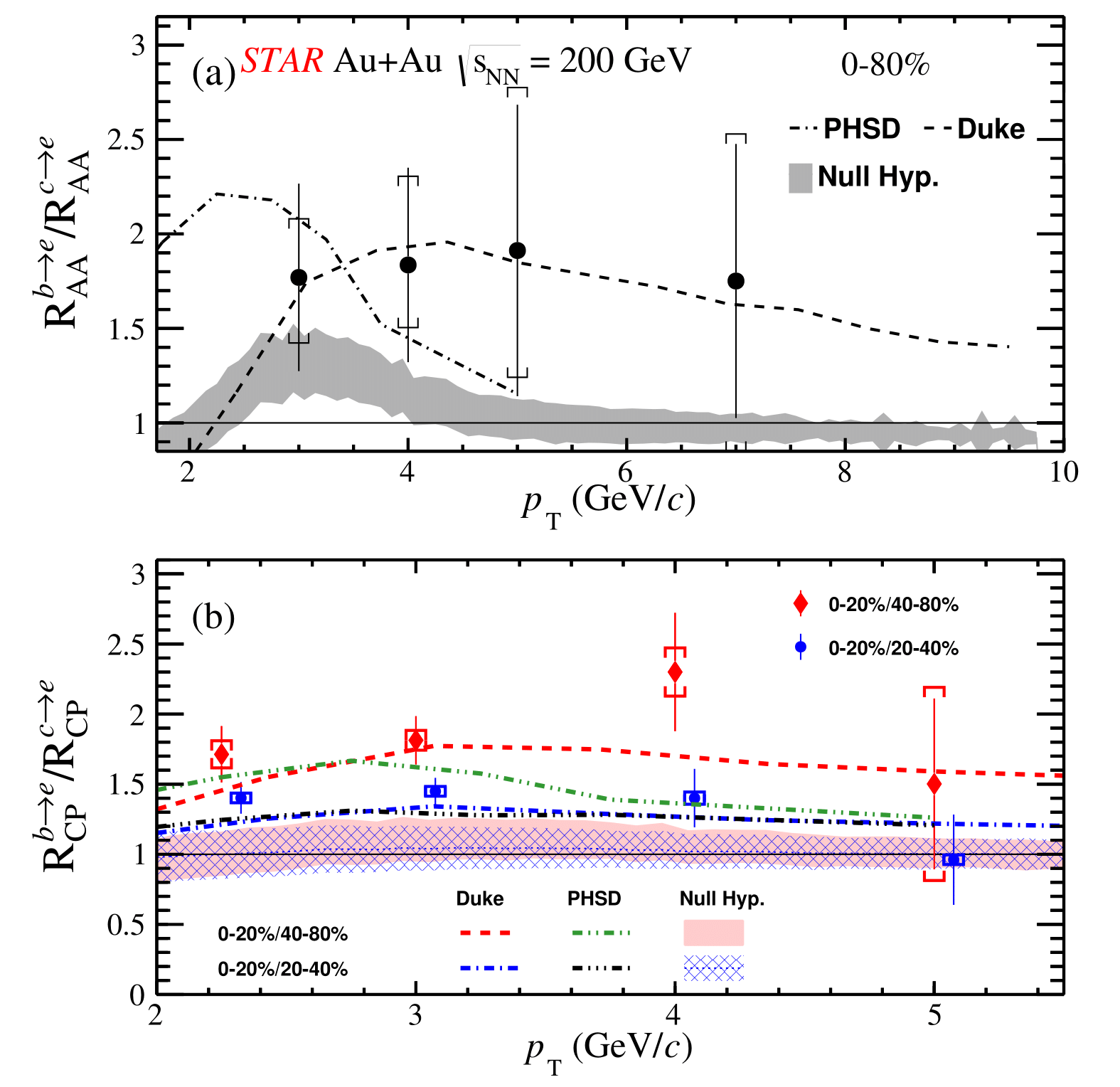 |
Figure: (a) The RAA ratio of bottom- to
charm-decay electrons in intervals
of electron pT in Au+Au collisions at
$\sqrt{s_{\mathrm{NN}}}$ = 200 GeV. (b) The RCP ratios of
bottom-decay electrons to that of
charm-decay electrons in intervals
of electron pT in Au+Au collisions at
$\sqrt{s_{\mathrm{NN}}}$ = 200 GeV. The red diamonds
show the ratios of RCP
(0−20%/40−80%), and the blue
circles show the ratios of RCP
(0−20%/20−40%). In all panels the
error bars and the brackets show
statistical and systematic
uncertainties, respectively. The
Duke and PHSD models are
shown as the various lines. The
null hypothesis calculations are
shown as the shaded bands.
|
|
Posted Mar 8, 2023
|
|
|
STAR focus: Higher-order cumulants and correlation functions of proton multiplicity distributions
in $\sqrt{s_{\mathrm{NN}}}$ = 3 GeV Au+Au collisions at the RHIC STAR experiment
|
|
Experimental observations at the Relativistic Heavy Ion Collider (RHIC) and the
Large Hadron Collider (LHC) have confirmed the existence of Quark-Gluon Plasma
(QGP) in high-energy heavy-ion collisions at μB ~ 0. The transition from hadronic matter
to QGP is believed to be a crossover based on Lattice QCD calculations, but there
may be a first-order phase transition and a critical point at finite baryon chemical
potential in the QCD phase diagram. Higher-order cumulants of conserved quantities
(Baryon number, Electric charge, and Strangeness) have been suggested as sensitive
observables to search for the critical point and phase boundary in the QCD phase
diagram. The fourth-order cumulant ratio (C4/C2) of conserved quantities is
predicted to exhibit a non-monotonic energy dependence due the critical point. A
recent paper on net-proton cumulants from the RHIC beam energy scan program has
demonstrated a non-monotonic trend, but with large statistical uncertainty.
|
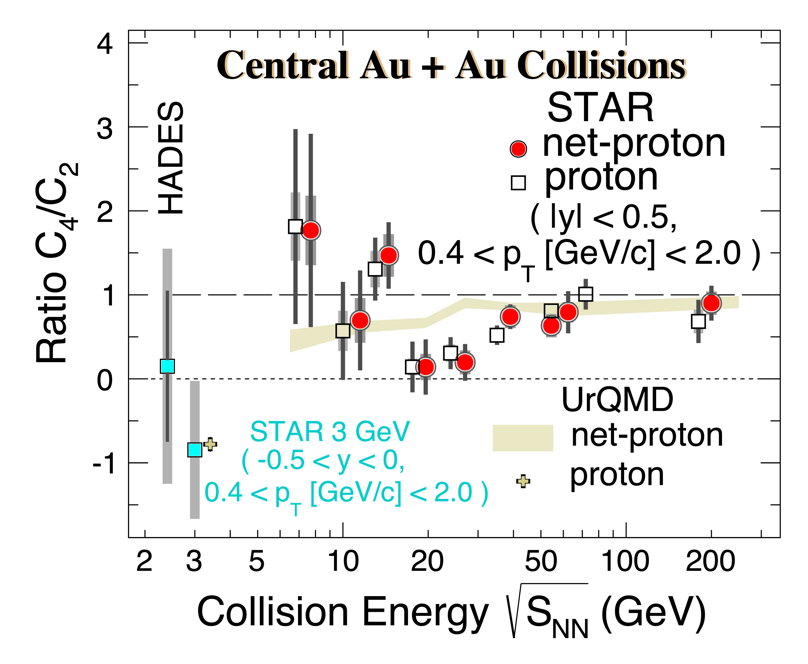 |
Figure: Collision energy dependence of the ratios of cumulants, C4/C2, for
proton (squares) and net-proton (red circles) from top 5% Au+Au collisions at
RHIC. The points for protons are shifted horizontally for clarity. The new result
for proton from the $\sqrt{s_{\rm NN}}$ = 3 GeV collisions is shown as a cyan
filled square. HADES data of 2.4 GeV top 10% collisions is also shown. The
vertical black and gray bars are the statistical and systematic uncertainties,
respectively. In addition, results from the transport model UrQMD are presented.
|
|
As a longer version of the recent published paper Phys. Rev. Lett. 128, 202303,
the paper Phys. Rev. C 107, 024908 [Editors’ Suggestion] summarizes in detail the
analysis of proton cumulant and correlation function measurements of STAR fixed-target
$\sqrt{s_{\rm NN}}$ = 3 GeV Au+Au collision data. The paper discusses the
effect of pileup which is important in fixed-target data analysis and gives a correction
method in higher-moments measurements. In addition, at low collision energy, due
to limited reference multiplicity to define centrality, a large initial volume fluctuation
effect is seen. A model dependent method to suppress the volume fluctuation effect
is tested in this work and shows that the most central centrality is least affected by
the effect. However the method is not ideal due to its model dependency.
The above figure shows the net-proton and proton fourth-order cumulant ratio
C4/C2 from the top 5% most central Au+Au collisions. As one can see there is a
clear non-monotonic energy dependence in the data but a monotonic dependence in the model
calculation. The cyan filled square at $\sqrt{s_{\rm NN}}$ = 3 GeV represents the
new measurement. The consistency of data with UrQMD calculation (yellow cross)
implies that the collisions occurred at 3 GeV are dominated by hadronic
interactions. It is expected that with more data from the RHIC beam energy scan
phase II, the uncertainty will be reduced.
|
|
Posted Feb 23, 2023
|
|
|
STAR focus: Pion, kaon, and (anti-)proton production in U+U Collisions at $\sqrt{s_{\mathrm{NN}}}$ = 193 GeV measured with the STAR detector
|
|
In general, attempts in relativistic heavy-ion collisions have been made to achieve maximum
energy densities in the collisions. One way to do so is by utilizing Uranium+Uranium collisions.
Because of the prolate deformation of the nuclei, U+U collisions at the same beam energy
and impact parameter but different orientations are expected to form dense matter with
varying compressions and lifetimes. Specifically, the deformation of uranium nuclei allows
for a gain in particle multiplicity (models suggest 6% to 35% more than Au+Au collisions)
and energy density by aligning the two nuclei with their long axes head-on (tip-tip). Further,
the prolate deformed uranium geometry allows for an initial temperature distribution that also
depends on the relative spatial orientation of the two nuclei. Some of these nuclei will collide
along their long axes, creating denser matter than routinely created at RHIC in collisions of
gold nuclei, which are more spherical. Some nuclei will collide with their long axes parallel,
although perpendicular to their directions of motion. This arrangement creates a matter with
an oblong cross-section but without the strong magnetic field generated by grazing incidence
collisions of spherical nuclei. All these have consequences on observables like particle yields,
elliptic flow, nuclear modification factors and correlations. In the year 2012, the Relativistic
Heavy Ion Collider (RHIC) at Brookhaven National Laboratory (BNL) collided the beams of
uranium ions (the heaviest ions ever used in a collider). The STAR experiment took data for
Uranium on Uranium (U+U) collisions at $\sqrt{s_{\mathrm{NN}}}$ = 193 GeV, allowing for collecting data for
one of the largest numbers of participating nucleon systems.
In this work, the STAR Collaboration has performed some basic experimental measurements
and studied the bulk properties of the medium in U+U collisions at $\sqrt{s_{\mathrm{NN}}}$ = 193 GeV averaged
over all orientations of the colliding nuclei. The identified particle ($\pi$±, $K$±, $p$, and $\bar{p}$)
results on transverse momentum spectra, the particle yields (dN/dy), the mean transverse
momentum (⟨pT⟩), the particle ratios, and the kinetic freeze-out parameters are obtained and
compared with the corresponding published results of Au+Au collisions at $\sqrt{s_{\mathrm{NN}}}$ = 200 GeV.
A comparative study with AMPT model modified to incorporate the deformation of uranium
nucleus is also carried out. These results have been recently published in Physical Review
C.
|
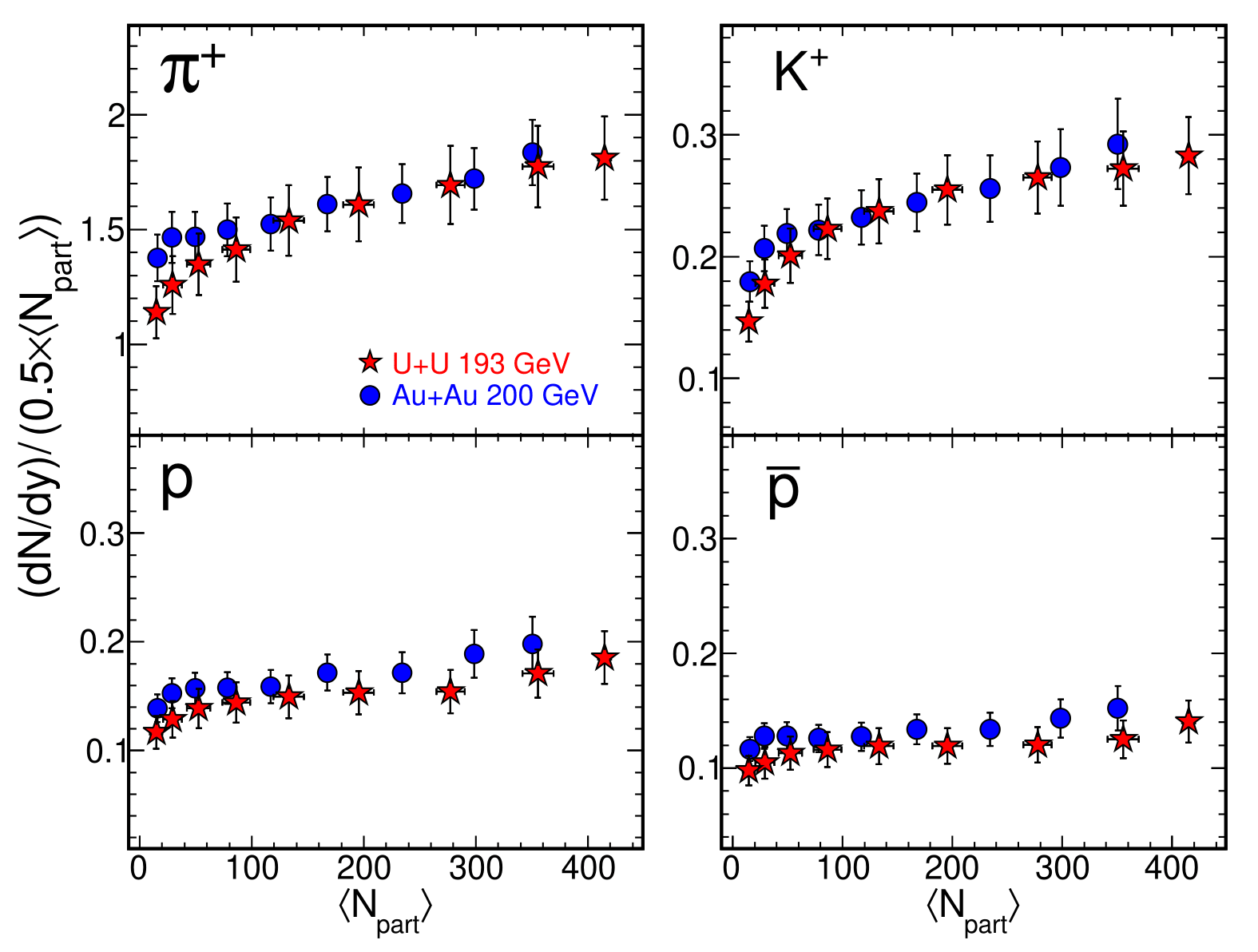
|
Figure: dN/dy of $π$+, $K$+, $p$ and $\bar{p}$ scaled by ⟨Npart⟩/2 as a function of ⟨Npart⟩ at midrapidity
(|y| < 0.1) for U+U collisions at $\sqrt{s_{\mathrm{NN}}}$ = 193 GeV. The results are compared with Au+Au
collisions at $\sqrt{s_{\mathrm{NN}}}$ = 200 GeV. The uncertainties represent total systematic and statistical
uncertainties added in quadrature, dominated by systematic uncertainties.
|
|
The experimentally measured value of the average number of participating nucleons obtained
in U+U is greater than 400, which is higher than that in Au+Au collisions. Comparison of
results from U+U with those from Au+Au collisions as a function of the number of
participating nucleons shows that for a given number of participating nucleons value, the
results are consistent between U+U and Au+Au collisions. These suggest that combining all
different initial state orientations of the colliding uranium nuclei give similar results as one
would obtain by colliding spherically symmetric nuclei. These results depend only on the
number of participating nucleons but not on different systems. The AMPT model, with three
different nucleon cross-sections studied, does not consistently describe all the observables at
all numbers of participating nucleon values. These findings call for further investigation into
the AMPT model in terms of the particle production mechanism and the collision dynamics.
In future experiments involving colliding uranium nuclei, it would be interesting to measure
the different final state observables for identified orientations of the colliding ellipsoidal
uranium nuclei.
|
|
Posted Feb 9, 2023
|
|
|
STAR focus: Pattern of Global Spin Alignment of φ and K*0 mesons in Heavy-Ion Collisions
|
|
The STAR Collaboration recently published the “Pattern of Global Spin Alignment of φ and K*0 mesons in Heavy-
Ion Collisions” in Nature.
Notwithstanding decades of progress since Yukawa first developed a description of the force between nucleons in
terms of meson exchange, a full understanding of the strong interaction remains a major challenge in modern
science. One remaining difficulty arises from the non-perturbative nature of the strong force, which leads to the
phenomenon of quark confinement at distances on the order of the size of the proton. Here we show that in
relativistic heavy-ion collisions, where quarks and gluons are set free over an extended volume, two species of
produced vector (spin-1) mesons, namely φ and K*0, emerge with a surprising pattern of global spin alignment. In
particular, the global spin alignment for φ is unexpectedly large, while that for K*0 is consistent with zero. The ρ00
for φ mesons, averaged over beam energies between 11.5 and 62 GeV is 0.3512 ± 0.0017 (stat.) ± 0.0017 (syst.).
Taking the total uncertainty as the sum in quadrature of statistical and systematic uncertainties, our results indicate
that the φ-meson ρ00 is above 1/3 with a significance of 7.4σ. Th ρ00 for K*0, averaged over beam energies of 54.4
GeV and below is 0.3356 ± 0.0034 (stat.) ± 0.0043 (syst.).
|
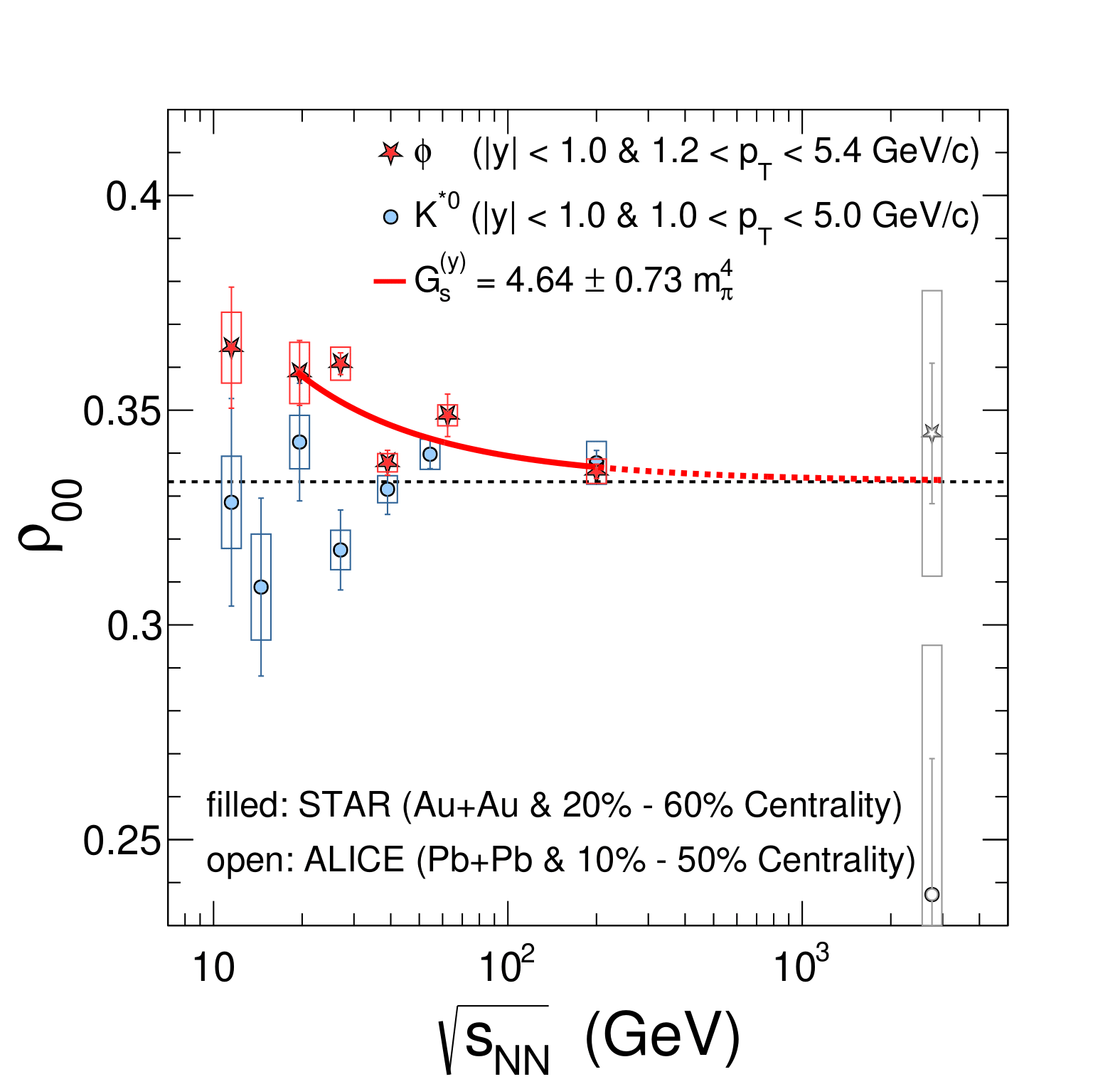 |
Figure: Global spin alignment of φ and K*0 vector mesons in
heavy-ion collisions. The measured matrix element ρ00 as a
function of beam energy for the φ and K*0 vector mesons
within the indicated windows of centrality, transverse
momentum (pT ) and rapidity (y). The open symbols indicate
ALICE results for Pb+Pb collisions at 2.76 TeV. The red solid
curve is a fit to data in the range of $\sqrt{s_{\mathrm{NN}}}$ = 19.6 to 200 GeV,
based on a theoretical calculation with a φ-meson field. Th
red dashed line is an extension of the solid curve with the
fitted parameter Gs(y). The black dashed line represents ρ00 =
1/3.
|
|
Measurements of the global spin alignment of vector mesons is argued to provide new knowledge about the vector
meson fields. The vector meson fields are an essential part of the nuclear force that binds nucleons inside atomic
nuclei, and are also pivotal in describing properties of nuclear structure and nuclear matter. The ρ00 for the φ meson
has a desirable feature in that all contributions depend on squares of field amplitudes; it can be regarded as a field
analyzer which makes it possible to extract the imprint of the φ-meson field even if the field fluctuates strongly in
space-time. Another important feature worthy of mention is that an essential contribution to the φ-meson ρ00 is from
the term $~S\cdot(\mathrm{E}_{\phi}\times \mathrm{p})$, where Eφ is the electric part of the φ-meson field induced by the local, net strangenes
current density, and S and p are the spin and momentum of the strange (anti)quarks, respectively. Such a term is
nothing but the quark version of the spin-orbit force which, at the nucleon level, plays a key role in the nuclear shell
structure. Our measurements of a signal based on global spin alignment for vector mesons reveal a surprising pattern
and a value for φ meson that is orders of magnitude larger than can be explained by conventional effects. This work
provides a potential new avenue for understanding the strong interaction at work at the sub-nucleon level.
|
|
Posted January 19, 2023
|
|
|
STAR focus: Azimuthal transverse single-spin asymmetries of inclusive jets and identified hadrons
within jets from polarized pp collisions at √s = 200 GeV
|
|
Recently, the STAR Collaboration published the most precise measurement of the transverse
single-spin asymmetries for charged hadrons inside jets in Phys. Rev. D 106, 072010.
Transverse spin experiments at STAR provide new ways to map out the three-dimensional
nature of quark fragmentation and illustrate the interplay between the structure of a hadron
and the color environment. The Collins effect describes the azimuthal distribution of hadron
fragments from a transversely polarized quark, and thus provides access to both the quark
transversity in the proton and the transverse momentum dependent Collins fragmentation
function. Transversity is one of the three leading twist parton distribution functions of the
nucleon. It describes the transverse spin structure of quarks in a transversely polarized proton.
The Collins fragmentation function is one of the most important fragmentation functions in the
transverse-momentum-dependent (TMD) formalism. This effect has only been studied in semi-inclusive deep-inelastic
scattering (SIDIS) and electron-positron annihilation before the STAR experiment.
|
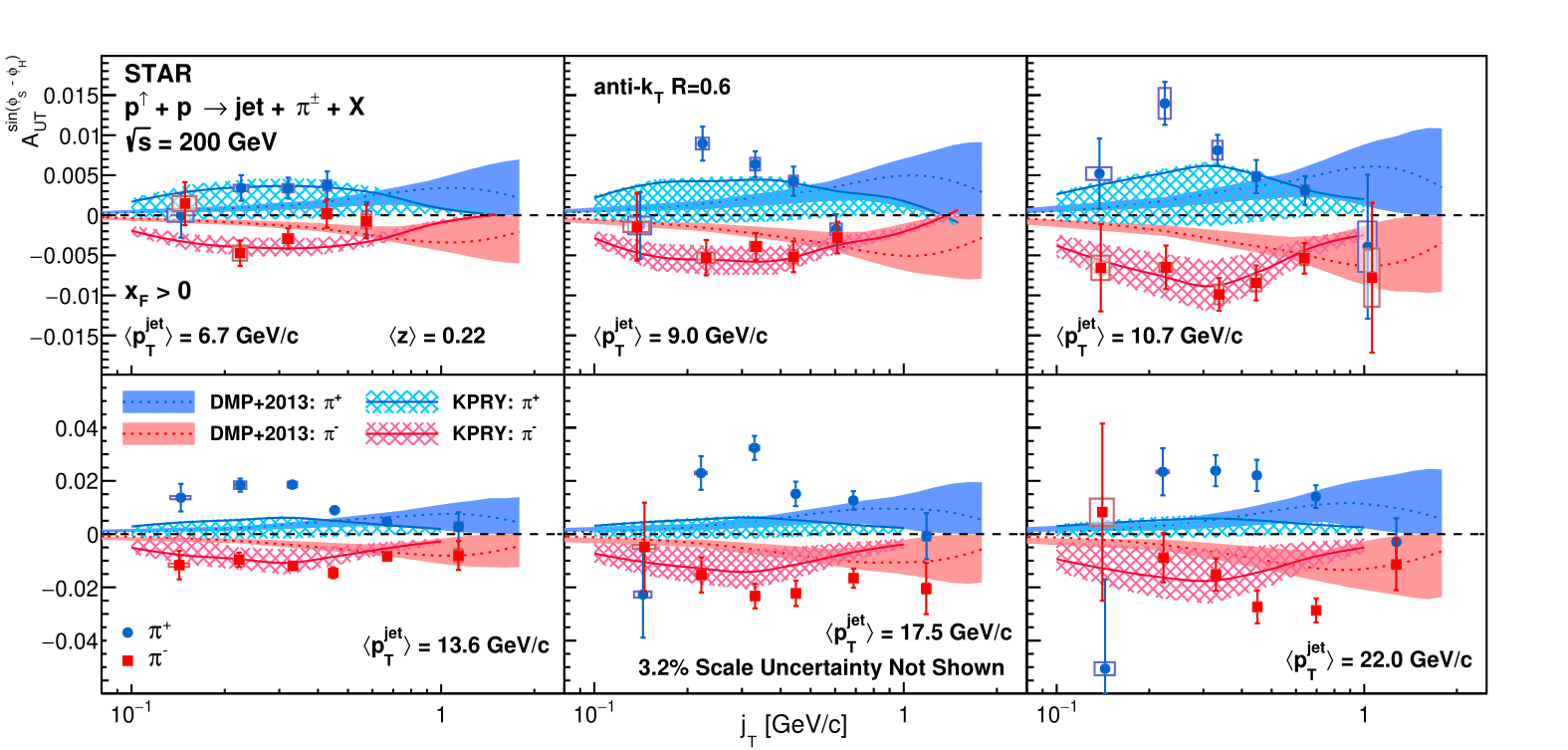 |
|
|
The figure presented above shows the first measurement of Collins asymmetry with jT
(momentum transverse to the jet axis) dependence in pp collisions at √s = 200 GeV. The results
here are divided into six different jet-pT bins that probe different hard scales in the experiment.
The DMP+2013 and KPRY model expectations are also presented in the plot. Both are based on fits
to experimental data from SIDIS and electron-positron processes. Our results slightly favor the
KPRY model that treats TMD evolution up to the next-to-leading logarithmic effects; however,
significant discrepancies exist between the data and both model calculations. These new results
will provide valuable new constraints on the kinematic dependence of the Collins
fragmentation function when included in future global analyses.
|
|
Posted Oct 28, 2022
|
|
|
STAR focus: Evidence for Nonlinear Gluon Effects in QCD and their A Dependence at STAR
|
|
Extracting the data from previous experiments, gluon density grows rapidly towards
small momentum fraction (x) with respect to the nucleon. Under the color glass condensate
(CGC) framework, the growth is explained by gluon splitting. The nonlinear QCD effects
at small x should tame this growth by gluon recombination. The so called “gluon
saturation” is reached at the point when the splitting and recombination are balanced.
Understanding the nonlinear behavior of the gluon is one of the most important physics
goals for RHIC Cold QCD program and the future electron ion collider (EIC) project.
Back-to-back dihadron azimuthal angle correlation has been proposed to be a sensitive
probe to directly access the underlying gluon dynamics involved in hard scatterings.
With a high gluon density at the initial state, the product of back-to-back dihadron
modulation will be suppressed. It is predicted that the density of gluons per unit
transverse area is larger in nuclei than in nucleons and is amplified by a factor of A1/3 for a
nucleus with mass number A; thus, nuclei provide a natural environment to study
nonlinear gluon evolution.
The STAR Collaboration performed the measurements of back-to-back azimuthal
correlations of di-π0s produced at forward pseudorapidities (2.6 < η < 4.0) in p+p,
p+Al, and p+Au collisions at a center-of-mass energy of 200 GeV. The results have been
recently published in Phys. Rev. Lett. 129, 092501.
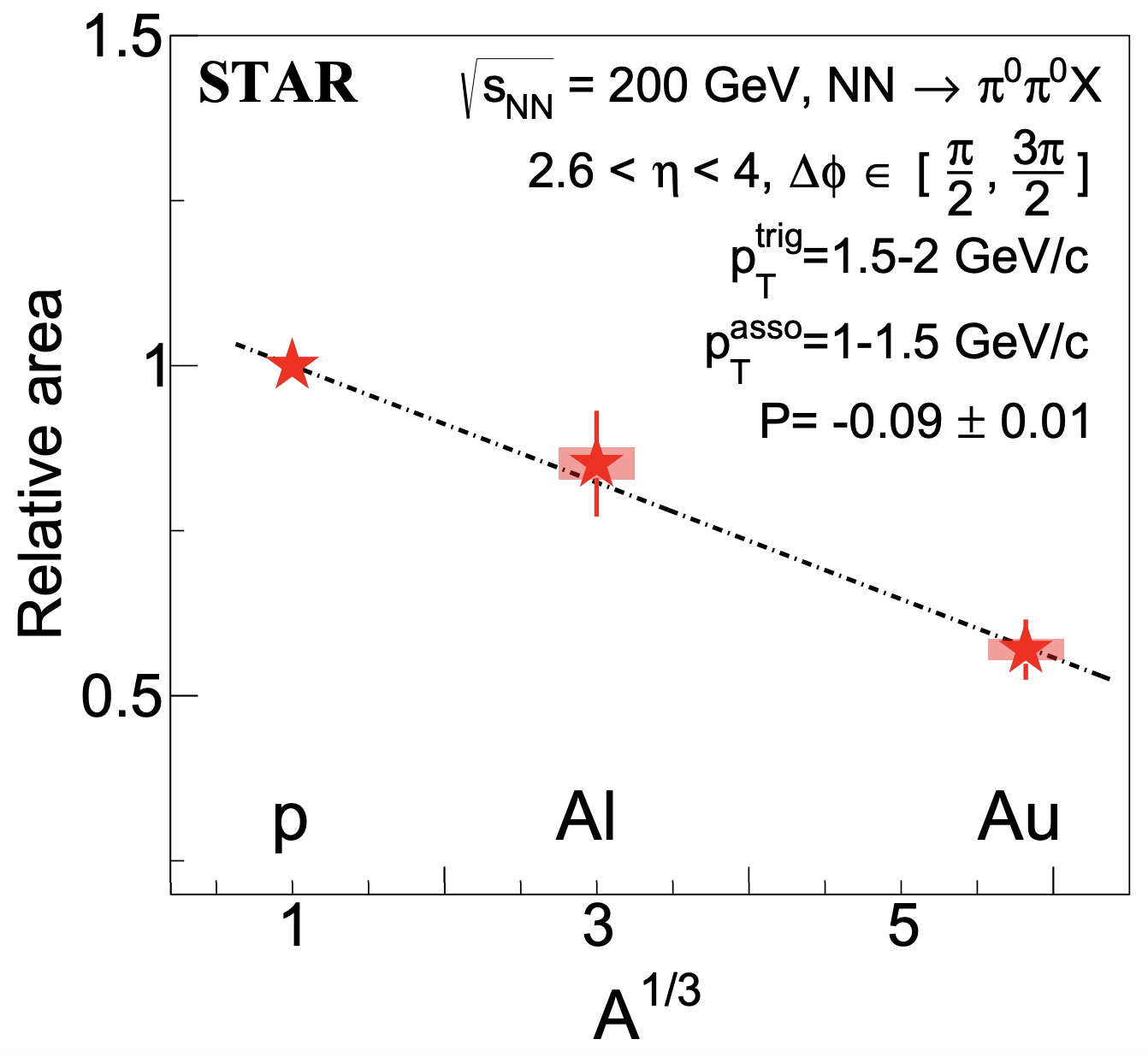
We observe a clear suppression of the correlated yields of
back-to-back π0 pairs in p+Al and p+Au collisions compared to the p+p data. The
observed suppression is larger at smaller transverse momentum, which indicates lower
x and Q2 . The larger suppression found in p+Au relative to p+Al collisions exhibits a
dependence of the saturation scale Q2s on the mass number A. A linear scaling of the
suppression with A1/3 is observed with a slope of −0.09±01.
|
|
 |
|
|
Figure: Relative area of back-to-back
di-π0 correlations at forward
pseudorapidities (2.6 < η < 4.0) in p+Au and p+Al with respect to p+p
collisions for $p_T^{\mathrm{trig}}$=1.5–2 GeV/c and $p_T^{\mathrm{asso}}$=1–1.5
GeV/c. The area is the integral of the
back-to-back correlation after pedestal
subtraction. The data points are fitted by
a linear function, whose slope (P) is
found to be −0.09±01.
|
|
Posted August 22, 2022
|
|
|
STAR focus: Measurements of proton high order cumulants in $\sqrt{s_{\mathrm{NN}}}$ = 3 GeV Au+Au
collisions and implications for the QCD critical point
|
|
With the discovery of the quark-gluon plasma (QGP) at the Relativistic Heavy Ion Collider
(RHIC), physicists are starting to investigate the phase structure of the QCD matter, especially in
the high baryon density region. The stark differences between the properties of QGP and lower
energy nuclear matter draw interest to the thermodynamic processes, specifically those related to
the nature of phase transitions. Experimenters can access the QCD phase diagram, expressed in
temperature (T) and baryonic chemical potential (μB), and search for phase boundaries by varying
the heavy-ion collision energy. At regions of equal baryon and anti-baryon density, μB = 0,
theoretical approaches work well, with lattice QCD calculations predicting a smooth cross-over
transition from hadronic matter to a QGP. In addition, Lattice QCD calculations have predicted a
positive cumulant ratio of net-proton (proton minus anti-proton) C4/C2 for the formation of QGP
matter at μB = 200 MeV [1]. However, at finite μB, the existence and the nature of the phase transition
are not well understood.
Recent reports on net-proton fluctuation measurements from RHIC's Beam Energy Scan program
(BES-I) have demonstrated the non-monotonic collision energy dependence in the 4TH order net-proton
cumulant ratio C4/C2 from the top 5% central Au+Au collisions of the range of 7.7 – 200
GeV [2].
|
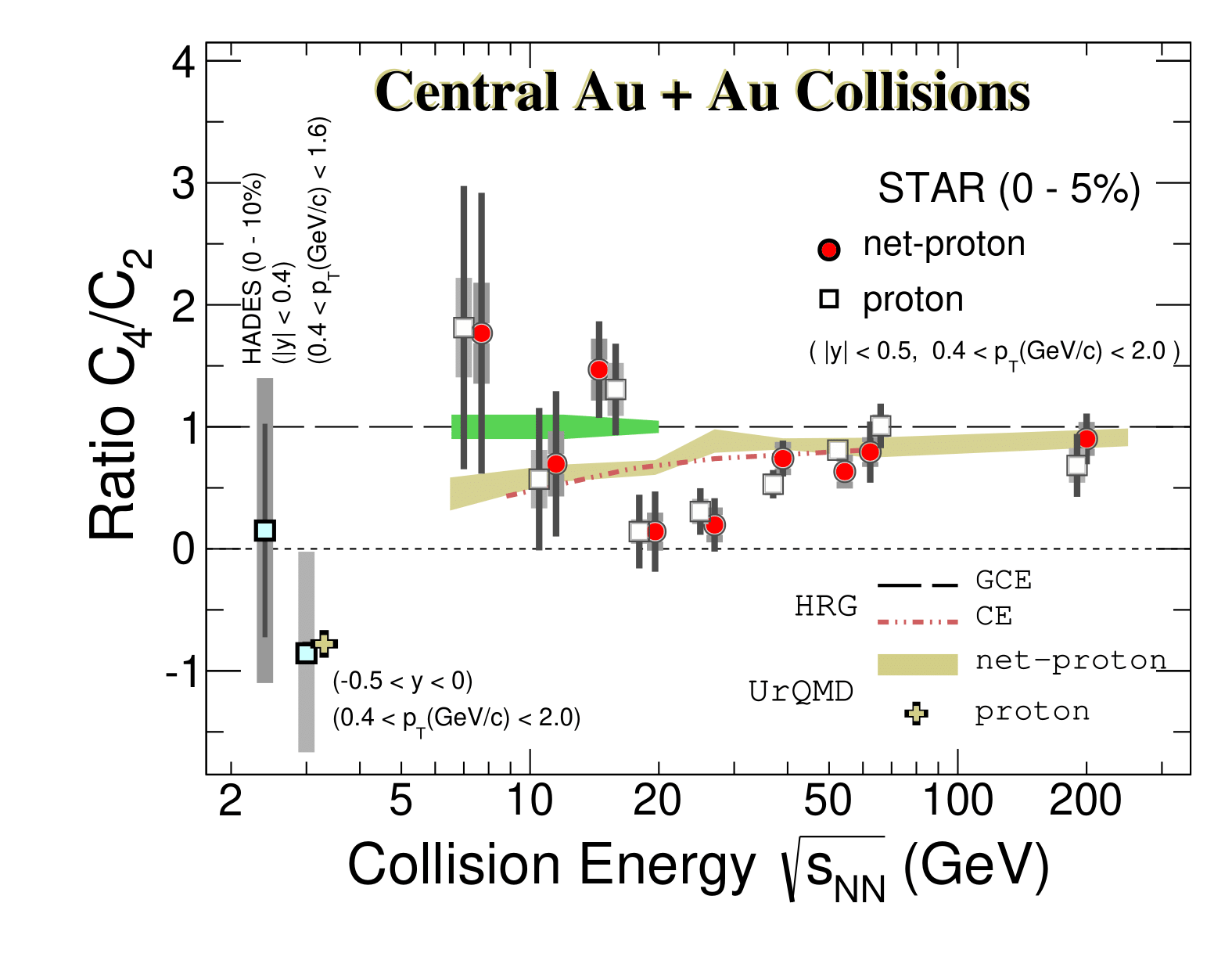 |
Figure: Collision energy dependence of the ratios of
cumulants, C4 /C2 , for proton (squares) and
net-proton (red circles) from top 5% Au+Au collisions
at RHIC. The points for protons are shifted
horizontally for clarity. The new result for proton
from the $\sqrt{s_{\mathrm{NN}}}$ = 3 GeV collisions is shown as a filled
square. HADES data of 2.4 GeV top 10% collisions
is also shown. The vertical black and gray bars are
the statistical and systematic uncertainties,
respectively. In addition, results from the HRG
model, based on both Canonical Ensemble (CE) and
Grand-Canonical Ensemble (GCE), and transport
model UrQMD are presented.
|
|
In this Letter [3], we report cumulants and their ratios of proton
multiplicity distribution from $\sqrt{s_{\mathrm{NN}}}$ =3 GeV
Au+Au collisions. The new data are measured by the STAR experiment configured in
fixed-target mode. At this collision energy, the corresponding baryonic chemical potential μB ~ 750 MeV,
close to the largest value ever reached in heavy ion collisions. Protons are measured with the
acceptance (-0.5 < y < 0 and 0.4 < pT < 2.0 GeV/c). The rapidity and transverse momentum
dependencies of the cumulant ratios C2/C1, C3/C2 , and C4/C2 are discussed. As shown in the
figure, a suppression with respect to the Poisson baseline is observed in proton C4/C2 = -0.85
0.09 (stat) 0.82 (syst) in the most central collisions at $\sqrt{s_{\mathrm{NN}}}$ = 3 GeV. The hadronic transport model
UrQMD reproduces the observed trend in the centrality dependence of the cumulant ratios. This
new result is consistent with fluctuations driven by baryon number conservation at the high
baryon density region. These data imply that the QCD critical region, if created in heavy-ion
collisions, could only exist at energies higher than $\sqrt{s_{\mathrm{NN}}}$ = 3 GeV.
References:
[1] A. Bazavov et al. (HotQCD), Phys. Rev. D96, 074510 (2017) and R. Bellwied et al., Phys.
Rev. D104, 094508 (2021).
[2] (STAR Collaboration), Phys. Rev. Lett. 126 (2021) 92301.
[3] (STAR Collaboration), Phys. Rev. Lett. 128, (2022) 202303.
|
|
Posted May 29, 2022
|
|
|
STAR focus: Measurements of 3ΛH
and 4ΛH lifetimes and yields in Au+Au collisions in the high baryon density region
|
|
The hyperon-nucleon (Y-N) interaction is an important ingredient in the description of the equation-of-state of high baryon density matter,
such as the interior of neutron stars and the hadronic phase of a heavy-ion collision. Hypernuclei, being bound states of hyperons and nucleons,
are one of the only means for experimentalists to access to the Y-N interaction.
However, hypernuclei meausurements in heavy-ion collisions are scarce, mainly due to the low production rates at high energies.
In contrast, at low collision energies, an enhancement in the hypernuclei production yield is expected due to the higher baryon density,
although this has not been verified experimentally. The STAR collaboration recently published new measurements in
Phys. Rev. Lett. 128, 202301 of the yields of two light
hypernuclei (3ΛH and 4ΛH)
at $\sqrt{s_{\mathrm{NN}}}$ = 3 GeV, together with measurements of their lifetimes, using the Beam-Energy-Scan-II data taken in 2018.
|
|
 |
|
|
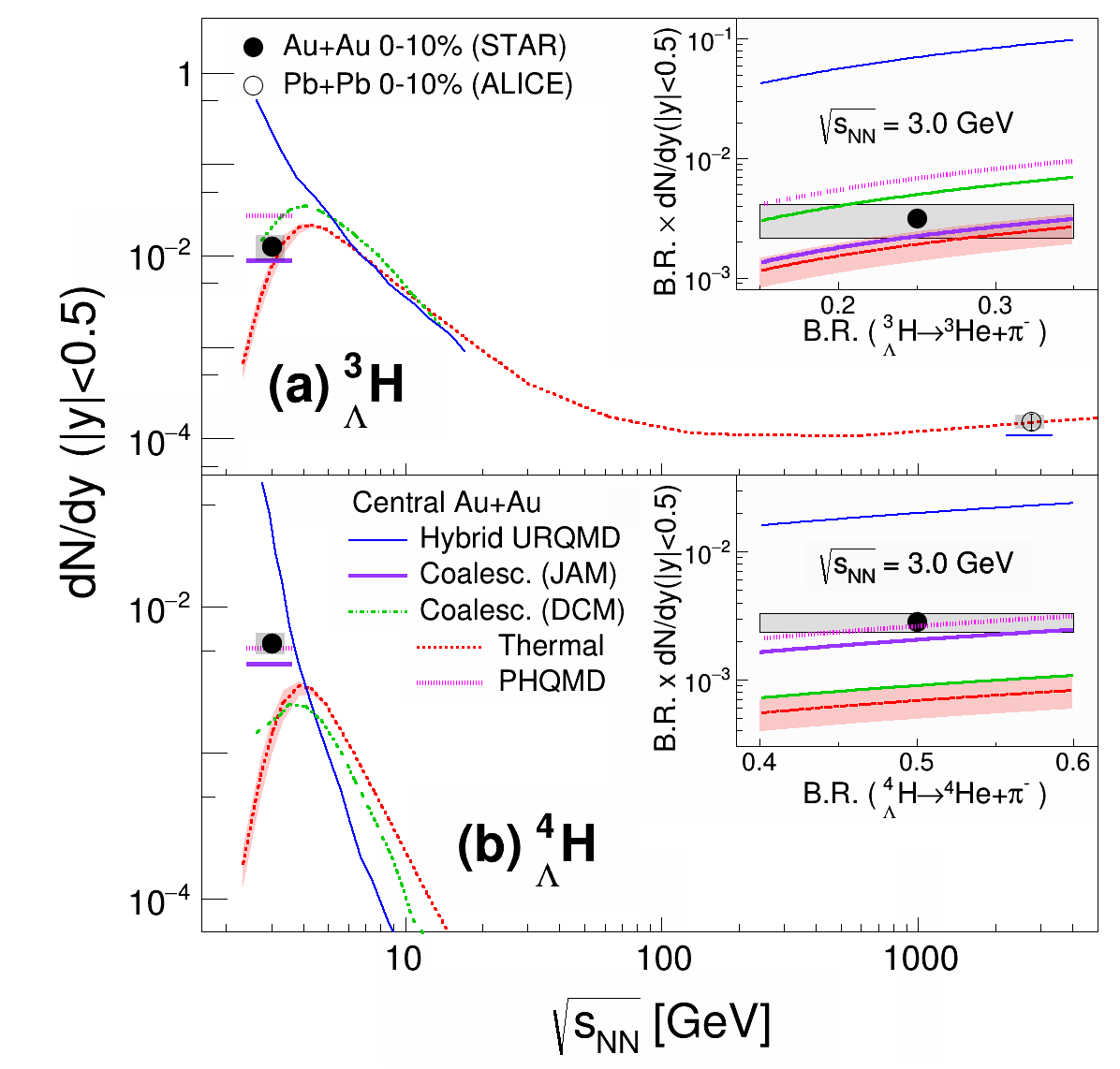
Figure (a) 3ΛH and (b) 4ΛH yields
at mid-rapidity as a function of beam energy in central heavy ion collisions.
The symbols represent measurements while the lines represent different theoretical calculations. The data points assume a branching ratio
of 25(50)% for 3(4)ΛH → π + 3(4)He. The insets show the
yields at |y|<0.5 times the branching ratio as a function of the branching ratio.
Our measurements show that in central heavy-ion collisions, the 3ΛH yield at $\sqrt{s_{\mathrm{NN}}}$ = 3 GeV is
enhanced compared to the yield at $\sqrt{s_{\mathrm{NN}}}$ = 2.76 TeV by approximately a factor of 100, in accordance with thermal model and coalescence model predictions.
For 4ΛH, the measured yield is underestimated by thermal model calculations.
Such observations establish low energy collision experiments as a promising tool to study hypernuclei properties, and also provide guidance on searches for exotic strange
matter such as double-Λ hypernuclei or strange dibaryons.
Besides the production yields, the intrinsic properties of hypernuclei, such as their binding energies and lifetimes, provide information on the Y-N interaction.
Taking advantage of the high production yields, we extracted the most precise
3ΛH and 4ΛH lifetimes to date. Both lifetimes
are shorter compared to the free Λ lifetime by approximately 20%. The 3ΛH lifetime is consistent
with theoretical calculations incorporating attractive pion final state interactions, while the 4ΛH lifetime is
consistent with estimations based on the emperical isospin rule. Such precise measurements provide means to verify our understanding of the simplest bound Y-N systems.
|
|
Posted May 23, 2022
|
|
|
STAR focus: Differential measurements of jet substructure and partonic energy loss in Au+Au
collisions at $\sqrt{s_{\mathrm{NN}}} =$ 200 GeV
|
|
The STAR Collaboration recently published the first “Differential measurements of jet substructure and partonic energy loss in Au+Au
collisions at $\sqrt{s_{\mathrm{NN}}} =$ 200 GeV" in Phys Rev C 105 (2022) 4, 044906.
Parton energy loss serves as the earliest signature of the Quark-Gluon Plasma (QGP) in central heavy-ion collisions. Hard-scattered partons traverse through
the QGP, and through their interactions with the medium, lose energy via many different channels. Thus it is crucial to study the degree to which the energy loss
is dependent on the parton shower topology. In this measurement, for the first time, STAR has quantified an angular or resolution scale for a particular jet,
and differentially measured the energy loss for two populations, one with wider opening angles and one with narrower angles.
Data from Au+Au collisions at $\sqrt{s_{\mathrm{NN}}} =$ 200 GeV, from 2007, with a single high energy calorimeter tower are selected and both trigger and
recoil jets are reconstructed with charged particle tracks and towers with ET > 2 GeV. These di-jets with a hard-constituent selection are termed Hard-Core di-jets,
which are primarily free of any combinatorial background contribution. Once we find Hard-Core jets, we drop the 2 GeV threshold down to 0.2 GeV and run the jet
finder over all the soft tracks and towers. The di-jets which geometrically match in η-φ space to our Hard-Core di-jets are now called the Matched di-jets.
The advantage of such a procedure is to provide us with two collections of di-jets originating from a hard scattering, one with only high momentum particles which
undergo energy loss, and the other including both high and low momentum particles, which can potentially include the recovery of the quenched energy.
The reference dataset for this measurement is proton-proton collisions also at $\sqrt{s}$ = 200 GeV collected in 2006 and embedded into minimum-bias AuAu
collisions from 2007. This embedded reference ensures that the effect of the heavy-ion background and the STAR detector are comparable and any potential
differences between the datasets can be attributed to the effects of topology/substructure dependent energy loss.
|
|
|
|
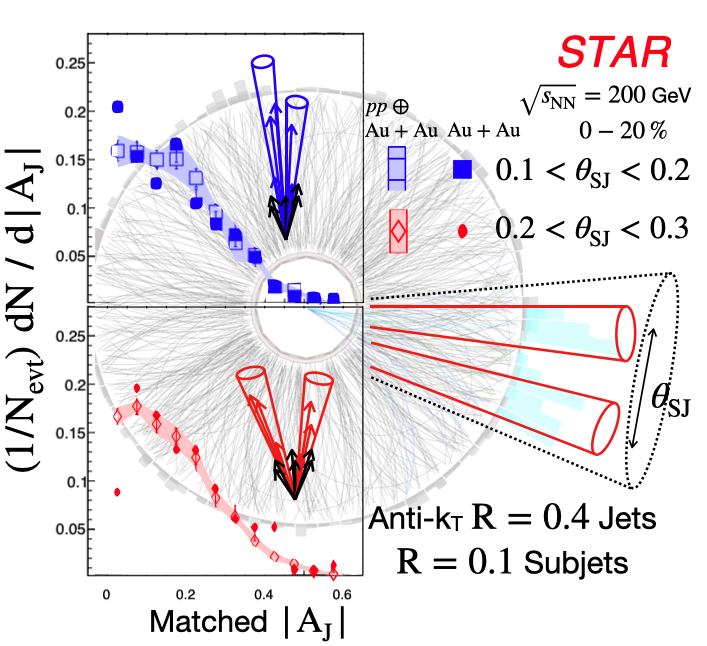
For the differential measurement, the di-jet pairs are tagged based on the recoil jet’s opening angle defined using the subjets.
This is a new substructure observable introduced in this publication which re-clusters the tracks and tower constituents of the anti-kT R=0.4 jet into subjets
with the same anti-kT algorithm but a smaller jet radius of R=0.1. The leading and sub-leading subjets are then selected and the η-φ distance
between the subjet axes is taken as the opening angle observable θSJ. The figure presented above shows both the di-jet asymmetry for
Matched di-jets on left and a cartoon showing the subjet opening angle on the right for the recoil jets. The blue markers represent narrow recoil jets and the
red markers include the wide subjets. For both, wide and narrow jet populations, we find that the energy loss experienced by high pT particles is fully
recovered within the jet cone included in soft particles as shown by a balanced AJ of Matched di-jets for both Au+Au (solid markers) and the embedded
reference (open markers). This shows the first evidence for energy loss being independent on the jet topology, i.e. its opening angle.
With such differential measurements, we can now quantify the mechanism of energy loss for specially selected di-jets are due to soft-gluon radiation off a
single color charge undergoing the QCD equivalent of the LPM effect.
|
|
Posted May 4, 2022
|
|
|
STAR focus: Probing the gluon structure of the deuteron with J/ψ photoproduction in d+Au in ultra-peripheral collisions
|
|
In a recent measurement published
in Phys. Rev. Lett. 128, 122303, the STAR Collaboration has reported a result on
colliding high-energy photons with gluons inside the
deuteron. It has provided a first glimpse of the gluonic
structure of the simplest atomic nucleus. The
momentum distribution of gluons, measured through the
J/ψ particle’s momenta shown in the figure, reflects
the spatial distribution of gluons inside the nucleus. In
addition, the breakup of the deuteron associated with
the J/ψ particle probes the gluon dynamics of the
nucleon-nucleon interaction, laying the foundation for
its precision measurement at the upcoming Electron-Ion Collider.
|
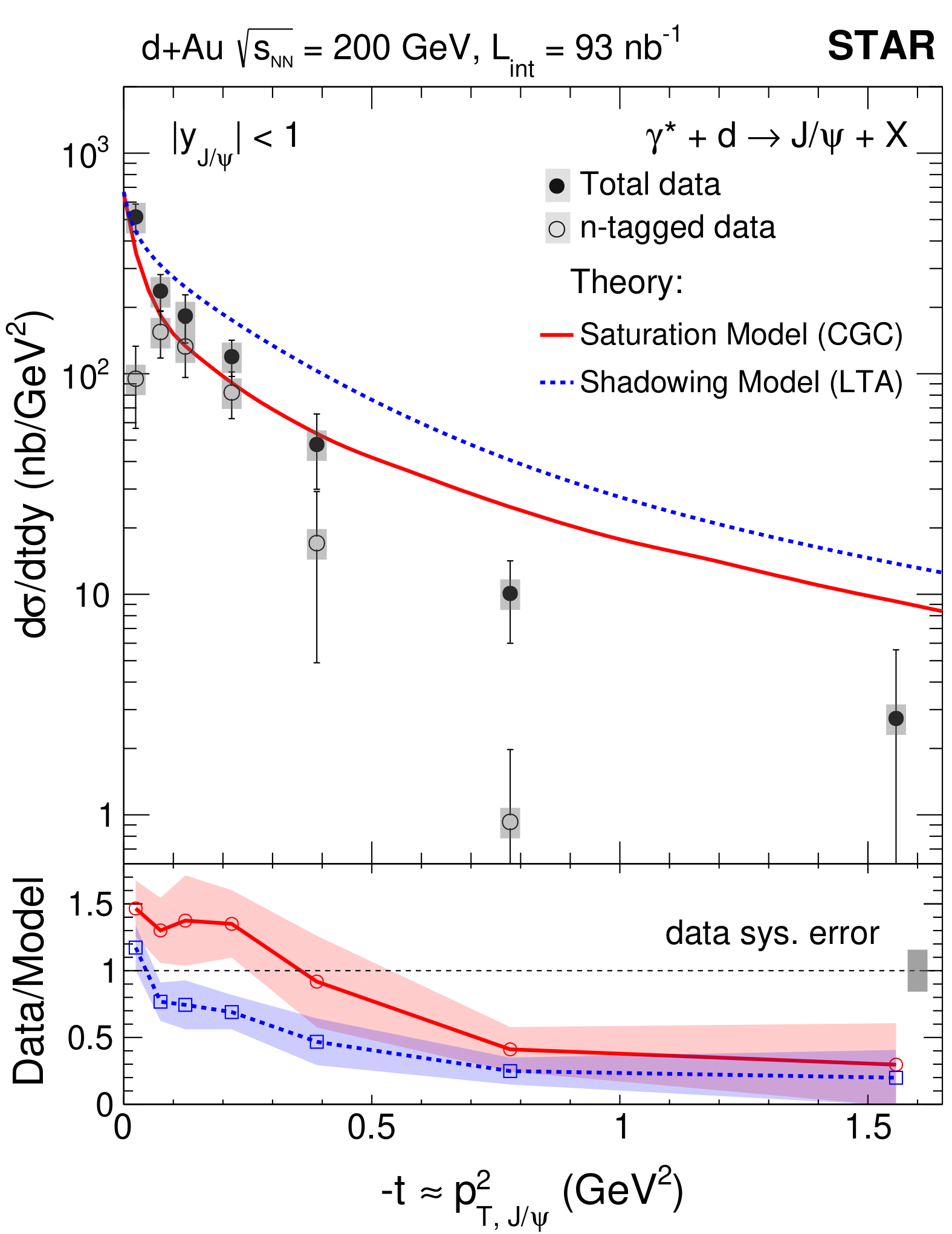 |
Figure: Upper: differential cross section as a function of
p2T,J/ψ of J/ψ photoproduction in UPCs at $\sqrt{s_{\mathrm{NN}}}$ = 200 GeV.
Data for the total diffractive process are shown with solid
markers, while data with neutron tagging in the deuteron-going ZDC are shown with open markers.
Theoretical predictions based on the saturation model (CGC) and the
nuclear shadowing model (LTA) are compared with data,
shown as lines. Statistical uncertainty is represented by the
error bars, and the systematic uncertainty is denoted by the
shaded box. Lower: ratios of total data and models are presented as a function
of −t ≈ p2T,J/ψ. Color bands are statistical uncertainty based on the data only, while systematic
uncertainty is indicated by the gray box.
|
|
Measuring diffractive Vector-Meson production, e.g. J/ψ, has been one of
the most powerful tools in studying the nucleon and
nucleus structure in high energy particle collisions.
Instead of using a hadron projectile, a high-energy photon emitted by the gold nucleus has
been used to probe the inner structure of the deuteron target, with its advantage of being a
clean probe. This is type of collision is known as an “Ultra-Peripheral Collision” (UPC). A naïve picture of this process is
the following. An incoming photon fluctuates into a quark-antiquark pair and forms a J/ψ
particle with close to zero transverse momentum. The gluons jiggling inside the deuteron,
although happening very rarely, can kick the J/ψ particle and it would deflect with some
momentum. This momentum kick is a Fourier transform of the position of gluons, such that the
position and momentum of gluons are the two sides of the same coin. Knowing one side would
imply the understanding of the other.
The Zero-Degree-Calorimeter (ZDC), a detector 18 meters away from the center of the STAR main detector,
can detect breakup neutrons from the deuteron. Understanding the nuclear
breakup has been one of the challenges in Ultra-Peripheral Collisions, as well as at the Electron-Ion
Collider. The reported data based on the deuteron has provided an essential experimental
baseline on how this system breaks apart and provide quantitative constraints to leading
theoretical models.
|
|
Posted March 24, 2022
|
|
|
STAR focus: Disappearance of partonic collectivity in $\sqrt{s_{\mathrm{NN}}}$ = 3 GeV Au+Au collisions at RHIC
|
|
Determining the nature of phase transition from hadronic matter to the Quark-Gluon Plasma (QGP) phase of the Quantum Chromodynamics (QCD) phase diagram at finite
net-baryon density has been the focus of the RHIC beam energy scan program.
The directed flow (v1) and elliptic flow (v2) are excellent probes for studying properties of the nuclear matter created in high-energy nuclear collisions
owing to their sensitivity to the expansion dynamics.
On the other hand, v1 and v2 are particularly sensitive to the Equation-of-State (EoS) and degrees of freedom of nuclear matter.
The large positive v2 along with the observation of its number-of-constituent-quarks (NCQ) scaling are strong evidence for the formation of a hydrodynamically
expanding QGP phase with partonic degrees of freedom.
Flow measurements at high baryon density region, e.g. 3 GeV, provide information that the created nuclear matter is dominant by hadronic or partonic degrees of freedom,
thus explore the QCD phase structure.
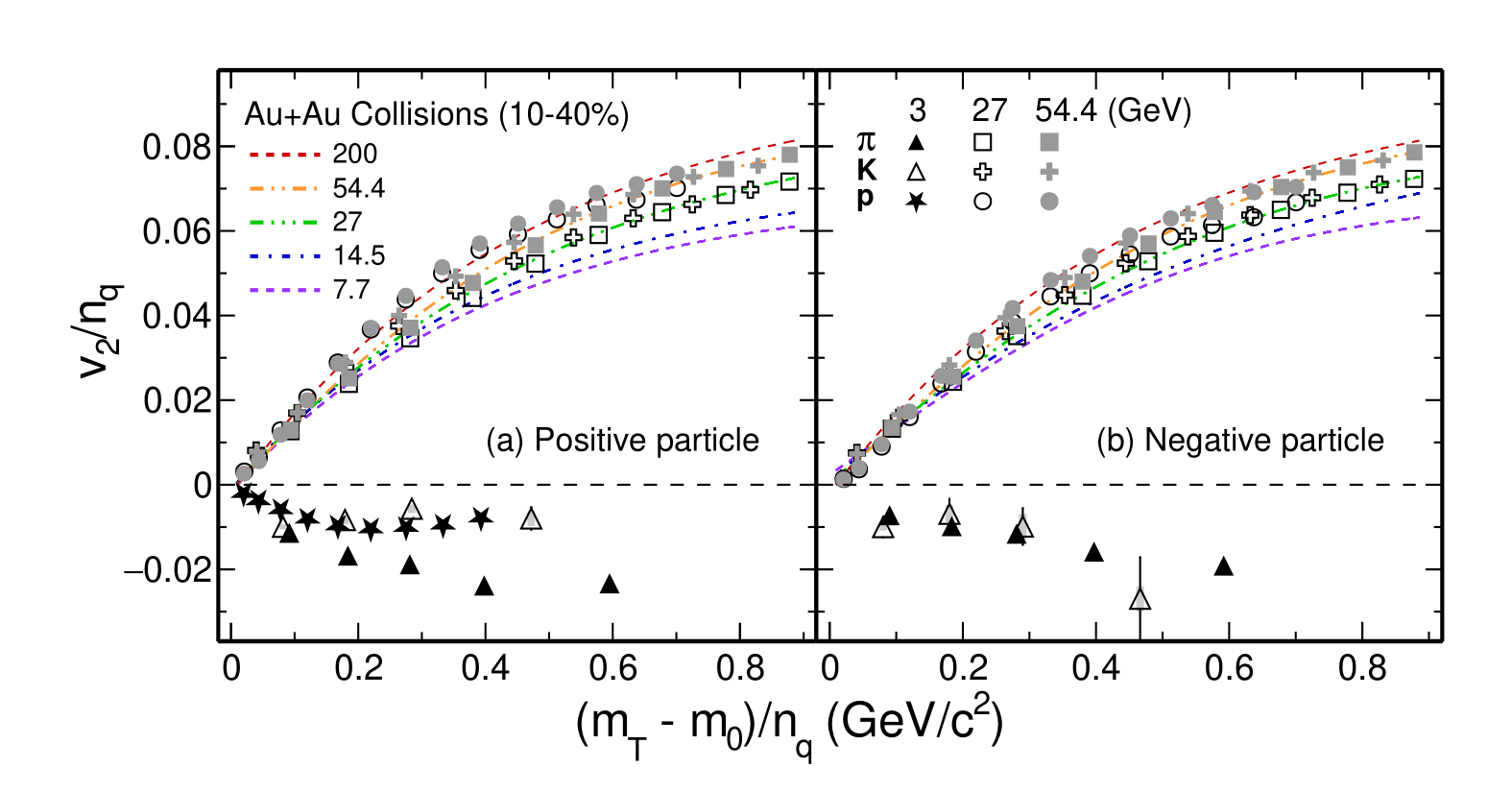
STAR collaboration recently published a new measurement of v1 and v2 for identified hadrons in Au+Au collisions
at $\sqrt{s_{\rm NN}}$ = 3, 27, and 54.4 GeV (Phys. Lett. B 827 (2022) 137003).
The lowest collision energy that RHIC has reached, 3 GeV, corresponds to a baryon chemical potential $\mu_{B} \sim$ 750 MeV on the QCD phase diagram.
The data were taken under the fixed-target configuration with the STAR detector covering the full acceptance from mid-rapidity to the target rapidity region.
In this paper, at the two higher collision energies, the observed v2 values at mid-rapidity are positive and consistent with previous measurements.
Meanwhile, the NCQ scaling of v2 holds well indicating partonic collectivity has been built-up.
Contrary to the results from higher collision energies, the measured v2 values at mid-rapidity for all hadrons are negative and the NCQ scaling disappears for the
positively charged particles in 3 GeV Au+Au collisions.
In addition, the v1 slopes at mid-rapidity for almost all observed hadrons are found to be positive, implying dominant repulsive baryonic interactions.
Furthermore, calculations of hadronic transport models with a baryonic mean-field qualitatively reproduced the data.
These observations imply the vanishing of partonic collectivity and a new EoS, likely dominated by baryonic interactions in the high baryon density region.
|
|
|
Figure: v2 scaled by the number of constituent quarks, v2/nq, as a function of scaled transverse kinetic energy ((mT-m0)/nq) for pions, kaons,
and protons from Au+Au collisions in 10-40% centrality at $\sqrt{s_{\rm NN}}$ = 3, 27, and 54.4 GeV for positively charged particles (left panel) and negatively charged
particles (right panel.) The measurements are in the rapidity range |y| < 0.5 at 27 and 54.4 GeV, and in $-$0.5 < y < 0 at 3 GeV. Color dashed lines represent the
scaling fit to data from Au+Au collisions at 7.7, 14.5, 27, 54.4, and 200 GeV from STAR experiment at RHIC.
Statistical and systematic uncertainties are shown as bars and gray bands, respectively.
|
|
Posted March 10, 2022
|
|
|
STAR focus: Measurement of inclusive electrons from
open heavy-flavor hadron decays in p+p collisions at $\sqrt{s}$ = 200 GeV with the STAR
detector
|
|
|
Studying the properties of the Quark Gluon Plasma (QGP) created in heavy-ion collisions
is a main goal of the RHIC physics program, and heavy flavor quarks are an excellent
probe to the QGP as they are produced mainly at the early stage of the collision due to
their large masses. Measurement of heavy quark production in p+p collisions serves as an
important reference to similar measurements in heavy-ion collisions for understanding the
nature of interactions between heavy quarks and the QGP. It also provides an important
testing ground for perturbative Quantum Chromodynamics (pQCD) calculations.
Electrons from semi-leptonic decays of heavy-flavor hadrons, referred to as heavy flavor
electrons (HFEs), are measured as proxies for heavy quarks.
Recently, the STAR collaboration published "Measurement of inclusive electrons from
open heavy-flavor hadron decays in p+p collisions at $\sqrt{s}$ = 200 GeV with the STAR
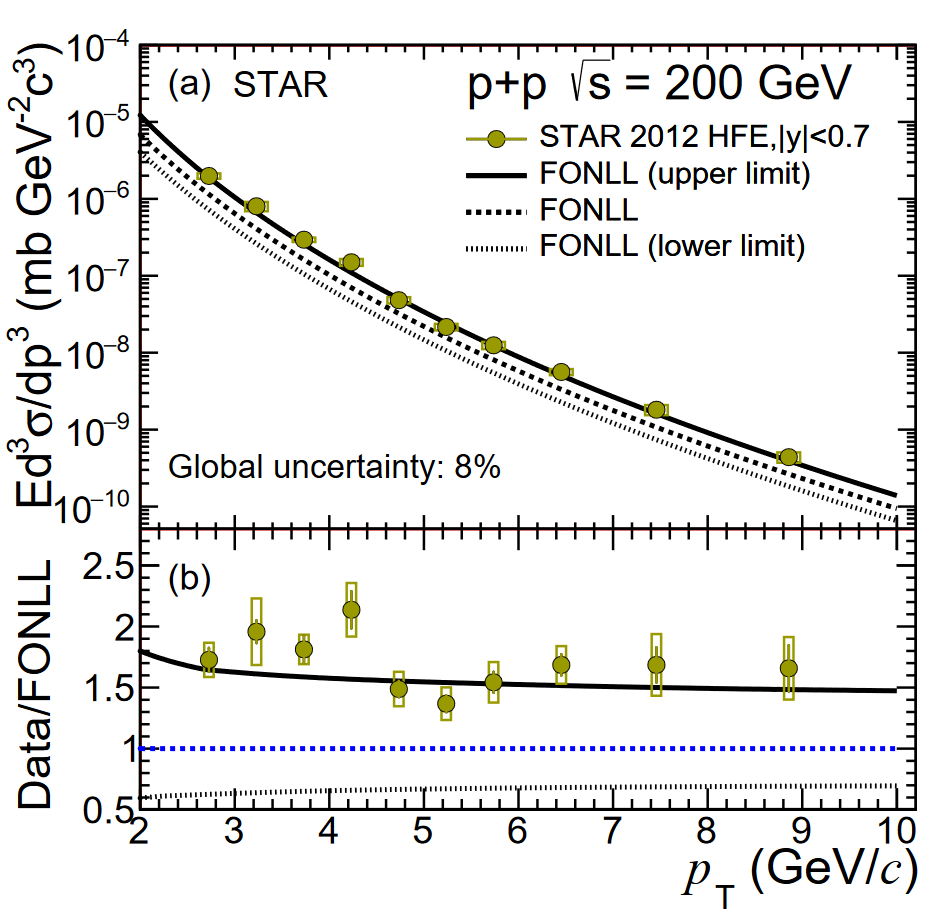
detector" in Phys. Rev. D 105, 032007 (2022). In this publication, a new measurement of
the production cross section for inclusive HFEs as a function of transverse momentum
(pT) at midrapidity (|y| < 0.7) for 2.5 < pT < 10 GeV/c in p+p collisions at $\sqrt{s}$ = 200 GeV is
reported. The result without subtracting the J/ψ, Υ, and Drell-Yan contributions is
consistent with previously published STAR and PHENIX results, with significantly
improved precision above 6 GeV/c. The result, with all background hadronic decay
sources removed, is qualitatively consistent with the upper limit of fixed-order next-to-leading logarithm (FONLL) calculations, providing further constraints on theoretical
calculations. Furthermore, this result provides a precise reference for nuclear modification
factor measurements of HFEs in heavy-ion collisions. It also facilitates a study on the
separation of the charm and bottom quark contributions to HFEs in p+p collisions.
|
|
|
|
Figure: (a) The HFE cross
section at STAR in p+p collisions at $\sqrt{s}$ = 200 GeV from 2012 (filled circles) and the FONLL
calculation (curves). (b) Ratio of data over FONLL calculation. The vertical bars and the
boxes represent statistical and systematic uncertainties, respectively.
|
|
Posted March 8, 2022
|
|
|
STAR focus: Search for the chiral magnetic effect via charge-dependent azimuthal
correlations relative to spectator and participant planes in Au+Au
collisions at 200 GeV
|
|
The STAR Collaboration recently published “Search for the chiral magnetic effect via charge-dependent
azimuthal correlations relative to spectator and participant planes in Au+Au collisions
at 200 GeV” in Physics Review Letters. 128, 092301 (2022).
The chiral magnetic effect (CME) refers to charge separation along a strong magnetic field due
to imbalanced chirality of quarks in local parity and charge-parity violating domains in quantum
chromodynamics. Such a strong magnetic field may exist at early times in non-central relativistic
heavy-ion collisions, on average perpendicular to the reaction plane. The experimental
measurement of the charge separation is made difficult by the presence of a major background
from elliptic azimuthal anisotropy (elliptic flow). This flow background and the CME signal have
different sensitivities to the spectator and participant planes, and could thus be determined by
measurements with respect to these planes. STAR reported such measurements in Au+Au
collisions at $\sqrt{s_{\mathrm{NN}}}$ = 200 GeV in the recently published Letter. It is found that the charge separation, with the flow
background removed, is consistent with zero in peripheral collisions. Some indication of finite
CME signals is seen in mid-central collisions. The results are shown in the figure below.
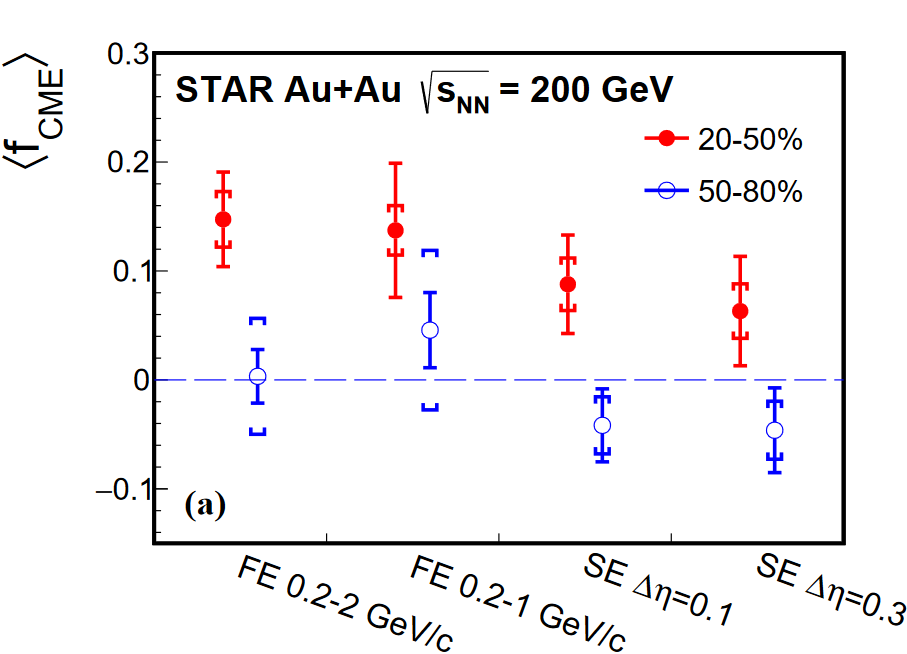
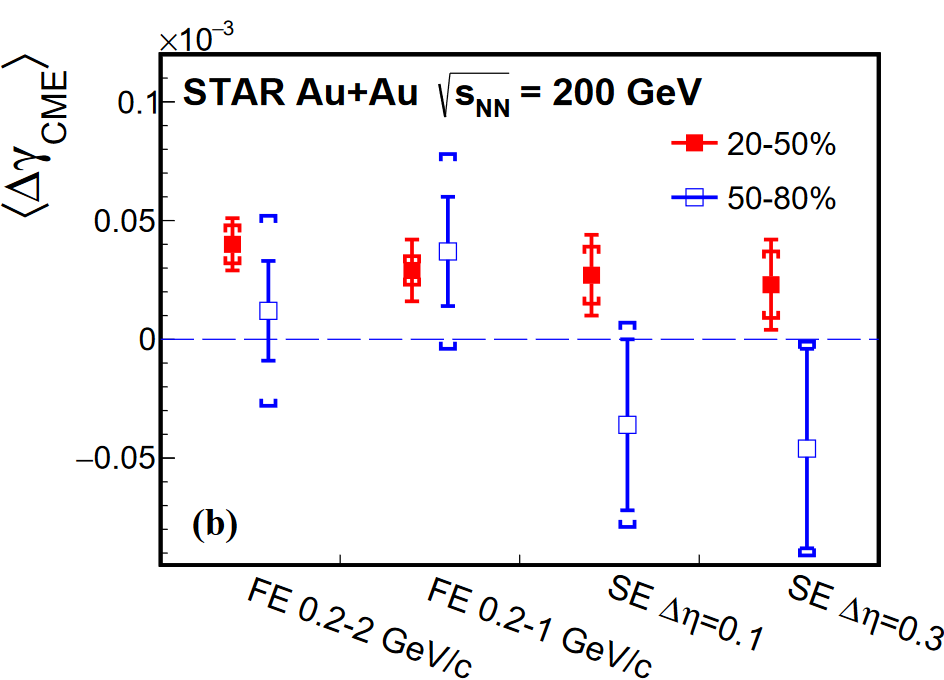
Figure: The flow-background removed <fCME >, the fraction of CME signal contained in the
inclusive Δγ measurement, (a) and <ΔγCME > (b) signal in 50-80% (open markers) and 20-50%
(solid markers) centrality Au+Au collisions at $\sqrt{s_{\mathrm{NN}}}$ = 200 GeV, extracted by various analysis
methods (FE: full event, SE: subevent) and kinematic cuts. Error bars show statistical
uncertainties; the caps indicate the systematic uncertainties.
In 2009 STAR made the first measurement of the CME-sensitive charge separation observable,
the Δγ correlator. Since then, many developments have been made to reduce or eliminate
backgrounds in the Δγ measurements. These backgrounds are caused by particle cluster
correlations, the effect of which is made reaction-plane dependent by the elliptic flow of those
clusters. A new approach is exploited in the current Letter, measuring the Δγ correlators with
respect to the first-order harmonic plane from the zero-degree calorimeters and the second-order
harmonic plane from the Time Projection Chamber (TPC) in STAR. Because the former
aligns better with the spectator plane and the latter aligns better with the participant plane, these
measurements contain different amounts of the plane sensitive flow backgrounds and the
magnetic field sensitive CME signal, and can thus be used to extract the possible CME. Full
events, where the particles of interest and the second-order harmonic plane are both
reconstructed from the entire TPC, and subevents, where they are reconstructed from two
separate halves of the TPC, are analyzed. The subevents are less affected by nonflow
correlations, those that are unrelated to the harmonic planes. As shown in the figure, the
possible CME signal is smaller in subevents than in full events, indicating that nonflow effects
may still be present in those measurements. A recent study of nonflow effects using models as well as
experimental data, suggests that the remaining nonflow effects in the subevent CME
measurements could even be negative. Further investigations are warranted to fully assess the
significance of these measurements.
|
|
Posted March 8, 2022
|
|
|
STAR focus: Measurement of cold nuclear matter effects for inclusive J/ψ in p+Au collisions
at √sNN = 200 GeV
|
|
The Quark-Gluon Plasma (QGP), a deconfined state of quarks and gluons, is believed to have existed momentarily after the Big Bang.
Creating the QGP in ultra-relativistic heavy-ion collisions and understanding its properties is one of the main goals of the RHIC physics program.
Among various probes used to study the QGP, quarkonia, bound states of heavy quark and anti-heavy quark pairs, play a unique role as they are expected to be dissociated in the QGP by the surrounding partons,
leading to experimentally observable yield suppression. Interpretation of quarkonium measurements in heavy-ion collisions is complicated by other effects, which need to be quantified in order to infer QGP
properties from these measurements. One such example is the so-called cold nuclear matter (CNM) effects, referring to the influence brought by the presence of the nucleus in
the collision but not related to the QGP formation.
STAR recently published a new measurement of the CNM effects for inclusive J/Ψ mesons at midrapidity in p+Au collisions at the center of mass energy per nucleon-nucleon pair
of 200 GeV (Phys. Lett. B 825 (2022) 136865). In p+Au collisions, the QGP is not expected to be created, and therefore measurement of the quarkoinum yield modification in these collisions
can be used to quantify the CNM effects. J/Ψ mesons are reconstructed through the dimuon decay channel, taking advantage of the trigger capability provided by the Muon Telescope Detector in
the RHIC 2015 run. The MTD dimuon trigger was able to sample the full luminosity delivered by RHIC for measuring J/Ψ down to zero transverse momentum (pT).
The J/Ψ yield suppression in p+Au collisions with respect to that in p+p collisions is shown as red stars in the figure. The magnitude of the suppression is about 30% below 2 GeV/c, which gradually goes away
above 3 GeV/c, indicating that the CNM effects are minimal for J/Ψ mesons at high-pT. Comparison to a similar measurement from 0-20% central Au+Au collisions, shown as blue circles in the figure, reveals that
the observed strong J/Ψ suppression above 3 GeV/c in heavy-ion collisions is mostly due to the hot medium effects, providing strong evidence for the formation of the quark-gluon plasma in these collisions.
|
|
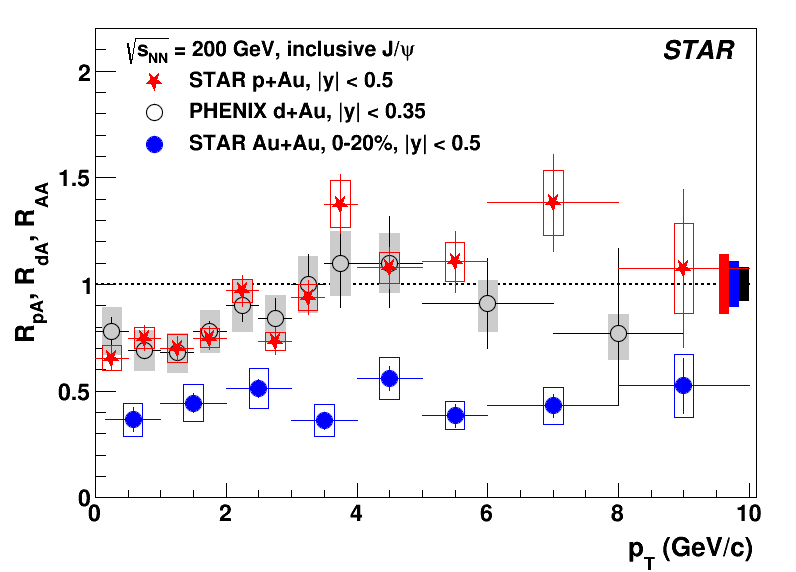
|
|
Figure: Inclusive J/Ψ RpAu (filled stars) and RdAu (open circles) as a function of pT compared to the J/Ψ RAA (filled circles) measured in 0-20%
central Au+Au collisions at 200 GeV. The error bars and open boxes around data points represent statistical and systematic uncertainties, while the filled boxes at unity display
the global uncertainties for each dataset.
|
|
Posted January 20, 2022
|
|
|
STAR focus: Investigation of Experimental Observables in Search of the Chiral Magnetic Effect in Heavy-ion Collisions in the STAR experiment
|
|
The chiral magnetic effect (CME) is predicted to occur as a consequence of a local violation of $\cal P$ and $\cal CP$ symmetries
in the strong interaction amidst a strong electromagnetic field generated in relativistic heavy-ion collisions, and may survive the expansion of the
quark-gluon plasma fireball and be detected in experiments.
Over the past two decades, the experimental searches for the CME have aroused extensive interest at the Relativistic Heavy Ion Collider (RHIC) and the
Large Hadron Collider (LHC), and so far there is no conclusive evidence for its existence.
Multiple observables have been proposed to study the CME, and it is desirable to have a comprehensive understanding of their sensitivities
and the connection between them. We have published a methodology study on the "Investigation of Experimental Observables in Search of the
Chiral Magnetic Effect in Heavy-ion Collisions in the STAR experiment" (Chinese Phys. C 46 014101)
In this publication, we have presented the relation between the three pertinent experimental approaches: the $\gamma$ correlator, the $R$ correlator, and
the signed balance functions via analytical derivation. The equivalence in the core components among these methods have been verified by exploiting
both simple Monte Carlo simulations and a realistic event generator Event-By-Event Anomalous-Viscous Fluid Dynamics (EBE-AVFD). This study indicates that,
if all the three methods are implemented on equal footings, they should exhibit similar sensitivities.
Additionally, we have applied the STAR frozen codes to the EBE-AVFD events of isobar collisions to investigate these observables' sensitivities
to the CME signal and the background contributions. The exactly same codes have been used in the blind-analysis procedure by STAR to analyze the isobar data.
The figure below shows the sensitivities of the observables to the difference in the hypothetical CME strength between Ru+Ru and Zr+Zr collisions
at $\sqrt{s_{\rm NN}} = 200$ GeV from 30-40% central events generated by EBE-AVFD.
It is found that $\Delta\gamma_{112}$ and $r_{\rm lab}$ have similar significance levels in accordance with the CME signal. $\sigma_{R2}^{-1}$, as
was implemented in the STAR frozen code, shows a relatively lower sensitivity to the signal increase, owing to the implementation details.
This study provides a reference point to gauge the STAR isobar-collision results on the CME which was just published in January, 2022.
|
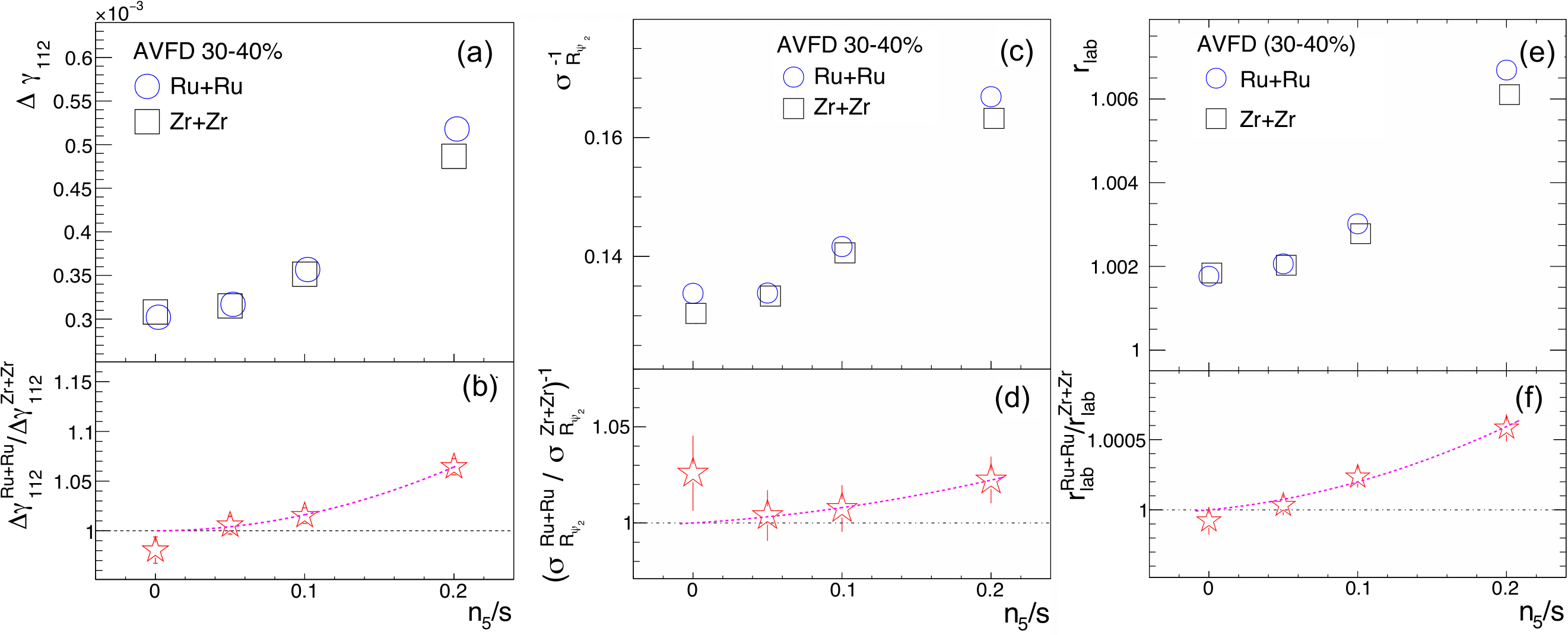
Figure: EBE-AVFD calculations of $\Delta \gamma_{112}$ (a), $\sigma^{-1}_{R2}$ vs $n_{5}/s$ (c) and $r_{\mathrm{lab}}$ (e) as functions
of $n_{5}/s$ for 30-40% isobar collisions at $\sqrt{s_{\rm NN}} = 200$ GeV, together with their corresponding ratio between Ru+Ru and Zr+Zr in the bottom
panels. $n_{5}/s$ is the input parameter for the CME strength in the EBE-AVFD model.
In panel (b), (d) and (f), the $2^{\rm nd}$-order polynomial fit function illustrates the rising trend starting from (0, 1).
|
|
Posted January 18, 2022
|
|
|
STAR focus: A new PYTHIA 8 underlying event tune for RHIC energies
|
|
STAR collaboration members have published “PYTHIA 8 underlying event tune for RHIC energies” in
Physical Review D 105, 016011 (2022).
In this publication, a new PYTHIA 8 tune, dubbed the “Detroit tune”, is produced that is able to describe underlying event data at mid-rapidity
at center-of-mass energies reached at RHIC and also the Tevatron using new RIVET analyses for STAR measurements. This is an important achievement
because accurately modeling the underlying event in proton-proton collisions is essential, and has not been achieved at these low collision energies in
existing PYTHIA 8 tunes. The Detroit tune is also compared to existing tunes at LHC energies, and is either comparable or slightly better in reproducing
underlying event data in events with high pT jets or hadrons.
Additionally, in this publication the validity of the Detroit and default Monash tunes are explored in data at forward rapidity. Compared to
data from BRAHMS and STAR at forward rapidities, neither tune is able to reproduce the data. This discrepancy is important to recognize as with
the STAR forward rapidity detectors beginning to take data, having a simulation that is able to accurately reproduce forward and mid-rapidity data will
be essential for analyses. This opens the door for future tuning exercises, and also for MC authors and phenomenologists to search for an accurate
representation of both the hard and soft particle production in proton-proton collisions.
In parallel to the publication, the authors have made all the RIVET analysis code utilized in the tuning procedure public on the
STAR Github page. This will provide the necessary materials for anyone to further study event
generator tuning with these RHIC data.
|
|
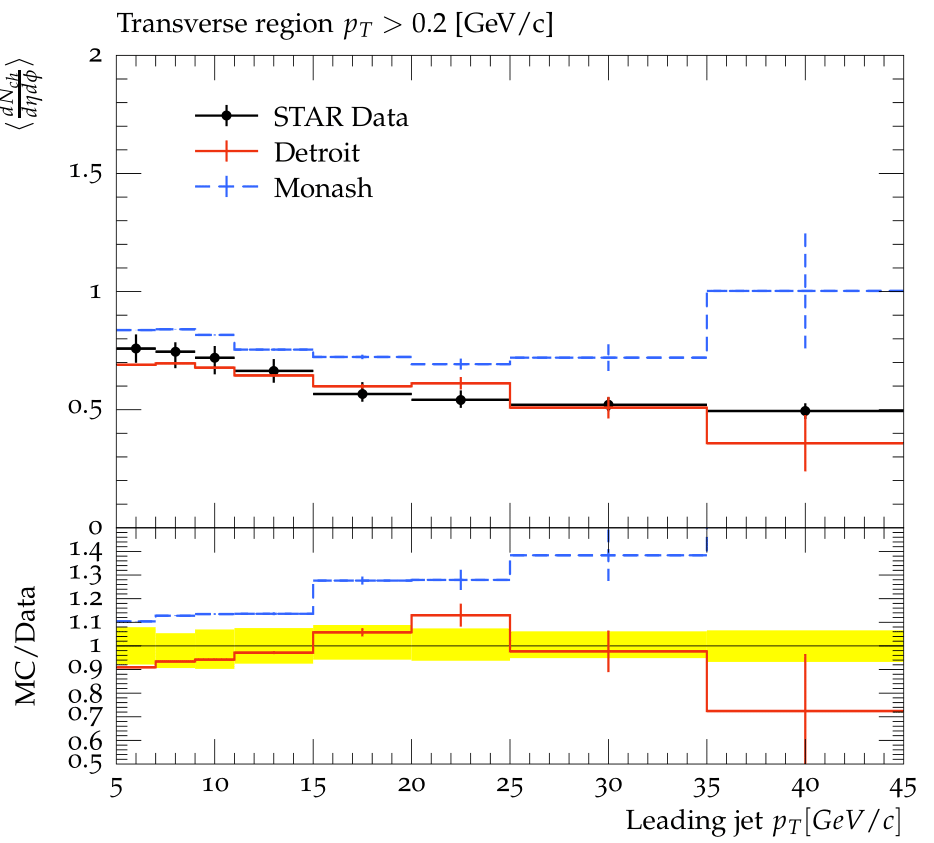
|
|
|
Figure: Top: Average charged track multiplicity as a function of leading jet pT in the azimuthal region transverse to the
jet axis measured by STAR. The two curves show the PYTHIA 8 distributions with the new Detroit tune (red solid) and default Monash tune (blue dashed).
Bottom: The ratio of the PYTHIA 8 curves with respect to data. The shaded yellow band shows the full data uncertainties.
|
|
Posted January 13, 2022
|
|
|
STAR focus: Measurement of the Sixth-order Cumulant of Net-proton Multiplicity Distributions in Au+Au Collisions at
√sNN = 27, 54.4, and 200 GeV at RHIC
|
|
One of the ultimate goals of high energy physics is to understand the phase structure of Quantum
Chromodynamics (QCD). The STAR collaboration's recent publication in Phys. Rev. Lett. 127, 262301
throws light on the nature of quark-hadron transition at
low baryon chemical potential through the first measurement of the sixth to second-order cumulant
(C6/C2) ratio of net-proton multiplicity distributions.
According to theoretical models and lattice QCD calculations, the ratio of the sixth to second-order
susceptibility of baryon numbers becomes negative at near the crossover transition temperature.
Experimentally, one can check the prediction by measuring the sign of C6/C2 of the net-proton
distribution, a good proxy of net-baryon distributions.
The figure below shows the centrality dependence of net-proton C6/C2 in Au+Au collisions at
the center-of-mass energies of 27, 54.4, and 200 GeV. The C6/C2 values are flat and consistent with
zero within uncertainties for 27 and 54.4 GeV. On the other hand, the central values of C6/C2
for 200 GeV are progressively negative from peripheral to central collisions. This systematic negative
sign trend of net-proton C6/C2 cannot be explained by the hadron transport model (UrQMD)
and is qualitatively consistent with the expectations from lattice QCD calculations. Hence our
experimental results could suggest a smooth crossover transition at the RHIC top energy, where the
baryonic chemical potential is ~ 20 MeV.
|
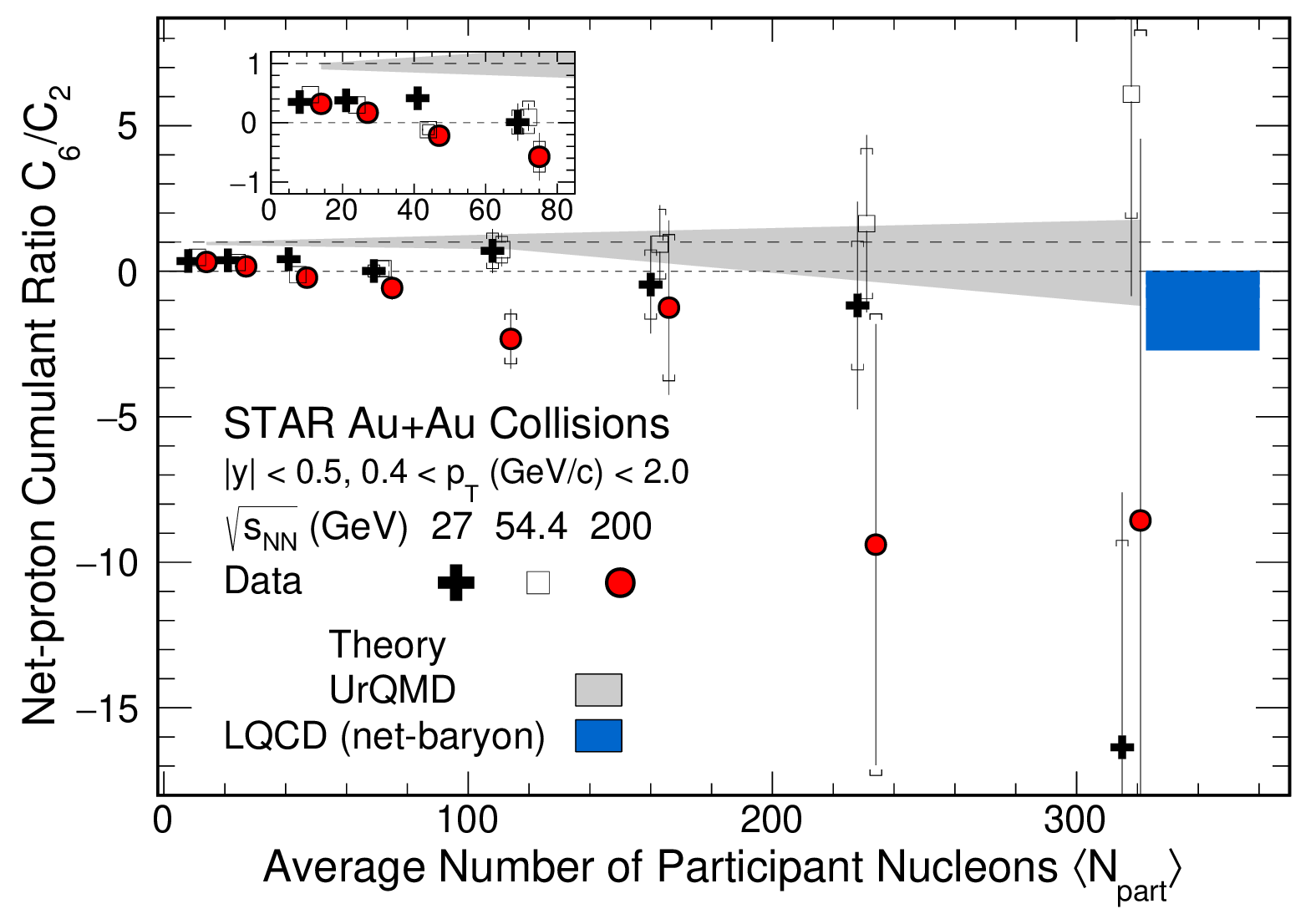
Figure: Centrality dependence of net-proton C6/C2 in Au+Au collisions at 27, 54.4, and 200 GeV. The inset
shows an expanded plot for 40-80% centrality. Results from UrQMD transport model are shown in a
gray band. Corresponding baryon number fluctuations from lattice QCD calculations are shown in a
blue band for T = 160 MeV with μB < 110 MeV
|
|
Posted December 20, 2021
|
|
|
STAR focus: Invariant Jet Mass Measurements in pp Collisions at √s = 200 GeV at RHIC
|
|
In a new paper published in Phys. Rev. D 104, 052007 (2021),
the STAR Collaboration measured for the first time the invariant mass,
M, of inclusive jets in pp collisions at √s = 200 GeV
with data taken in 2012. The anti-kT algorithm from the
FastJet package was used to cluster the collimated hadrons that result
from parton showers into collective objects called jets. The invariant
mass of a jet is defined as the magnitude of the four-momentum sum
of all of the constituents falling within the jet radius, R. By
comparing jet substructure measurements — with jet mass as one such
substructure observable — with calculations or event generators,
we can improve our understanding of both perturbative QCD (parton
production, shower) and non-perturbative QCD (hadronization), and
further tune our models to describe the data. To make this comparison
possible the data had to be corrected for detector effects, in this
case using a two-dimensional iterative Bayesian deconvolution method
in the RooUnfold package, which brought the jet mass and transverse
momentum, pT, to particle-level simultaneously. Additionally,
STAR presented the fully corrected mass of SoftDrop "groomed"
jets, which have soft radiation reduced, allowing for better comparison
to results from perturbative calculations and event generators at
parton-level.
|
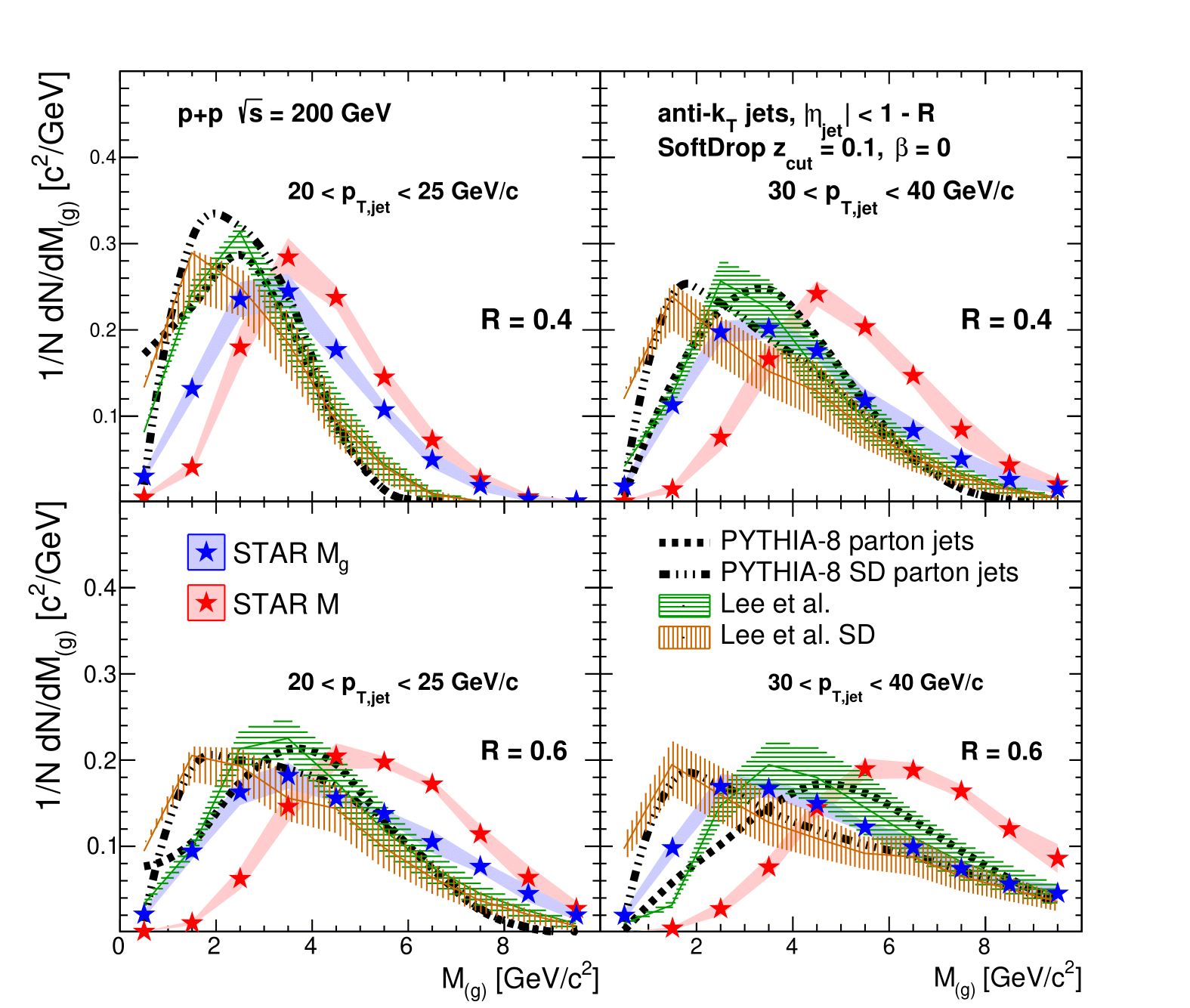
Figure: Comparison between hadron-level fully corrected STAR data and a calculation
at next-to-leading-log accuracy at parton-level as well as parton-level
Monte Carlo, for jet mass, M, and SoftDrop-groomed jet mass, Mg,
of anti-kT jets in pp collisions at √s = 200 GeV.
|
|
The jet mass results were presented for three selections of the jet
radius to tune the amount of typically soft radiation
unassociated with the initial partonic scattering contaminating the
jet, and the relative importance of radiation leaving the jet, or
exiting and then re-entering via a subsequent splitting. Three jet
pT selections are shown as well, to study the dependence
of the jet mass on its momentum. We find, as expected, that the jet
mass increases both with increasing R and pT, due
to the increased phase space for radiation. For each R and jet pT,
the jet mass is compared to leading-order Monte Carlo event generators
PYTHIA-6 (tuned to STAR), PYTHIA-8 (LHC tuned), and HERWIG-7 (LHC
tuned). We find that PYTHIA-6 describes data accurately in almost
all cases, while HERWIG-7 and PYTHIA-8 in general predict smaller
and larger jet mass, respectively, than what is observed. This demonstrates
the need for further tuning of these event generators at RHIC.
Finally, a comparison (see figure) was also made to parton-level,
with both parton-level PYTHIA-8 and a calculation from Lee and Ringer.
This comparison demonstrated the large impact of hadronization on
the jet mass as well as the efficacy of SoftDrop grooming in suppressing
the non-perturbative radiation in the jets to reduce the effect of
hadronization. These new data can be used to extract a non-perturbative
shape function for future calculations performed at RHIC energies.
Posted October 4, 2021
|
|
|
STAR focus: Measurement of Momentum and Angular Distributions of e+e- pairs from
Linearly Polarized Photons
|
|
Only a handful of fundamental interactions between light and matter are allowed by the theory of quantum electrodynamics,
all of which but one have been observed in the 80 or so years since their prediction.
The Breit-Wheeler process, the simplest mechanism for converting 'light quanta' into matter and antimatter, has eluded observation for decades,
despite being hotly pursued.The idea that you can create matter from smashing together light is a striking demonstration of the physics immortalized in
Einstein's famous E=mc2 equation, which revealed that energy and matter are two sides of the same coin.
Recently, the STAR collaboration published "Measurement of Momentum and Angular Distributions of e+e- pairs
from Linearly Polarized Photons" in
Physical Review Letters, in which presents observation
of the Breit-Wheeler process in heavy-ion collisions for the first time.
This discovery was made possible by a unique analysis which measured the quantum spin-momentum correlations of the produced e+e-
pair, revealing a
striking 4th order angular modulation (See Figure). Virtual photons live only briefly as they mediate the electromagnetic force and carry a virtual mass.
While virtual photons can be in the helicity 0 state, due to their virtual mass, real photons cannot, and instead must have +/-1 unit of helicity. This difference
has a profound impact on the produced e+e- pair, since the quantized spin of the colliding photons becomes encoded in the
final momentum of the produced electron
and positron, resulting in the observed modulated emission angle ($\Delta\phi$). As the figure shows, the STAR data agree with calculations of the
Breit-Wheeler process (QED), which predicts a strong cos$4\Delta\phi$ modulation from the collision of linearly polarized photons.
|
|
The measured cos$4\Delta\phi$ modulation proves another tantalizing prediction from decades ago. Heavy-ion collisions have long been expected to produce the
strongest magnetic fields in the Universe, of order 1015 Tesla. Physicists in the 1930's predicted that photons shooting through such strong magnetic fields
can be "bent", despite the photon itself not being charged - and therefore not directly interacting with the electromagnetic field. However, in quantum mechanics,
a real photon can briefly fluctuate into an e+e- pair which can interact with the strong electromagnetic fields.
The key prediction for this effect, called vacuum birefringence, is that the photon's path is split depending on the angle between the photon's polarization
and the magnetic field direction. In the recent STAR measurement, the colliding photons result from the highly boosted electromagnetic fields of the heavy ions,
so the photon's polarization direction is directly related to the classical electric and magnetic field direction. Therefore, the observed cos$4\Delta\phi$
modulation can be understood in terms of the absorption of light when the polarization of the photon (from one ion) is parallel vs. perpendicular to the magnetic
field direction (produced by the other ion). This absorption effect is directly related to vacuum birefringence, and provides the first experimental verification
that heavy-ion collisions really do produce ultra strong magnetic fields (approximately 1015 Tesla).
|
|
Read more about this discovery:
BNL News
Science News
Posted September 10, 2021
|
|
|
STAR focus: Observation of Ds/D0 in Au+Au collisions at √sNN = 200 GeV
|
|
The STAR Collaboration has recently published an article titled "Observation of Ds/D0 in Au+Au collisions
at √sNN = 200 GeV” in
Phys. Rev. Lett. 127, 092301.
Charm quarks are produced on timescales shorter than the Quark-Gluon Plasma (QGP) formation in heavy-ion collisions
and they subsequently experience the whole evolution of the QGP matter, making them an excellent probe to study the transport properties of the QGP.
In the QGP medium, one expects a different hadronization mechanism from p+p collisions through the recombination of charm quarks
and light/strange quarks (namely coalescence hadronization) to dominate at low pT (< 5 GeV/c) and fragmentation hadronization to dominate at higher pT.
Due to the enhanced strange-quark abundance in the QGP, an increased Ds production in heavy-ion collisions relative to p+p collisions
has been predicted in case of hadronization via quark recombination. Comparing the Ds/D0 yield ratio in heavy-ion collisions with
that in p+p therefore helps us understand the QGP effects on charm-quark hadronization.
In this paper we present the first measurement of Ds production and Ds/D0 yield ratio as a function of pT
for different collision centralities at midrapidity (|y| < 1) in Au+Au collisions at
√sNN = 200 GeV. A clear enhancement of the Ds/D0 yield ratio is found
compared to PYTHIA simulations of p+p events at the same collision energy. For the Ds/D0 ratios integrated over 1.5 < pT < 5 GeV/c
in the 10%–60% centrality range, the significance of this observation is more than 5 standard deviations.
The pT-integrated Ds/D0 ratio is compatible
with predictions from a statistical hadronization model. The enhancement, and its pT dependence, can be qualitatively described by model calculations
incorporating thermal abundance of strange quarks in the QGP and coalescence hadronization that includes charm quarks.
These results suggest that recombination of charm quarks with strange quarks in the QGP plays an important role in Ds-meson production in heavy-ion collisions.
|
|
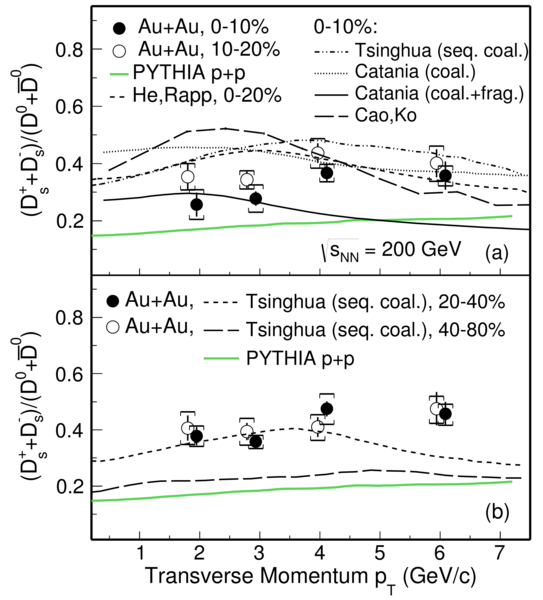
|
|
|
Figure: (a) Ds/D0 yield ratio as a function of pT compared to various model calculations from He/Rapp (0%–20%), Tsinghua,
Catania, and Cao-Ko in 0%–10% centrality interval of Au+Au collisions, and PYTHIA prediction in p+p collisions
at √sNN = 200 GeV.
(b) Ds/D0 yield ratio as a function of pT compared to model calculations from Tsinghua in 20%–40% (solid circles) and 40%–80% (open circles)
centrality intervals of Au+Au collisions at √sNN = 200 GeV.
Vertical bars and brackets on data points represent statistical and systematic uncertainties, respectively.
|
|
Posted August 30, 2021
|
|
|
STAR focus: Azimuthal Anisotropy Measurements
of Strange and Multi-strange Hadrons at Midrapidity in Collisions of U+U Nuclei at
√sNN = 193 GeV
|
|
The STAR Collaboration has recently published the results on azimuthal anisotropy measurements
of strange and multi-strange hadrons at midrapidity (|y| < 1.0) in collisions of U+U nuclei at
√sNN = 193 GeV in
Physical Review C 103, 064907 (2021).
Azimuthal anisotropy measurements of identified hadrons are excellent probes to understand
the quark-gluon plasma (QGP) medium and help in constraining transport and hydrodynamic
model simulations. Multi-strange hadrons containing only constituent strange quarks, especially the φ-meson($s\bar{s}$) and Ω($sss$),
provide a clean probe to investigate partonic collectivity of the QGP
phase in relativistic heavy-ion collisions. One can understand the initial conditions in heavy-ion
collisions via varying the collision system size. This could be achieved by colliding uranium nuclei which possess a prolate shape,
consequently yielding collision configurations
(body-body collisions) in which the initial overlap region is not spherical even in central collisions.
Studying various collision shapes will provide an additional constraint for the initial conditions in
models.
|
|
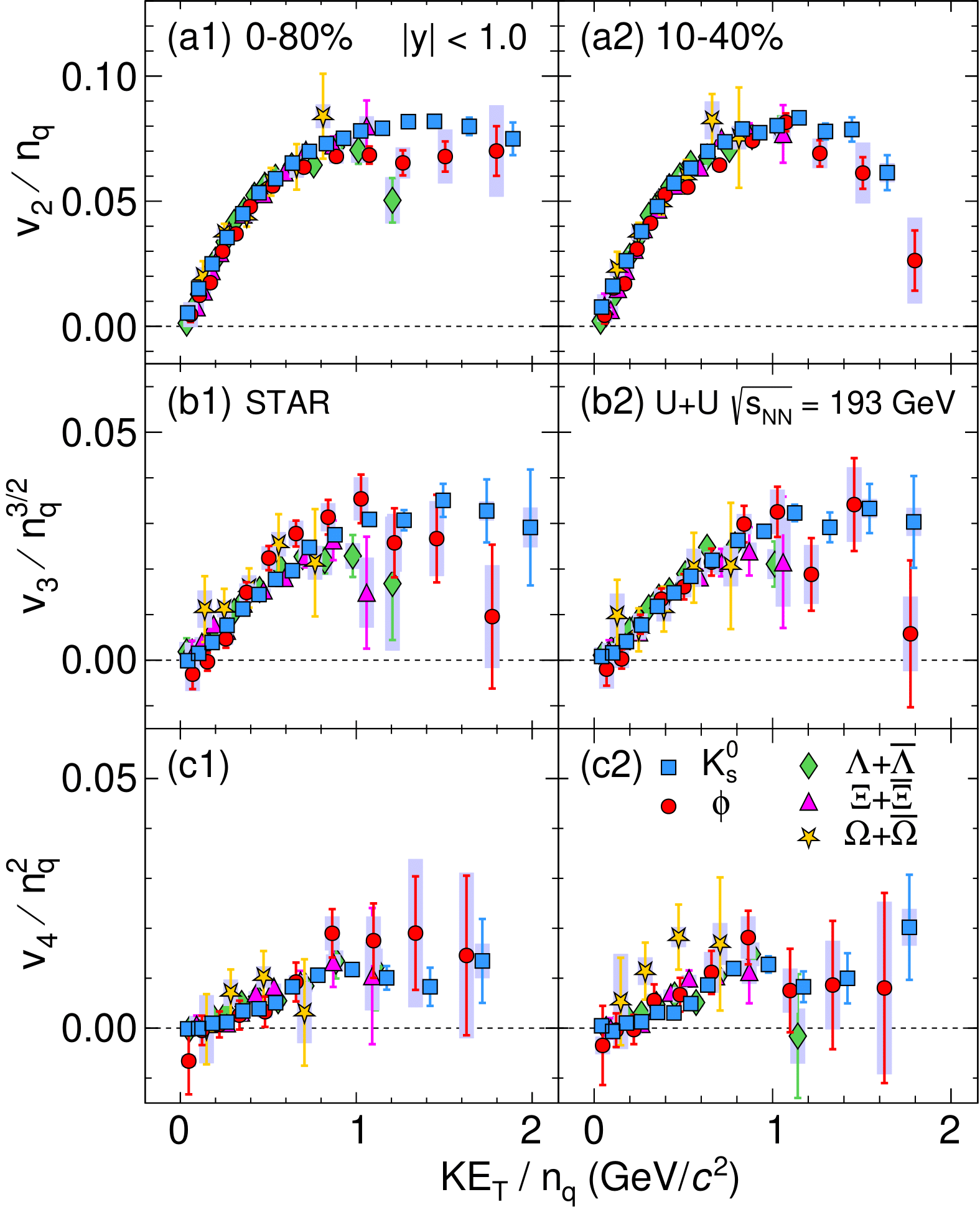
|
Figure: Flow coefficients v2, v3, and v4 as a function of transverse kinetic
energy KET/nq for various
particles at mid-rapidity (|y| < 1) in U+U collisions at √sNN = 193 GeV, scaled by the
number of constituent quarks (nq) to the power n/2. Left panels represent results for minimum bias (0-80%) and right
panels for centrality class (10-40%).
|
|
|
We reported systematic measurements of the transverse momentum (pT) dependence of flow coefficients
(v2, v3, and v4) in U+U collisions for minimum bias and three different centrality intervals,
compared with Au+Au collisions, hydrodynamic, and transport model calculations. We present
the number of constituent quark scaling (NCQ) of vn coefficients for strange and multi-strange hadrons
in U+U collisions at √sNN = 193 GeV. Our measurements show that the NCQ scaling holds
within experimental uncertainties for each harmonic order n = 2, 3 and 4. The vn/nqn/2
vs. KET/nq values lie on a single curve for all the particle species within ±15%. The measured NCQ
scaling of vn coefficients indicates the development of partonic collectivity during the QGP phase
in heavy-ion collisions. This observed scaling also suggests the formation of hadrons through
quark coalescence in the intermediate pT range (2.0 < pT (GeV/c) < 4.0). Although there are
considerable differences in the collision geometry between U+U and Au+Au, the hydrodynamical
evolution and the coalescence mechanism for hadron formation remain key features of QGP drops
formed in nucleus-nucleus collisions.
|
|
Posted June 19, 2021
|
|
|
STAR focus: Transverse Single-Spin Asymmetries of π0 and Electromagnetic Jets at Forward Rapidity
|
|
The STAR Collaboration has recently published an article titled "Measurement of transverse single-spin asymmetries of π0 and electromagnetic jets at
forward rapidity in 200 and 500 GeV transversely polarized proton-proton collisions” in
Physical Review D 103 092009 (2021).
Large transverse single-spin asymmetries (TSSA) had been observed for hadrons produced in transversely polarized hadron-hadron collisions.
Based on the QCD framework, the TSSAs can originate from two possible sources. One being an initial state effect which is correlated to the parton
distribution functions and another being a final state effect related to the fragmentation process. The classical measurement of a π0 TSSA usually mixes
the two effects. This paper reports measurements of the π0 TSSA together with the TSSA for EM-jets and a TSSA sensitive to the Collins mechanism. The
latter two results are sensitive to either the initial or final state effect respectively. The π0 TSSA result shows a weak energy dependence.
The jet TSSA is small but non-zero, and the Collins asymmetry is consistent with zero.
In this paper, we also present a novel phenomenon of the π0 TSSA. In the analysis, it was found that the π0 TSSA is not only governed by its
kinematics (energy and transverse momentum) but also by the event topology. The π0s which have no other energy around them are defined as
“isolated π0s”, which tend to have a larger TSSA than “non-isolated π0s”. The figure below shows that both for
√s = 200 GeV and 500 GeV,
the π0 TSSAs for the isolated π0s are significantly larger than for non-isolated π0s.
This difference suggests different underlying mechanisms for the two types of π0, which challenges our understanding to the origin of
the π0 TSSA. Diffractive production may be a suspect for the source of isolated π0,
this result certainly needs further efforts from both theorists and experimentalists.
|
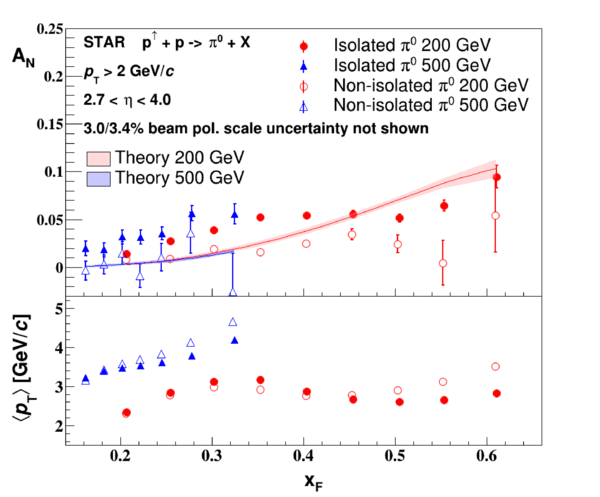
|
|
Figure: The transverse single-spin asymmetry as a function of xF for the isolated and non-isolated π0 in
transversely polarized proton-proton collisions at √s = 200 and 500 GeV. The error bars are statistical
uncertainties only. A systematic
uncertainty up to 5.8% of AN for each point is smaller than the size of the markers. Theory curves based on a recent global fit are also shown.
The average pT of the π0 for each xF bin is shown in the lower panel. The isolated π0 TSSAs are significantly larger than those for
non-isolated π0s.
| |
Posted June 3, 2021
|
|
|
STAR focus: Longitudinal Double-Spin Asymmetry for Inclusive Jet and Dijet
Production in Polarized Proton Collisions at √s = 200 GeV
|
|
How is the spin of the proton distributed among its quark, anti-quark, and gluon constituents? The
STAR experiment addressed this fundamental question using collisions of high-energy polarized
protons.
We recently published results on the “Longitudinal Double-Spin Asymmetry for Inclusive Jet and Dijet
Production in Polarized Proton Collisions at √s = 200 GeV” in Phys. Rev. D 103, L091103 (2021)
highlighted as PRD Editors' Suggestion. The data give insight in the gluon spin contribution to the proton spin.
We measured the asymmetries in the differential production cross sections of inclusive jet and dijet
probes for different longitudinal spin configurations of the colliding proton beams as a function of jet
transverse momentum and dijet invariant mass. Since gluon-gluon and gluon-quark scattering
contributions dominate the production of these probes in the STAR environment, the data provide
sensitivity to the gluon spin contribution to the proton spin.
|
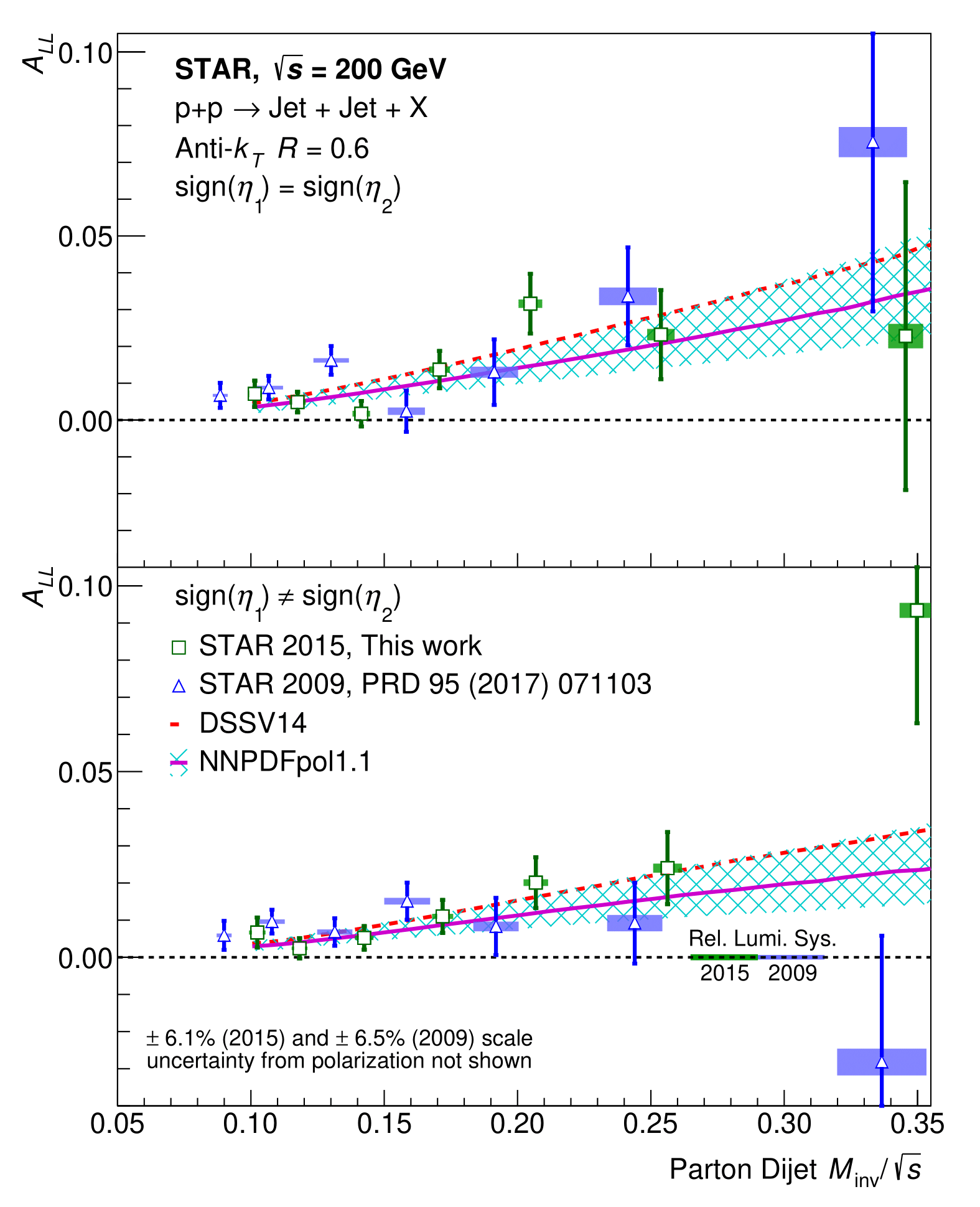 |
Left Figure: Results of the
double-spin asymmetry for dijets as a function of dijet
invariant mass for two different event topologies. The
topologies probe complementary gluon fractional
momenta. The green square markers show the new
results from data collected in 2015. The blue triangle
markers show our prior results based on data
collected in 2009 and are seen to be in good
agreement. The curves show dijet asymmetry
expectations from the DSSV14 and NNPDFpol1.1
theory collaborations and the band indicates the size
of the uncertainty in the NNPDFpol1.1 expectation.
|
|
Our prior results provided first evidence for a positive
polarization of the gluons in the polarized nucleon for
gluon fractional momenta larger than 0.05 upon their
inclusion in global analyses. Our new results have an
approximately twice larger figure of merit, with improved systematic uncertainties, and thus considerably
strengthen this evidence.
Since we concluded our data taking with longitudinally polarized protons in
2015, these data are anticipated to provide the most precise insights in gluon polarization well into the
future, likely until the future Electron-Ion Collider comes online.
|
|
Posted May 27, 2021
|
|
|
STAR focus: Methods for a blind analysis of isobar data collected by the STAR collaboration
|
|
The STAR Collaboration has recently published “Methods for a blind analysis of isobar data
collected by the STAR collaboration” in Nuclear Science and Techniques.
For more than a decade, STAR has searched for evidence of chiral magnetic effects (CME),
which refer to induction of an electric current by the magnetic field in a chiral system. In 2018
STAR collected data from isobaric nuclei, ${^{96}_{44}Ru}+{^{96}_{44}Ru}$ and ${^{96}_{40}Zr}+{^{96}_{40}Zr}$.
Varying the number of protons while
maintaining a consistent number of nucleons presents an opportunity to vary the initial
magnetic field while keeping background contributions approximately the same.
For the first time, STAR has implemented blind analyses of these data for CME-related studies.
Many of the typical blind analysis methods are not well-suited to the specific needs of the
isobar CME analyses. For example, many blind analysis methods “hide” or “offset” variables or
information needed to gain sensitivity to signals. For the isobar analysis, randomizing the sign
of charged-particle tracks or randomizing particle azimuthal angle would blind information
needed for the CME signal. However, so doing would also prevent charge-dependent efficiency
corrections and destroy correlations from secondary decays, respectively. Consequently, STAR
developed a new method for blind analysis of isobar collision data.
The STAR isobar blind analysis method is a three-step process. In the first step, analysts are
provided output files composed of events from a mix of the two isobar species. To the extent
possible, the order of events respects temporal changes in running conditions. Events are
randomly rejected at the level of ~10% to prevent determining the species by simply counting the
number of events associated with a particular run or event trigger.
|
|
Analysts use this mixed data
sample to tune analysis code and time-dependent Q/A.
In the second step, analysts are
provided an “unmixed-blind” sample of data comprised of files that obscure the true run
number—hence, the isobar species—but do not mix events across different runs. This sample
enables species-blind run-by-run Q/A and only run-by-run corrections and code alteration
directly resulting from these corrections are allowed at this stage. Once Q/A is complete and
analysis of the run-by-run Q/A data are final, full un-blinding proceeds. In this third stage,
physics results are produced with the previously tuned, vetted, and fixed analysis codes.
|
|
Work toward the blind analysis began, even before the isobar data were collected. To the
extent possible, information pertaining to the isobar species was restricted during the run. In
assembling the computing machinery for data production, information such as the data-taking
run, RHIC fill, event timestamp, collision species, ZDC hit rates, etc., were obfuscated to blind
the collision species. Physics analysts participated in a “mock-data challenge.” In this study,
analysts were presented data from collisions at GeV, also collected in 2018, produced in the
same three-step manner as intended for the blind isobar productions. This exercise served as
an opportunity for the software and computing team to develop, tune, and test the machinery
necessary for the blind isobar data samples. Furthermore, the mock-data challenge served as
an opportunity for analysts to test the feasibility of the methods to enable a robust data
analysis for their particular physics observables. An example of a quality-assurance plot from
the mock data challenge is shown, above.
The procedure described in our paper was accepted by the STAR institutional council in January
2018, prior to the start of the isobar collision runs. The isobar analysis is well underway
following the procedure outlined in the published manuscript.
|
|
Posted May 17, 2021
|
|
|
STAR focus: Flow and interferometry results from Au+Au collisions at $\sqrt{s_{\rm{NN}}}$ = 4.5 GeV
|
|
The STAR Collaboration has recently published “Flow and interferometry results from Au+Au collisions at $\sqrt{s_{\rm{NN}}}$ = 4.5 GeV”
in
Physical Review C 103, 034908.
|
A large 1-kg block of VERY cold (-100℃=-148℉) ice is placed on a
kitchen stove. It takes an hour for the temperature to change by
300℃. But 40 of those minutes are spent at a single temperature,
in the phase transition from liquid to gaseous H2O.
|
If you heat water at a constant rate, the temperature rises at a nearly constant rate, until it reaches 100 degrees Celsius,
at which point the temperature remains constant for some time, while the water vaporizes. During this process, all of the energy
goes into the so-called Latent Heat of Vaporization, rather than increasing the temperature. After the phase of the system has changed
from liquid to gas, the temperature again increases at a nearly constant rate. The same process, in reverse, occurs when the system
cools as energy leaves the system—the temperature drops in one phase, then remains constant for some time, then continues to drop.
Latent Heat is a feature of all First Order Phase Transitions (1oPT), and its magnitude is driven by the underlying physics of the
system—in this case, the interactions between H2O molecules. Scientists often focus intensely on phase transitions
to understand the fundamental nature of a system.
|
|
It is currently believed that the transition from the Quark Gluon Plasma (QGP) phase to the hadronic phase is a 1oPT with a
Latent Heat driven by the interaction between quarks and gluons. Identifying and quantifying this transition has been one of the driving
motivations behind experiments at RHIC. Since at least 30 years ago, theoretical modeling has suggested that the system created in the collision
will have a “long” lifetime if the system is near the transition temperature. However the QGP only lives for about a billionth of a trillionth
of a second—about the time required for light to cross an atomic nucleus! How can we measure those timescales? Nuclear physicists use
quantum correlations between subatomic particles, called pions, emitted from the QGP to measure spatial and temporal scales, a technique
known as “femtoscopy”. By systematically changing the initial temperature of the QGP—at RHIC, the beam energy is systematically
varied—we look for the difference between the “out” and the “side” radius to first rise, and then fall.
|
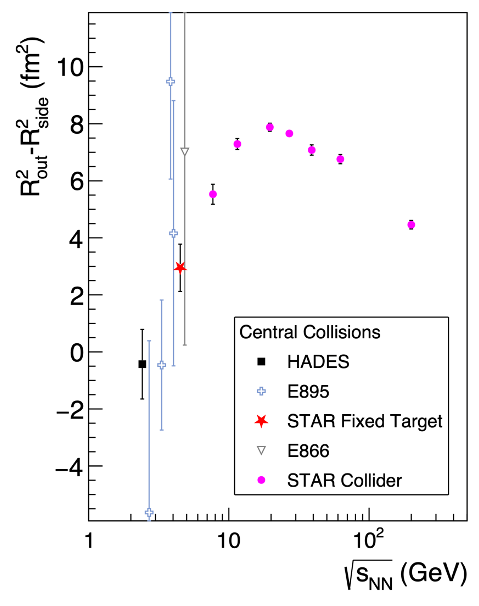
The difference between the "out" and "side" radii is a measure of the lifetime of QGP.
It is seen to grow, and then fall, as the collision energy is increased, in agreement with theoretical expectations for a
first-order phase transition.
|
In a recent publication, the STAR Collaboration reports a compelling observation of this long-sought signal that supports the
phase transition picture. This observation was possible due to several key features of the experiment. The unprecedented flexibility
of the RHIC facility allowed high-statistics, precision measurements over a wide range of closely spaced energies. This included running
the experiment in a novel configuration, in which only one nuclear beam impinges on a stationary gold foil. This so-called
“fixed target” measurement is the focus of the recent STAR paper. The result at the low collision energy accessible in this mode was crucial,
as it defines the left side of the peak structure with much smaller uncertainty than was possible in earlier measurements at similar energies.
These earlier results are shown in the figure as open points; their error bars are clearly too large to allow detection of the underlying peak.
After years of systematic experimentation, we now have experimental observation and measurement of the timescale signature consistent
with a first-order phase transition in heavy ion collisions. While systematic theoretical study is needed to understand the signal
and its physical implications, STAR’s recent publication represents a big step towards mapping the phase structure of hot QCD matter.
|
|
Posted May 8, 2021
|
|
|
STAR focus: Tantalizing Signs of Phase-change 'Turbulence' in RHIC Collisions
Sample of BNL news article by Karen McNulty Walsh and Peter Genzer.
Read the full article here
|
|
UPTON, NY—Physicists studying collisions of gold ions at the Relativistic Heavy Ion Collider (RHIC), a U.S. Department of Energy Office of Science
user facility for nuclear physics research at DOE’s Brookhaven National Laboratory, are embarking on a journey through the phases of
nuclear matter—the stuff that makes up the nuclei of all the visible matter in our universe. A new analysis of collisions conducted at different
energies shows tantalizing signs of a critical point—a change in the way that quarks and gluons, the building blocks of protons and neutrons,
transform from one phase to another.
|
The STAR detector at the U.S. Department of Energy's Brookhaven National Laboratory
|
|
The findings, just published by RHIC’s STAR Collaboration in the
journal Physical Review Letters, will help
physicists map out details of these nuclear phase changes to better understand the evolution of the universe and the conditions in the
cores of neutron stars.
“If we are able to discover this critical point, then our map of nuclear phases—the nuclear phase diagram—may find a place in the textbooks,
alongside that of water,” said Bedanga Mohanty of India’s National Institute of Science and Research, one of hundreds of physicists collaborating
on research at RHIC using the sophisticated STAR detector.
|
|
Continue Reading
|
|
Posted Mar 9, 2021
|
|
|
STAR focus: Measurements of $W$ and $Z/\gamma^*$ cross sections and their ratios in $p+p$ collisions at RHIC
|
|
The STAR Collaboration has recently published “Measurements of $W$ and $Z/\gamma^*$ cross sections and their ratios in $p+p$ collisions at RHIC” in
Phys. Rev. D 103, 012001.
One of the fundamental goals of nuclear physics is to understand the proton’s structure and
dynamics. Parton distribution functions (PDFs) of the proton account for the probability of
finding a parton at a given fraction of the proton’s momentum, $x$, and four-momentum
transfer, $Q^2$ . Although PDFs have become more precise, there are still kinematic regions where
more data are needed to help constrain global PDF extractions, such as the ratio of the sea
quark distributions $\bar{d}/\bar{u}$ near the valence region. Furthermore, different measurements
appear to suggest different high-$x$ behaviors of this ratio. The $W$ boson cross-section ratio
($W^+/W^-$) is sensitive to the $\bar{d}/\bar{u}$ distributions at large $Q^2$ . Such a measurement can be
used to help constrain the $\bar{d}/\bar{u}$ ratio.
Through $W$ and $Z$ boson production in $p+p$ collisions at a center-of-mass energy of 510 GeV,
STAR has measured $W$ and $Z$ cross sections via the boson's leptonic decay channel from the
2011, 2012, and 2013 RHIC data sets. The combined result for the $W$ cross-section ratio is
shown in Fig. 1, along with comparisons to several PDF predictions. A PDF reweighting study,
using the new $W^+/W^-$ measurement, was done to provide an initial assessment of the data's
sensitivity for $\bar{d}$, $\bar{u}$, $\bar{u}-\bar{d}$, and $\bar{d}/\bar{u}$ PDF distributions. The reweighting
study shows modest constraining power on the PDFs. However, a proper assessment of the
data's impact on PDF distributions requires a full global PDF analysis, including this STAR data in
the fits used to extract the PDFs.
|
|
|
Fig. 1: STAR $W^+/W^-$ cross-section ratio measurements as a function of decay lepton
pseudorapidity. Curves show various PDF predictions.
|
|
In addition to the $W$ cross-section ratio, STAR also reports on the measured $W/Z$ cross-section
ratio, differential, and total $W$ and $Z$ cross sections, which are also sensitive to the proton's
quark and antiquark distributions and can constrain proton PDFs further when used in a global
PDF analysis.
|
|
Posted January 8, 2021
|
|
|
STAR focus: Measurement of Inclusive Charged-Particle Jet Production in Au + Au collisions
at $\sqrt{s_{\rm{NN}}}=200$ GeV
|
|
The STAR Collaboration has recently published "Measurement of inclusive charged-particle jet production in Au + Au collisions
at $\sqrt{s_{\rm{NN}}}=200$ GeV” in Physical Review C 102, 054913 (2020)
|
|
Collisions of heavy atomic nuclei at the Relativistic Heavy Ion Collider (RHIC) at BNL and the Large Hadron Collider (LHC) at CERN generate tiny
droplets of matter under conditions of extreme temperature and density, similar to those of the early universe a few microseconds after the
Big Bang, called the Quark-Gluon Plasma (QGP). The QGP, which has been studied at colliders for two decades, is a “perfect liquid,” with exotic
properties. Among the most important experimental tools to study the QGP are jets, from rare hard scatterings of quarks and gluons from the
colliding nuclei, and which are seen in the detectors as correlated sprays of particles. Jets generated in head-on (“central”) nuclear collisions
plough through the QGP and interact with it before flying off to the detectors. This interaction causes the jets to lose energy (“jet quenching”),
suppressing their production rate relative to that in proton-proton collisions and other simple systems, where a QGP is not expected to be
formed.
|
Figure 1. STAR event display of a central (head-on) Au + Au collision with back-to-back jets.
|
|
Since the beginning of the RHIC program STAR has played a key role in the discovery and elucidation of jet quenching, and it continues to pioneer
in this area. Figure 1 shows a STAR event display of a central Au + Au collision, including a pair of energetic jets that are back-to-back in
azimuth at 90 degrees to the beam direction, as expected from the hard scattering of incoming quarks or gluons. While such jets are easy to see
when highlighted in color, finding and measuring them accurately in the complex environment of Au + Au collisions is very challenging. Solving
this problem has required the development of novel approaches to background suppression.
|
|
Using these novel techniques, STAR recently reported the first measurement of jet yield suppression in central Au + Au collisions at RHIC,
opening up a new chapter in the study of jet quenching. Figure 2 shows the strong yield suppression of jets in central Au + Au collisions compared
to that in glancing (“peripheral”) collisions (filled blue points). The figure also shows a similar measurement by ALICE for jets at the LHC
(filled red) and for single charged particles at both RHIC and LHC (faded blue and red); such comparisons provide crucial constraints on
theoretical models. These new data are a significant step towards meeting the goal of the 2015 NSAC Long Range Plan to explore the inner workings
of the QGP using jet probes.
|
Figure 2. New STAR measurement of the yield suppression of jets in head-on Au + Au collisions (filled blue points). Absence of suppression
corresponds to a value of unity. Also shown are similar measurements for jets at the LHC and single charged particles at both RHIC and LHC.
|
|
Posted December 1, 2020
|
|
|
STAR focus: Measurement of Groomed Jet Substructure Observables in pp Collisions at $\sqrt{s} = 200$ GeV
with STAR
|
|
The STAR collaboration has recently published the first "Measurements of Groomed Jet Substructure Observables in pp Collisions
at $\sqrt{s} = 200$ GeV with STAR" in Phys. Lett. B Volume 811.
This paper presents differential measurements of jets substructure via the SoftDrop momentum fraction ($z_{\rm{g}}$) and groomed jet radius
($R_{\rm{g}}$) for jets in the kinematic range $15 < p_{\rm{T}} < 60$ GeV/$c$ and for a variety of jet resolution parameters from $R=0.2$ to $R=0.6$.
These substructure measurements are expected to be sensitive to the modeling of jet evolution in vacuum, including both perturbative and
non-perturbative parts of the jet shower and serve as a baseline for future measurements in heavy ion collisions.
The measurements are fully unfolded and corrected to particle level in 2-dimensions i.e., $p_{\rm{T, jet}}$ and $z_{\rm{g}}$ or $R_{\rm{g}}$ via
bayesian unfolding as implemented in the RooUnfold package. We find the STAR tuned PYTHIA 6 model is able to quantitatively reproduce the trends of
both substructure observables in data whilst LHC tuned PYTHIA 8 and HERWIG 7 are unable to describe both measurements and end up predicting larger
opening angle for jets (PYTHIA 8) or more symmetric splittings (HERWIG 7), respectively. These comparisons highlight the need for further tuning of
MC models at varied center of mass energies and for understanding hadronization effects on jet evolution at RHIC kinematics.
|
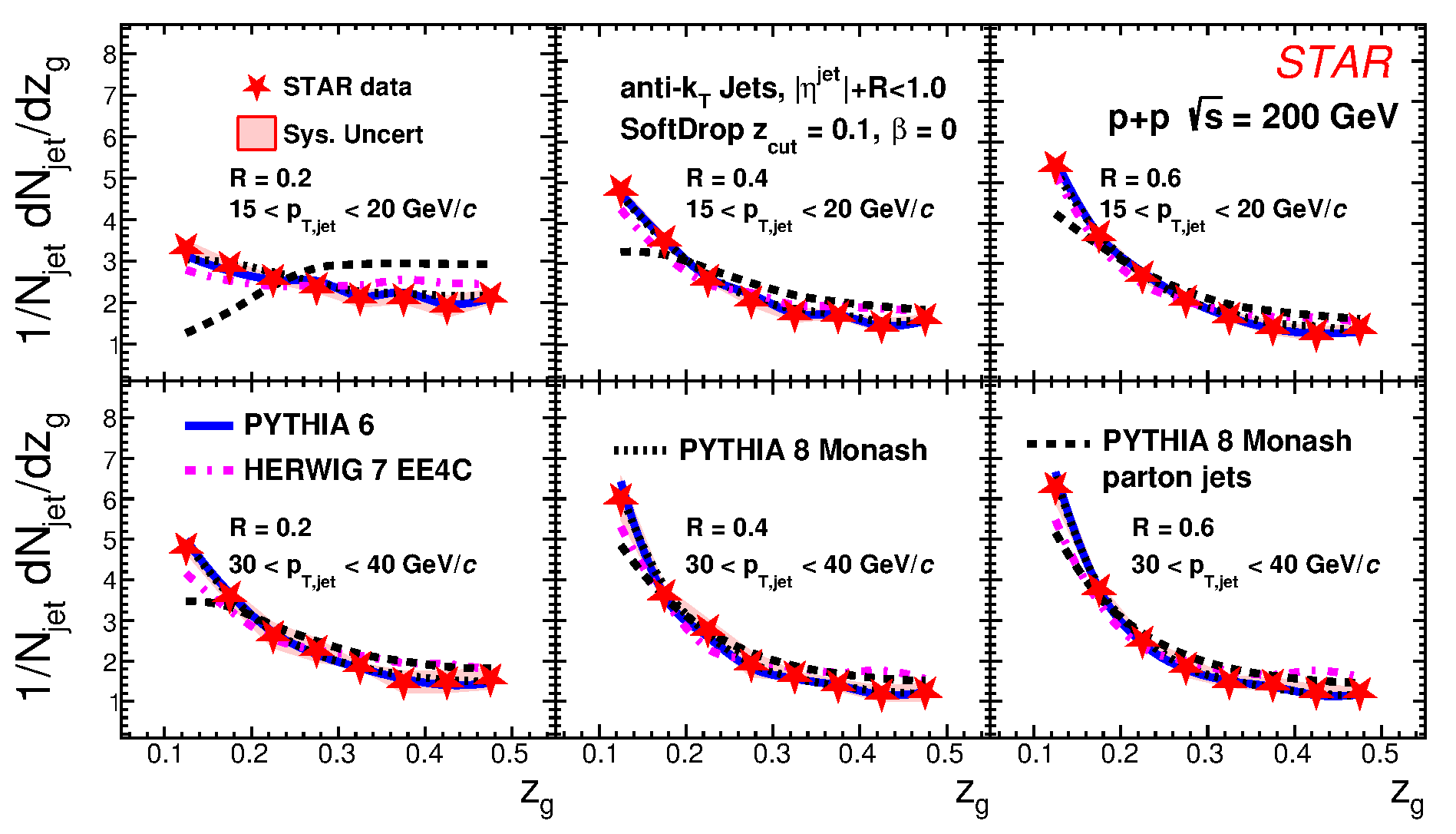
Figure: Radial scans of the SoftDrop $z_{\rm{g}}$ in pp collisions at $\sqrt{s} = 200$ GeV for
anti-k$_{\rm{T}}~R=0.2$ (left), $R=0.4$ (middle)
and $R=0.6$ (right) jets of varying transverse momenta ($15 < p_{\rm{T, jet}}< 20$ GeV/$c$ and $30 < p_{\rm{T, jet}} < 40$ GeV/$c$ in the top
and bottom rows respectively). The measurements are compared to various MC models shown in the colored lines.
|
|
The differential measurements enable radial and $p_{\rm{T}}$ scans of the jet substructure which show significant modifications to
the $z_{\rm{g}}$ shape for jets with smaller resolution parameters and lower $p_{\rm{T, jet}}$ with respect to the ideal DGLAP splitting function,
and do not reproduce the characteristic $1/z$ shape seen at higher $p_{\rm{T, jet}}$. We understand this as a consequence of significantly
constricting the phase space for radiation within the reconstructed jets.
We also compared our measurements to recent calculations at next-to-leading-log accuracy for $R_{\rm{g}}$. These
predictions are for jets at the parton level without non-perturbative corrections, with large systematic uncertainties arising from scale
variations close to $\Lambda_{QCD}$. We see large discrepancies between the calculations and data for all of the jet resolution parameters and
momenta except at the largest resolution parameter and highest $p_{\rm{T, jet}}$ where the scales are strictly perturbative. These comparisons
highlight the need for more realistic calculations, including corrections arising from non-perturbative effects and higher-order corrections at
small jet scales to further quantitatively understand the jet substructure at RHIC energies.
|
|
Posted December 1, 2020
|
|
|
STAR focus: Measurement of Inclusive $J/\psi$ Polarization in $p+p$ collisions at $\sqrt{s}$ = 200 GeV
|
|
The STAR Collaboration has recently published “Measurement of inclusive $J/\psi$ polarization in $p+p$ collisions at $\sqrt{s}$ = 200 GeV by the STAR
experiment” in Physical Review D 102, 092009.
The $J/\psi$ meson, a bound state of charm quark and its anti-quark, is one of the simplest systems in Quantum Chromodynamics (QCD). It was
discovered in 1974 but its production mechanism in elementary particle collisions is still not fully understood. One of the difficulties is that the
transition from charm and anti-charm quark interstate to the final-state color neutral meson involves soft processes, which cannot be calculated
perturbatively and has to rely on modeling. The most popular models on the market are the Color Singlet Model (CSM), Color Evaporation Model and
Non-relativistic QCD (NRQCD) framework. These models can describe the production yields measured from SPS to LHC energies reasonably well, but
could not match the measured polarization consistently. Measurements of $J/\psi$ polarization provide powerful tests and constraints on
modelling the $J/\psi$ production mechanism in vacuum.
The polarization parameters are measured via the angular distributions of the decayed leptons in the rest frame of the $J/\psi$ with respect to a
certain quantization axis (reference frame). This paper presents the first measurement of inclusive $J/\psi$ polarization parameters
$\lambda_\theta$, $\lambda_\phi$, $\lambda_{\theta\phi}$ in two reference frames (Helicity frame and Collis-Soper frame) via both di-electron and
di-muon decay channels. The results are shown as a function of transverse momentum in the figure and compared to calculations from various theoretical
models. The inclusive $J/\psi$’s do not exhibit significant transverse or longitudinal polarization. Among several model calculations, the NRQCD coupled
with Color-Glass-Condensate (CGC) implementation agrees the best overall with data. The data presented in this paper provide additional tests and
valuable guidance for theoretical efforts towards a complete understanding of the $J/\psi$ production mechanism in vacuum.
|
|
|
|
Figure: $J/\psi$ polarization parameters $\lambda_\theta$, $\lambda_\phi$, $\lambda_{\theta\phi}$ as a function of transverse momentum in
Helicity frame (Left) and Collis-Soper frame (Right) in $p+p$ collisions at $\sqrt{s}$ = 200 GeV measured through di-electron and di-muon decay
channels. Results are compared to various theoretical model calculations.
|
|
Posted November 30, 2020
|
|
|
STAR focus: Strange Hadron Production in Au+Au collisions at $\sqrt{s_{\rm{NN}}}$ = 7.7, 11.5, 19.6, 27, and 39 GeV
|
|
The STAR Collaboration has recently published "Strange hadron production in Au+Au collisions
at $\sqrt{s_{\rm{NN}}}$ = 7.7, 11.5, 19.6, 27, and 39 GeV"
in Physical Review C 102, 034909 (2020) and
it is also highlighted as PRC Editors' Suggestion.
Strange hadrons are an excellent probe for identifying the phase boundary and onset of deconfinement in the QCD phase diagram.
The STAR Collaboration has performed precision measurements of strange hadron
($\mathrm{K}^{0}_{\mathrm S}$, $\Lambda$, $\overline{\Lambda}$, $\Xi^-$, $\overline{\Xi}^+$, $\Omega^-$, $\overline{\Omega}^+$, and $\phi$)
production at mid-rapidity ($|y| < 0.5$) in Au+Au collisions at $\sqrt{s_{\rm{NN}}}$ = 7.7, 11.5, 19.6, 27, and 39 GeV from the Beam Energy
Scan Program at the Relativistic Heavy Ion Collider (RHIC). Transverse momentum spectra, averaged transverse mass, and the overall integrated
yields of these strange hadrons have been extracted with high precision for all centralities and collision energies. Generally, the STAR BES
data follow the trend of the previous measurements from AGS, SPS and RHIC. But the precision data also reveal new features, such as the deviation
of $\overline{\Lambda}$ and $\Lambda$ $\left< m_{\rm T}\right>-m_0$ at lower energies and the non-monotonic energy dependence
of $\Lambda$ and $\Xi^-$ $dN/dy$. The thermal model has been tested with the measured antibaryon-to-baryon ratios
($\overline{\Lambda}$/$\Lambda$, $\overline{\Xi}^+$/$\Xi^-$, $\overline{\Omega}^+$/$\Omega^-$), and then the temperature normalized strangeness
and baryon chemical potentials at hadronic freeze-out ($\mu_{B}/T_{\rm ch}$ and $\mu_{S}/T_{\rm ch}$) are extracted for central collisions.
The strange baryon-to-pion ratios are found to be consistent with the calculations of the statistical hadron gas model, and
for $\Lambda$/$\pi$ ratio, consistent with hadronic transport models as well.
The nuclear modification factors ($R_{\tiny{\textrm{CP}}}$) and antibaryon-to-meson ratios as a function of transverse momentum are presented
for all collision energies, and they are shown in the left and right figures, respectively.
The $\mathrm{K}^{0}_{\mathrm S}$ $R_{\tiny{\textrm{CP}}}$ shows no suppression for $p_{\rm T}$ up to 3.5 $\mbox{$\mathrm{GeV} / c$}$ at
energies of 7.7 and 11.5 GeV. The $\overline{\Lambda}$/$\mathrm{K}^{0}_{\mathrm S}$ ratio also shows baryon-to-meson enhancement at
intermediate $p_{\rm T}$ ($\approx$2.5 $\mbox{$\mathrm{GeV} / c$}$) in central collisions at energies above 19.6 GeV. Both observations suggest
that there is likely a change of the underlying strange quark dynamics at collision energies below 19.6 GeV.
|
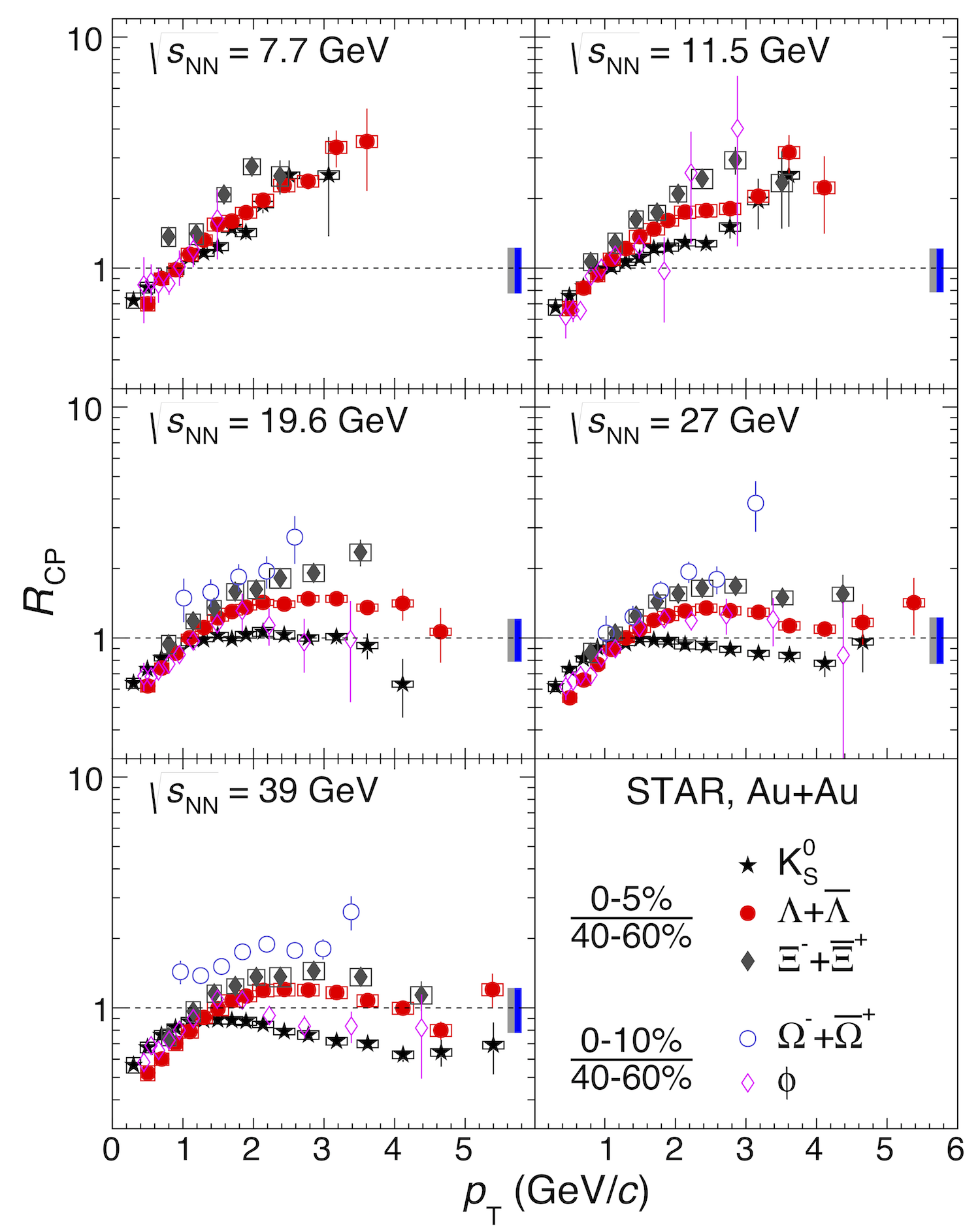
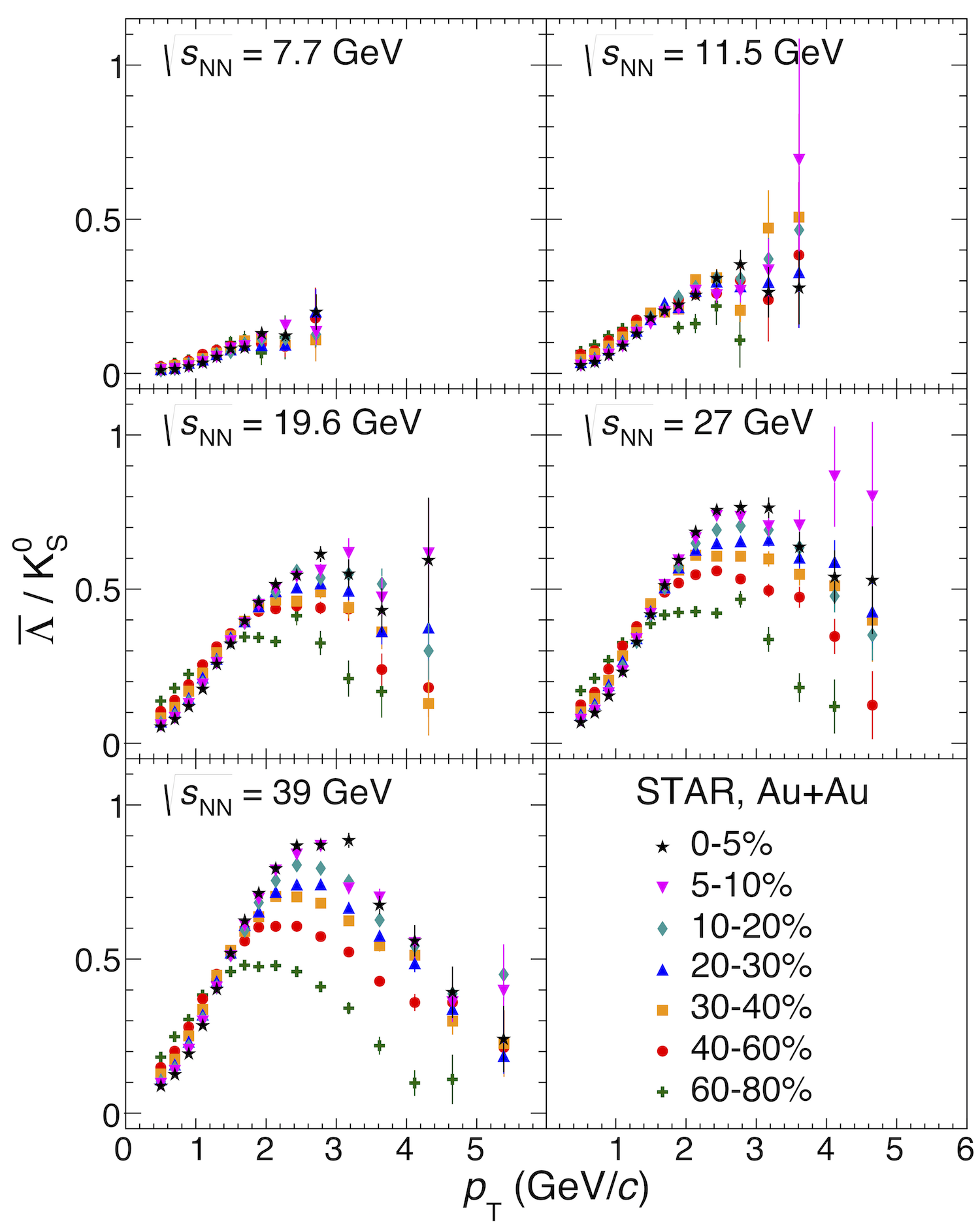
|
|
Left: The nuclear modifcation factor ($R_{\tiny{\textrm{CP}}}$) of strange hadrons at mid-rapidity ($|y|<0.5$) in Au+Au collisions
at $\sqrt{s_{\rm{NN}}}$ = $7.7-39$ GeV.
Right: $\overline{\Lambda}$/$\mathrm{K}^{0}_{\mathrm S}$ ratio versus $p_{\rm T}$ at mid-rapidity ($|y|<0.5$) in different centralities
from Au+Au collisions at $\sqrt{s_{\rm{NN}}}$ = $7.7-39$ GeV.
|
|
|
The results in this paper significantly improve the experimental knowledge in the energy range where key features of the QCD phase diagram
are nowadays being studied. For more details on the analysis and discussion of the results see the full
paper here.
|
|
Posted October 5, 2020
|
|
|
STAR focus:
Precise Measurement of the Mass Difference and the Binding Energy of the Hypertriton and Antihypertriton at STAR
|
|
In March 2020, the STAR Collaboration published "Measurement of the mass difference and the binding energy of the
hypertriton and antihypertriton" in
Nature Physics.
In this paper, we present two measurements from gold-gold collisions at a center-of-mass energy per nucleon pair of
$\sqrt{s_{NN}} = 200$ GeV: the relative mass difference between $\rm^3_\Lambda H$ (the hypertriton) and $\rm^3_{\bar{\Lambda}}\overline{H}$
(the antihypertriton) (see Fig. 1), as well as the $\Lambda$ hyperon binding energy for $\rm^3_\Lambda H$ and $\rm^3_{\bar{\Lambda}}\overline{H}$
(see Fig. 2). The hypernucleus $\rm^3_{\Lambda}H$ is reconstructed through its mesonic decay channels
$\rm^3_{\Lambda}H \rightarrow {^3}He + \pi^-$ (2-body decay) and $\rm^3_{\Lambda}H \rightarrow$ $ d + p + \pi^-$ (3-body decay).
The significance $S/ \sqrt{S+B}$, where $S$ is signal counts and $B$ is background counts in the invariant mass window
$2.986 - 2.996$ GeV$/c^{2}$, is 11.4 for $^3_\Lambda$H and 6.4 for $\rm^3_{\bar{\Lambda}}\overline{H}$.
The signal counts from 2-body/3-body decay channels are about 121/35 for $^3_\Lambda$H and 36/21 for $\rm^3_{\bar{\Lambda}}\overline{H}$,
respectively.
According to the CPT theorem, which states that the combined operation of charge conjugation, parity transformation and time reversal must be
conserved, particles and their antiparticles should have the same mass and lifetime but opposite charge and magnetic moment. Here, we test CPT
symmetry in a nucleus containing a strange quark, more specifically in the hypertriton. A comparison of the masses of the hypertriton and the
antihypertriton allows us to test CPT symmetry in a nucleus with strangeness for the first time, and we observe no deviation from the expected
exact symmetry with precision of 10$^{-4}$.
This hypernucleus is the lightest one yet discovered and consists of a proton, a neutron, and a $\Lambda$ hyperon. We measure the
$\Lambda$ hyperon binding energy $B_{\Lambda}$ for the hypertriton, and find that it differs from the widely used value and from
predictions, where the hypertriton is treated as a weakly bound system. Our results place stringent constraints on the hyperon-nucleon
interaction, and have implications for understanding neutron star interiors, where strange matter may be present.
|
Fig 1: Measurements of the relative mass-to-charge ratio differences between nuclei and antinuclei. The current measurement of the
relative mass difference ${\Delta m}/m$ between $^3_\Lambda$H and $\rm^3_{\bar{\Lambda}}\overline{H}$ constrained
by the existing experimental limits for decay daughters is shown by the red star marker. The green point is the new $^{3}$He result after
applying the constraint provided by the present $^{3}_{\Lambda}$H result. The differences between $d$ and $\bar{d}$ and
between $^3$He and $\rm^3\overline{He}$ measured by the ALICE collaboration are also shown. The two $^3$He - $\rm^3\overline{He}$ points
are staggered vertically for visibility. The dotted vertical line at zero is the expectation from CPT invariance. The horizontal error bars
represent the sum in quadrature of statistical and systematic uncertainties.
|
|
Read More
Posted March 10, 2020
|
|
|
STAR focus: Polarization of Λ (Λ) hyperons along the beam
direction in Au+Au collisions at $\sqrt{s_{\rm{NN}}}$ = 200 GeV
|
|
The STAR Collaboration has recently published
“Polarization of Λ (Λ) hyperons along the beam direction
in Au+Au collisions at collisions at $\sqrt{s_{\rm{NN}}}$ = 200 GeV”
in
Physical Review Letter 123, 132301.
This paper reports on the first ever measurements of the Λ hyperon polarization
along the beam direction in heavy-ion collisions.
In a non-central heavy-ion collision, the system expands stronger
in the reaction plane direction compared to that in the out-of-plane direction, a phenomenon known as elliptic flow.
Such nontrivial velocity fields lead to a non-zero vorticity component along the beam direction
dependent on the azimuthal angle of fluid elements relative to the reaction plane (see left figure), and therefore to particle spin polarization.
Spin polarization can be experimentally measured via hyperons parity-violating weak decay.
|
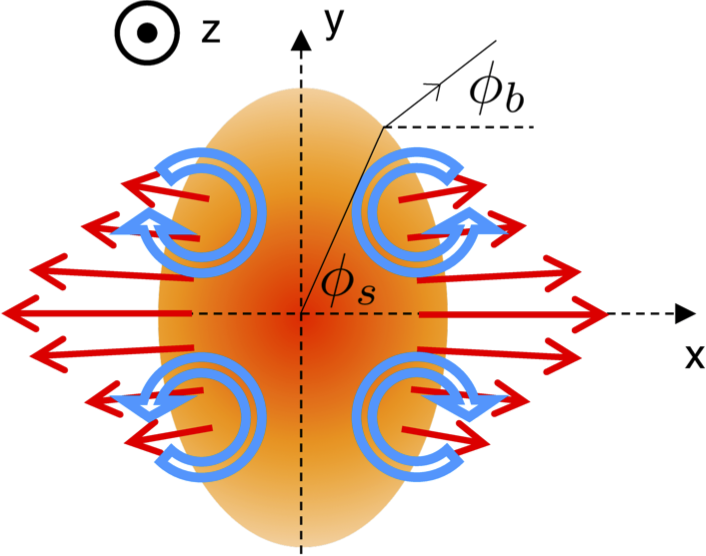
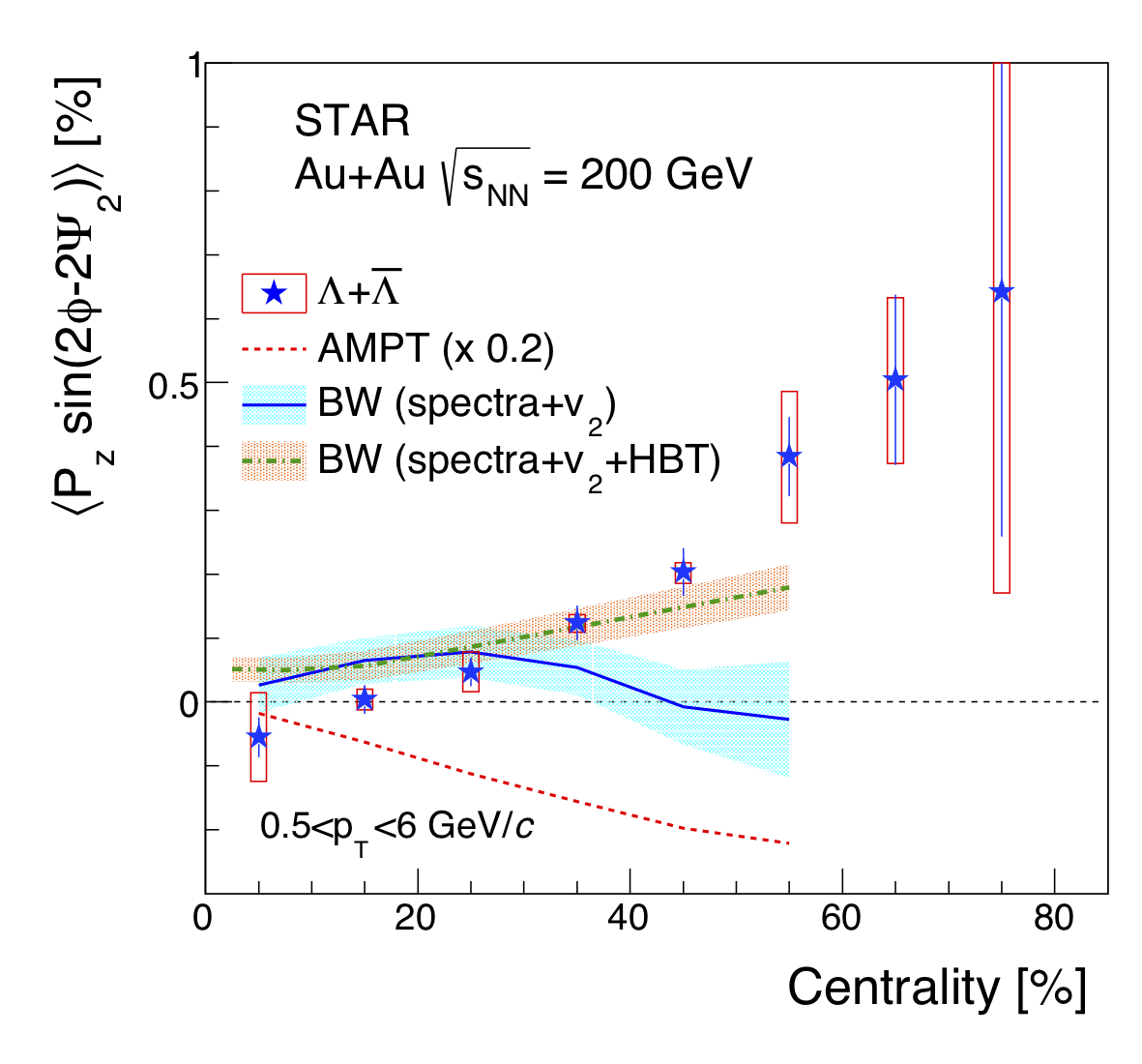
|
|
Left:
A sketch illustrating the system created in a non-central heavy-ion collision
viewed in the transverse plane (x-y), showing stronger in-plane expansion (solid arrows)
and expected vorticities (open arrows). In this figure the colliding beams are
oriented along the z-axis and the x-z plane defines the reaction plane.
Right:
The second Fourier sine coefficient of the polarization of Λ and Λ along
the beam direction as
a function of centrality in Au+Au collisions at 200 GeV.
Results using Λ hyperons at 200 GeV exhibit Λ's emission angle dependence of the polarization
along the beam direction, as expected from elliptic flow, indicating a quadrupole pattern of
the vorticity z-component. Right figure presents a sine modulation of the polarization relative
to the reaction plane angle as a function of collision centrality. The observed phase of the sine modulation
is opposite to some theoretical predictions, e.g. a multi-phase transport model (AMPT) and viscous hydrodynamic model.
In contrast, the blast-wave model calculations representing the kinematic vorticity reproduce the modulation phase better.
These results together with the results of the global polarization
(Nature 548, 62 (2017),
PRC98, 014910 (2018))
may provide information on the relaxation time needed to convert the vorticity to particle polarization.
|
|
Posted October 24, 2019
|
|
|
STAR focus:
Measurements of inclusive $J/\psi$ suppression in Au+Au collisions at $\sqrt{s_{\rm{NN}}}$ = 200 GeV through the dimuon channel
|
|
The STAR Collaboration has recently published "Measurements of inclusive $J/\psi$ suppression
in Au+Au collisions at $\sqrt{s_{\rm{NN}}}$ = 200 GeV through the dimuon channel at STAR"
in Phys. Lett. B 797 (2019) 134917.
This publication reports the first measurement of inclusive $J/\psi$ suppression at mid-rapidity
through the dimuon decay channel in Au+Au collisions at $\sqrt{s_{\rm{NN}}}$ = 200 GeV. It is made possible
thanks to the Muon Telescope Detector upgrade completed in 2014 at STAR. Among the various probes
used to study the existence and properties of the Quark Gluon Plasma (QGP) created in relativistic heavy-ion
collisions, quarkonia are considered a unique one. A fundamental feature of the QGP is that partons, instead
of hadrons, are the relevant degrees of freedom of the system. Quarkonia are expected to exist as hadrons
in the QGP until the Debye radius, which is inversely proportional to the medium temperature, becomes smaller
than the quarkonium size. Under such conditions, the color-screening effect would lead to dissociation of
the quarkonia in the medium. This can be observed experimentally through measurements of $J/\psi$ suppression in
heavy-ion collisions with respect to that in p+p collisions. Such a suppression is believed to be unambiguous
evidence of the QGP formation.
The figure below shows the $J/\psi$ RAA, used to quantify the suppression level, as a function of
centrality for pT > 0.15 GeV/c and pT > 5 GeV/c in Au+Au collisions
at $\sqrt{s_{\rm{NN}}}$ = 200 GeV. At both low and high pT, the $J/\psi$ RAA is seen to
decrease from peripheral to central collisions, consistent with increasing hot medium effects.
|
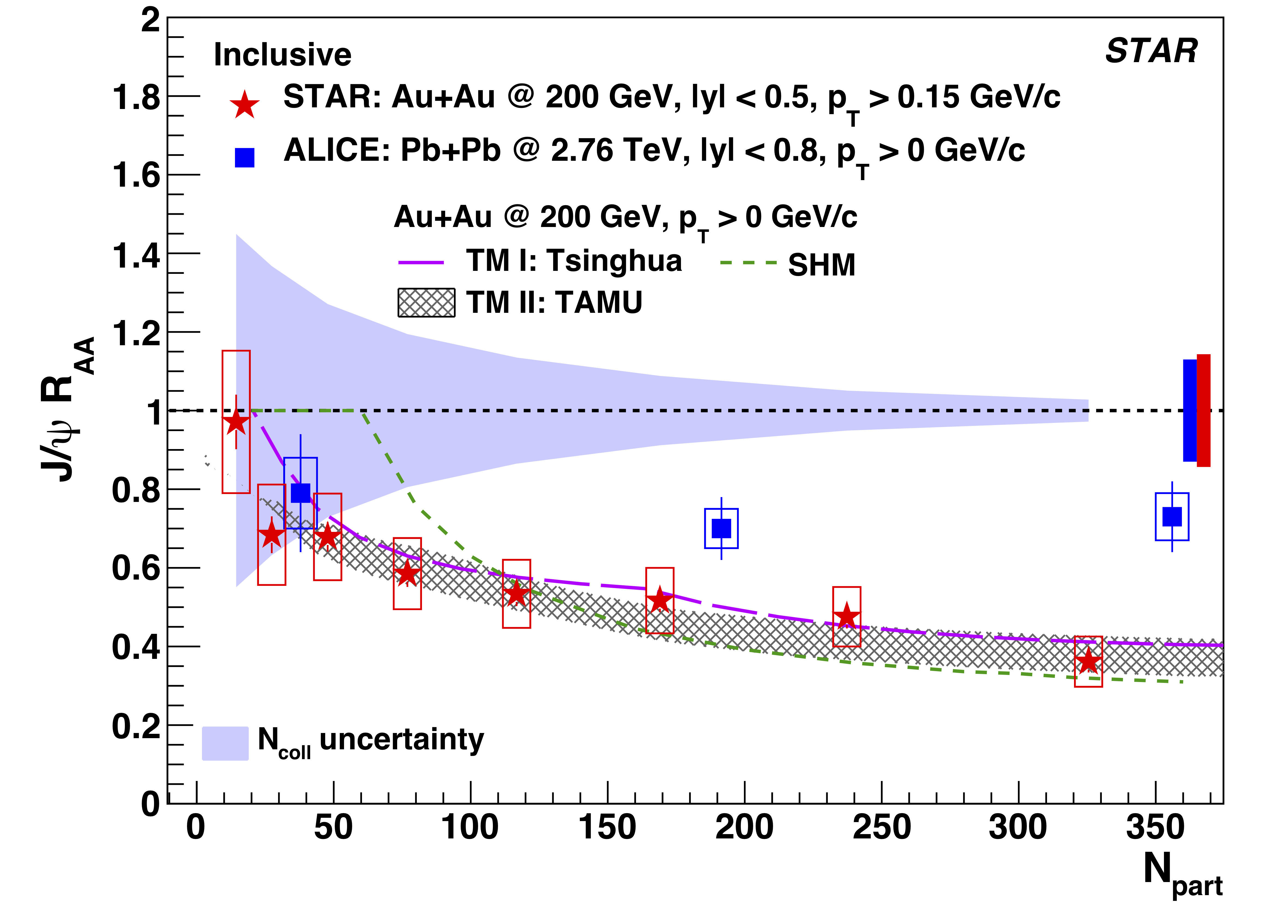
|
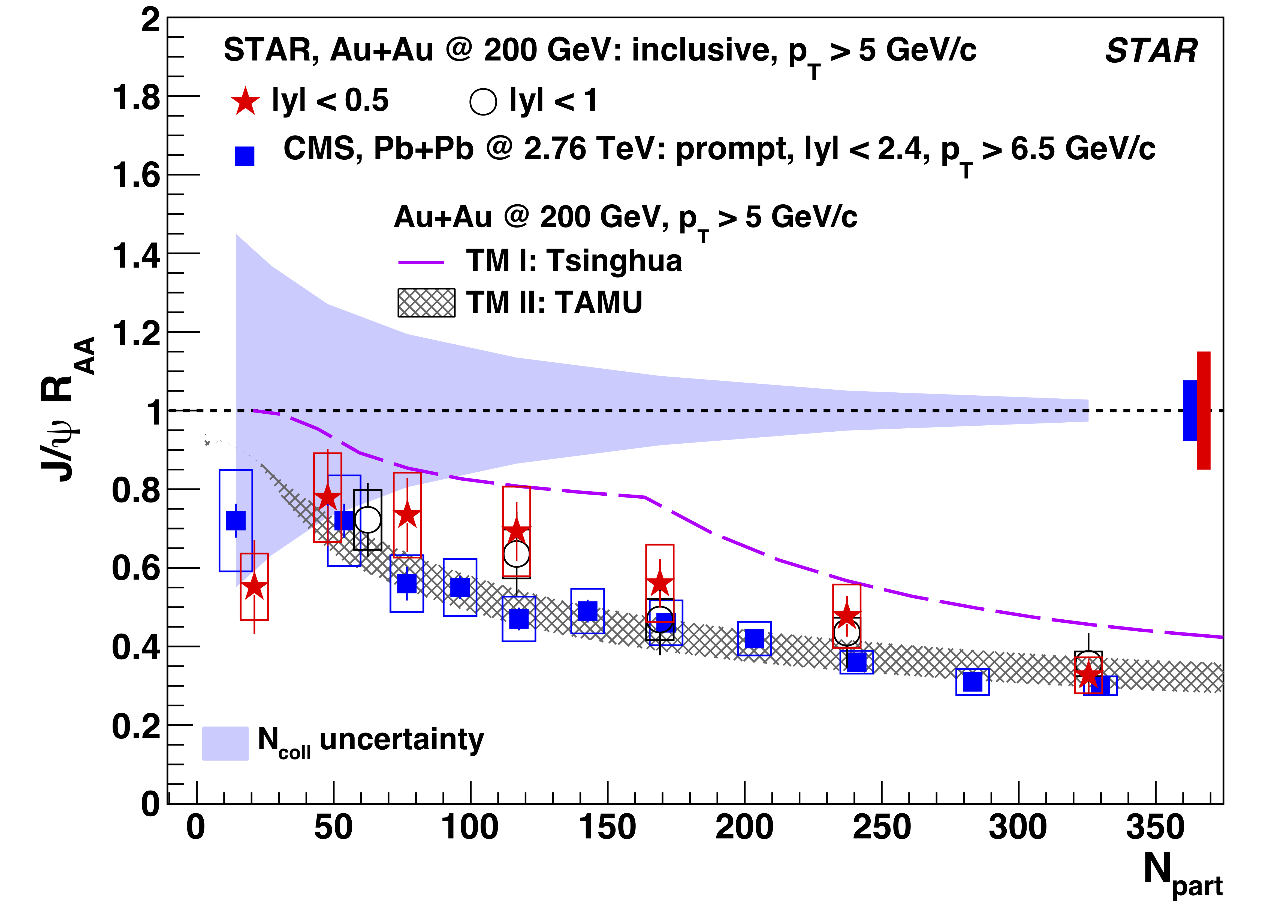
|
|
Figure: $J/\psi$ RAA as a function of centrality above 0.15 (left) and 5 (right) GeV/c in Au+Au
collisions at $\sqrt{s_{\rm{NN}}}$ = 200 GeV, compared to those for Pb+Pb collisions at $\sqrt{s_{\rm{NN}}}$ = 2.76 TeV.
|
|
For high-pT $J/\psi$, where the cold nuclear matter effects and the regeneration contribution are
expected to be minimal, the $J/\psi$ production in 0-10% central collisions is suppressed by a factor of 3.1, providing strong
evidence for the color-screening effect in a deconfined medium. Compared to similar measurements carried out for Pb+Pb collisions
at $\sqrt{s_{\rm{NN}}}$ = 2.76 TeV, the low-pT $J/\psi$'s are much more suppressed in central and semi-central collisions
at RHIC than at the LHC, likely due to the smaller charm quark production cross-section and thus smaller regeneration contribution at
RHIC. On the Other hand, there is a hint that the high-pT $J/\psi$ RAA is systematically higher at
RHIC for semi-central bins. This could be because the temperature of the medium created at the LHC is higher than that at RHIC,
leading to a higher dissociation rate. The new results presented in this publication could help constrain model calculations and
deepen our understanding of the QGP properties.
|
|
Posted October 24, 2019
|
|
|
STAR focus:
Measurements of the transverse-momentum-dependent cross sections of $J/\psi$ production at mid-rapidity in proton+proton
collisions at $\sqrt{s}$ = 510 and 500 GeV
|
|
The STAR Collaboration has recently published "Measurements of the transverse-momentum-dependent cross sections
of $J/\psi$ production at mid-rapidity in proton+proton collisions at $\sqrt{s}$ = 510 and 500 GeV with the STAR
detector" in Physical Review D 100, 052009 (2019).
The $J/\psi$ meson is a subatomic particle, a bound state of charm and anticharm quarks, which was discovered in 1974
at Brookhaven National Laboratory (BNL) and Standford Linear Accelerator Center. However, the $J/\psi$ production mechanism
is still not yet fully understood after several decades of the discovery. Therefore, it is important to continue confronting
the models that incorporate the most current understanding with new data.
Relativistic Heavy-Ion Collider (RHIC) at BNL provides a unique collision energy to study the detailed production mechanism of the
$J/\psi$. In addition, in 2013-2014 the STAR detector has implemented a new subdetector dedicated for muon detection, the Muon Telescope Detector (M$
and this provides us an opportunity to probe the low-pT region of the $J/\psi$ production.
This publication presents the $J/\psi$ meson production cross sections in proton+proton collisions at center-of-mass energies of 510 and
500 GeV using the μ+μ- and e+e- decay channels to probe low-pT and
high-pT regions, respectively.
|
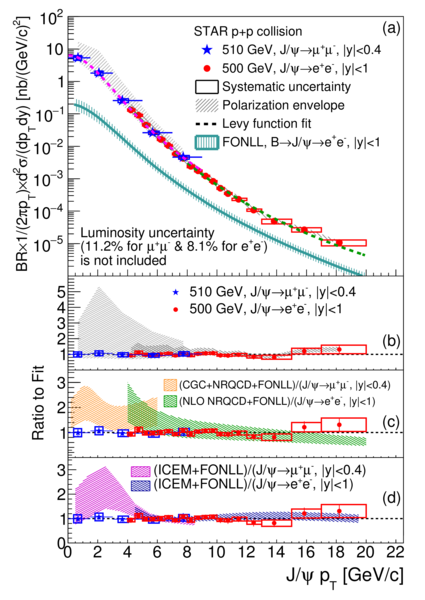
|
FIG: (a) The $J/\psi$ differential full production cross sections as a function of $p_{T}^{J/\psi}$ in proton+proton collisions at
$\sqrt{s}$ = 510 and 500 GeV measured through the $\mu^{+}\mu^{-}$ (blue stars) and $e^{+}e^{-}$ decay channels (red circles). The
shaded region around the data points denotes the polarization envelope and the green curve is the estimation of the B-hadron feed-down
from FONLL.
(b, c, d) Ratios of data and different model calculations to the Levy fit function.
|
|
|
Read More
Posted October 24, 2019
|
|
|
STAR focus: STAR uses weak bosons to probe the spin structure of the proton
|
|
The STAR Collaboration has recently published,
“Measurement of the longitudinal spin asymmetries
for weak boson production in proton-proton
collisions at √s = 510 GeV,”
in
Physical Review D 99, 051102(R).
This paper reports on measurements of the
parity-violating asymmetry in the production of
positrons and electrons from decays of weak bosons
from collisions with one of the proton beams
polarized longitudinally. In 510 GeV center-of-mass
proton-proton collisions at RHIC, W+ bosons are
produced primarily in the interactions of up quarks
and down antiquarks, whereas W- bosons originate
from down quarks and up antiquarks. The
spin-asymmetry measurements of the decay positrons
thus provide sensitivity to the up quark and down
antiquark helicities in the proton, whereas the
decay electrons do so for the down quark and up
antiquark helicities. Combined, they make it
possible to delineate the light quark and antiquark
polarizations in the proton by flavor.
|
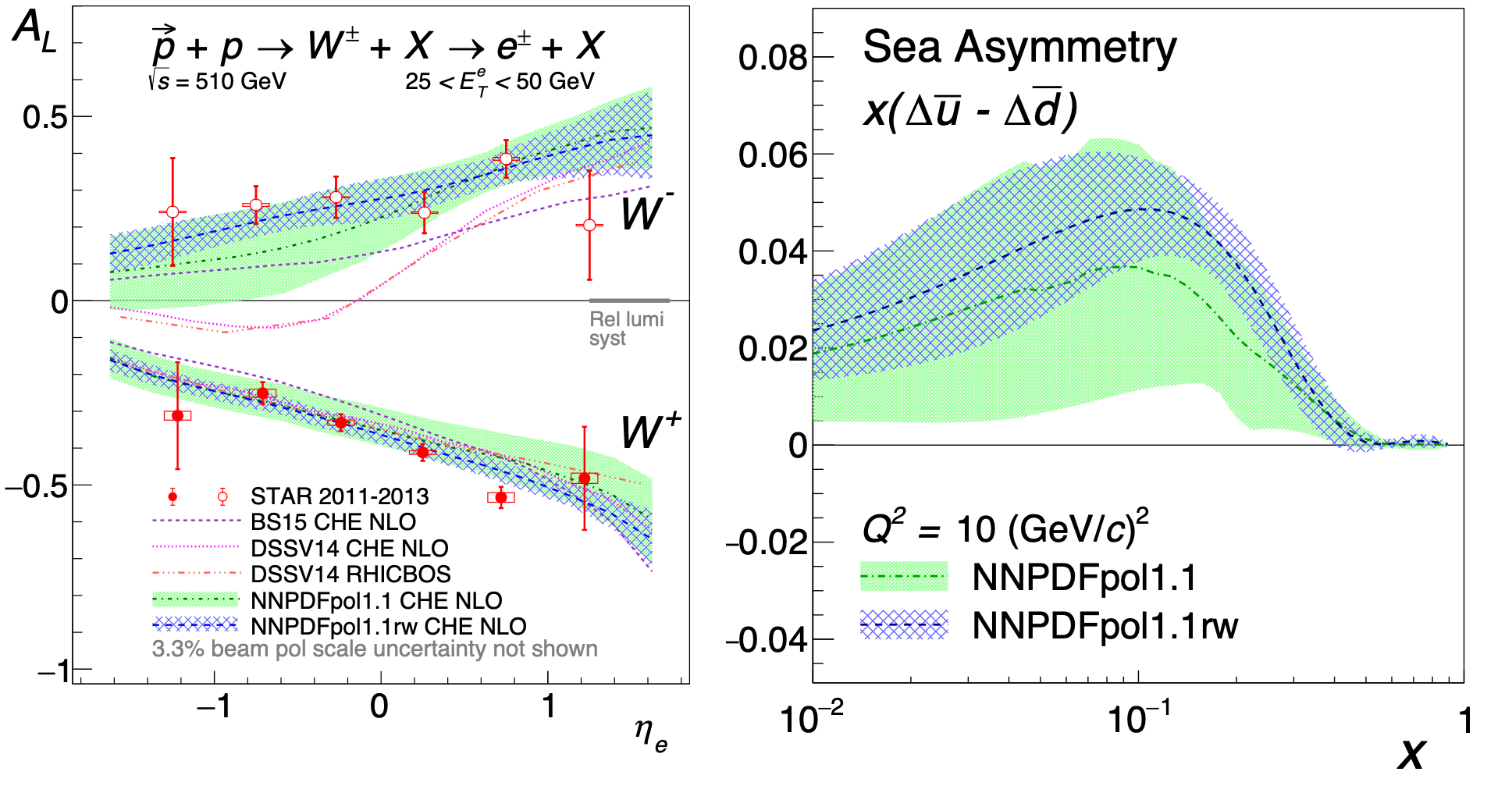
|
|
Left: Longitudinal single-spin
asymmetries, AL,
for W± production as a
function of the positron or electron
pseudorapidity, ηe, for the
combined STAR 2011, 2012 and 2013 data samples for 25
< ET < 50GeV (points) in
comparison to theory expectations (curves and
bands). Right: The difference of the light
sea-quark polarizations as a function of x at a
scale of Q2 =
10(GeV/c)2. The green band shows the
NNPDFpol1.1 results and the blue hatched band shows
the corresponding distribution after the STAR 2013
W± data are included by reweighting.
These measurements provided one of the two initial
motivations for the spin-physics program at RHIC and
the data, shown in the left panel of the figure above,
are the final data from STAR on this topic. Shown are
the results from previously published data obtained in
2011 and 2012 combined with new results from the
dedicated RHIC run in 2013. As seen from the right
panel, the data have now reached a level of precision
that makes it possible, for the first time, to
conclude that the polarization of up antiquarks is
larger than that of the down antiquarks.
|
|
Posted March 27, 2019
BNL News
|
|
|
STAR focus: Precise Measurements of the Open Charm Meson Prodution at STAR
|
|
The STAR Collaboration has recently published
“Centrality and transverse momentum dependence of
D0-meson production at mid-rapidity in Au +
Au collisions at √sNN = 200 GeV,”
in Physical
Review C 99, 034908 (2019).
This paper presents a new measurement of D0 meson
production enabled by the Heavy Flavor Tracker (HFT)
high-resolution silicon detector system in Au + Au
collisions at √sNN = 200 GeV. Compared to the previous
measurement with the TPC only, the new data contain
greatly improved precision which allows us to
systematically investigate the D0 meson production in
wide centrality and transverse momentum regions. The
new improved data are expected to further constrain
our understanding of the charm medium interaction as
well as to better determine the medium transport
parameters together with the previous publication on
D0 elliptic flow measurement.
|
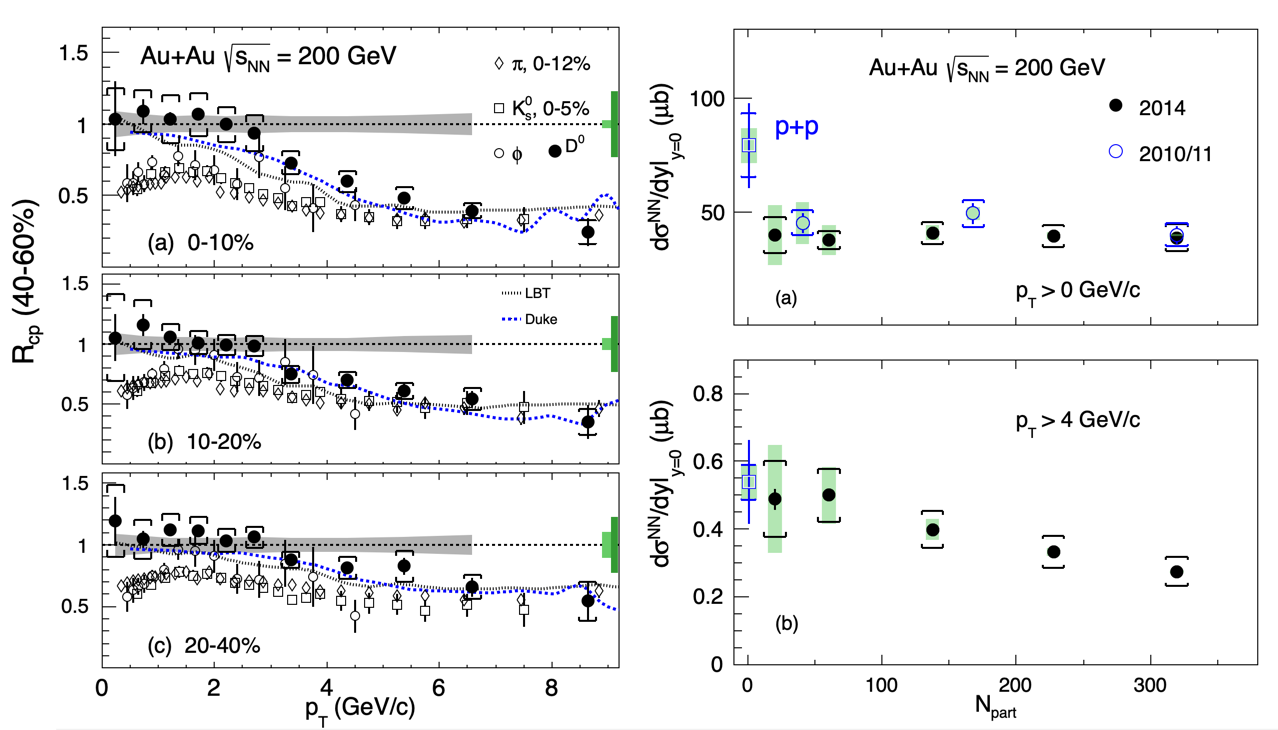
|
|
Left: D0 RCP for different centrality
classes with the 40–60% spectrum as the reference
compared to that of other light and strange mesons (π,
Κs, and φ) as well as the
model calculations. Right:
Integrated D0 cross section per
nucleon-nucleon collision at mid-rapidity
for pT > 0 (a)
and pT > 4 GeV/c (b) as a
function of centrality Npart. The green boxes on the
data points depict the overall normalization
uncertainties in p + p and Au + Au data
respectively.
The nuclear modification factors RCP
of D0 meson are shown in the left
figure, and show significantly suppression at
high pT and the suppression level is
comparable to that of light hadrons
at pT > 5 GeV/c, indicates
that charm quarks lose significant energy when
traversing through the hot QCD medium. Right figure
shows
the pT-integrated D0
production cross section per nucleon-nucleon
collisions in Au + Au collisions together with the
measurement in p + p. The
full-pT integrated cross section in
Au + Au collisions seem to be smaller than that
in p + p collisions by 1.5σ,
indicating that cold nuclear matter effects (CNM)
and/or hadronization through quark coalescence may
play an important role in Au + Au collisions. While
for pT > 4 GeV/c, it shows a clear
decreasing trend from peripheral to mid-central and
central collisions.
|
|
Read more
Posted March 27, 2019
|
|
|
STAR focus:
Azimuthal harmonics in small and large collision systems at RHIC top
energies
|
|
The STAR Collaboration has recently published, Azimuthal Harmonics in Small
and Large Collision Systems at RHIC Top Energies,
in Physical
Review Letter, 122, 172301(2019).
This publication reports and compares recent integral and differential
measurements (obtained with the STAR TPC), of the flow harmonics ($v_n, n=1-3$)
for charged hadrons produced in U+U collisions ($\sqrt{s_{{NN}}}$ = 193 GeV) and
Au+Au, Cu+Au, Cu+Cu, d+Au, and p+Au collisions ($\sqrt{s_{{NN}}}$ = 200 GeV).
The measurements for these disparate collision-systems, allow systematic
variations of the initial-state eccentricity and its fluctuations, as well as
the size of the produced fireball at approximately the same collision
energy. All are expected to influence the magnitude of $v_n$. The comparisons
between the measurements for these small, medium and large collision systems,
give unique insights into the role of final-state interactions as the
collision-system size is varied. Similarly, the measurements provide more
discerning constraints which can aid extraction of the temperature-dependent
specific shear viscosity of the hot and dense media created in the
collisions.
|
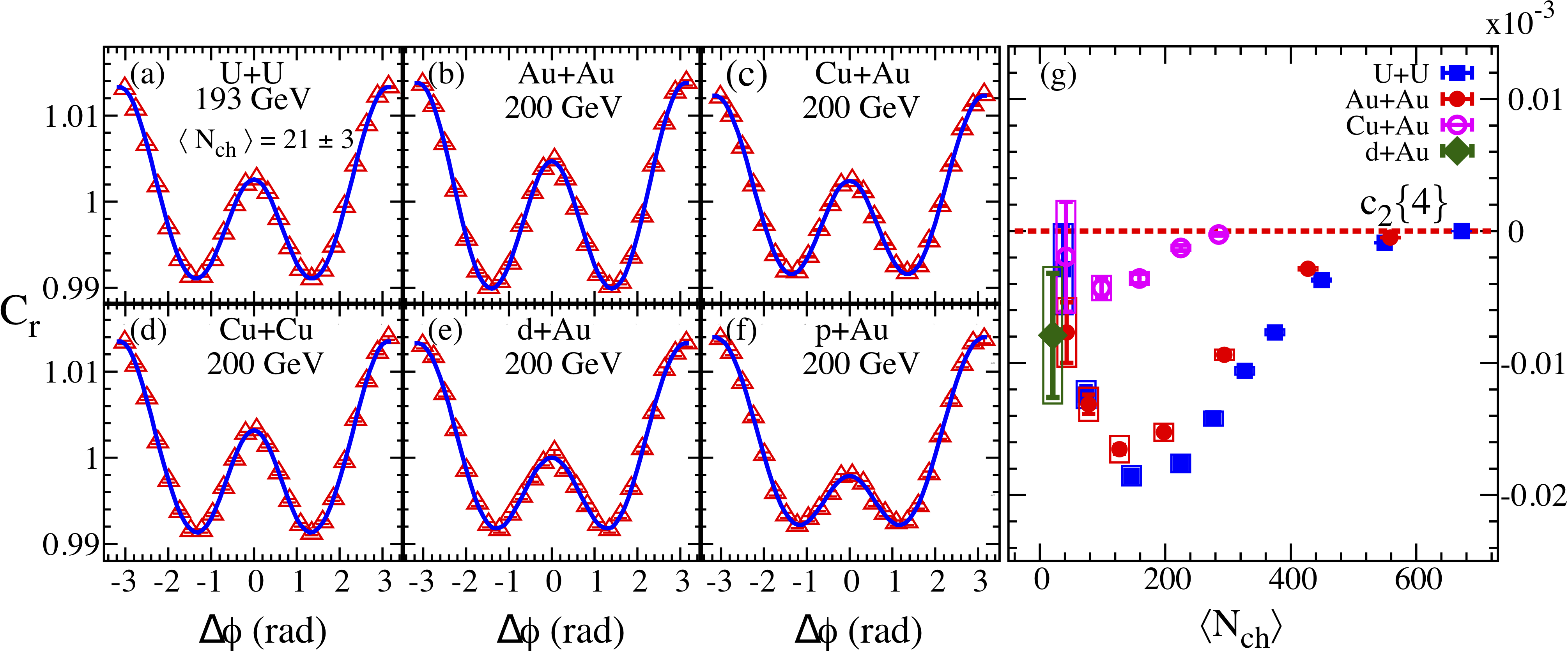
Two-particle azimuthal
correlation functions (a-f) and four-particle cumulants (g) for pT-integrated
track pairs. Results are shown for U+U (a) collisions (193 GeV) and Au+Au (b),
Cu+Au (c), Cu+Cu (d), d+Au (e) and p+Au (f) collisions (200 GeV) for the same
charged particle multiplicity $N_{ch}$. Panel (g) shows the four-particle
second-order cumulant vs. $N_{ch}$, obtained with the three sub-events method
from the same data sets.
|
|
The measurements exploit both the two- and multi-particle correlation
techniques to extract $v_n$ as a function of the transverse momentum ($p_T$) and
mean charged particle multiplicity $N_{ch}$. The first figure shows
representative correlation functions (a-f) and four particle cumulants (g) which
accentuate the qualitative similarity between the charged particle azimuthal
distributions obtained for the full range of collision-system sizes. Further
quantitative study reveals that for a fixed value of $N_{ch}$, the
$v^{even}_{1}$ and $v_{3}$ coefficients are essentially independent of the
colliding species, indicating that for a given $N_{ch}$, the fluctuation-driven
initial-state eccentricities, $\varepsilon_{1}$ and $\varepsilon_{3}$, are
system independent. By contrast, the $v_{2}$ coefficients indicate sizeable
variations (for fixed $N_{ch}$) with the colliding species, showing the strong
collision-system dependence of the shape-driven eccentricity
$\varepsilon_{2}.$
|
|
Posted May 31, 2018
Read more
|
|
|
STAR focus: Collision Energy Dependence
of pt Correlations in Au+Au Collisions at RHIC
|
|
The STAR Collaboration recently has had the paper “Collision-energy
dependence of pt correlations in Au+Au collisions at energies available at the
BNL Relativistic Heavy Ion Collider” has published
in
Phys. Rev. C 99, 044918.
The study of event-by-event correlations and fluctuations in global
quantities can provide insight into the properties of the hot and dense matter
created in Au+Au collisions at RHIC. Correlations of transverse momentum, pt,
have been proposed as a measure of thermalization and as a probe for the
critical point of QCD. A detailed study of the of dependence of two-particle pt
correlations on collision energy and centrality may demonstrate the effects of
thermalization. If the matter produced in collisions at RHIC passes through the
QMD critical point, the fluctuations are predicted to increase with respect to a
baseline of uncorrelated emission. A possible signature of the critical point
could be non-monotonic behavior of the two-particle correlations as a function
of the collision energy in central collisions.
This paper reports two-particle transverse-momentum correlations from Au+Au
collisions taken during the RHIC Beam Energy Scan at center of mass energies
ranging from 7.7 GeV to 200 GeV. These measurements are compared to previous
measurements from the CERES Collaboration at the Super Proton Synchrotron and
from ALICE at the Large Hadron Collider. The data are compared with UrQMD
model calculations and with a model based on a Boltzmann-Langevin approach
incorporating effects from thermalization.
|
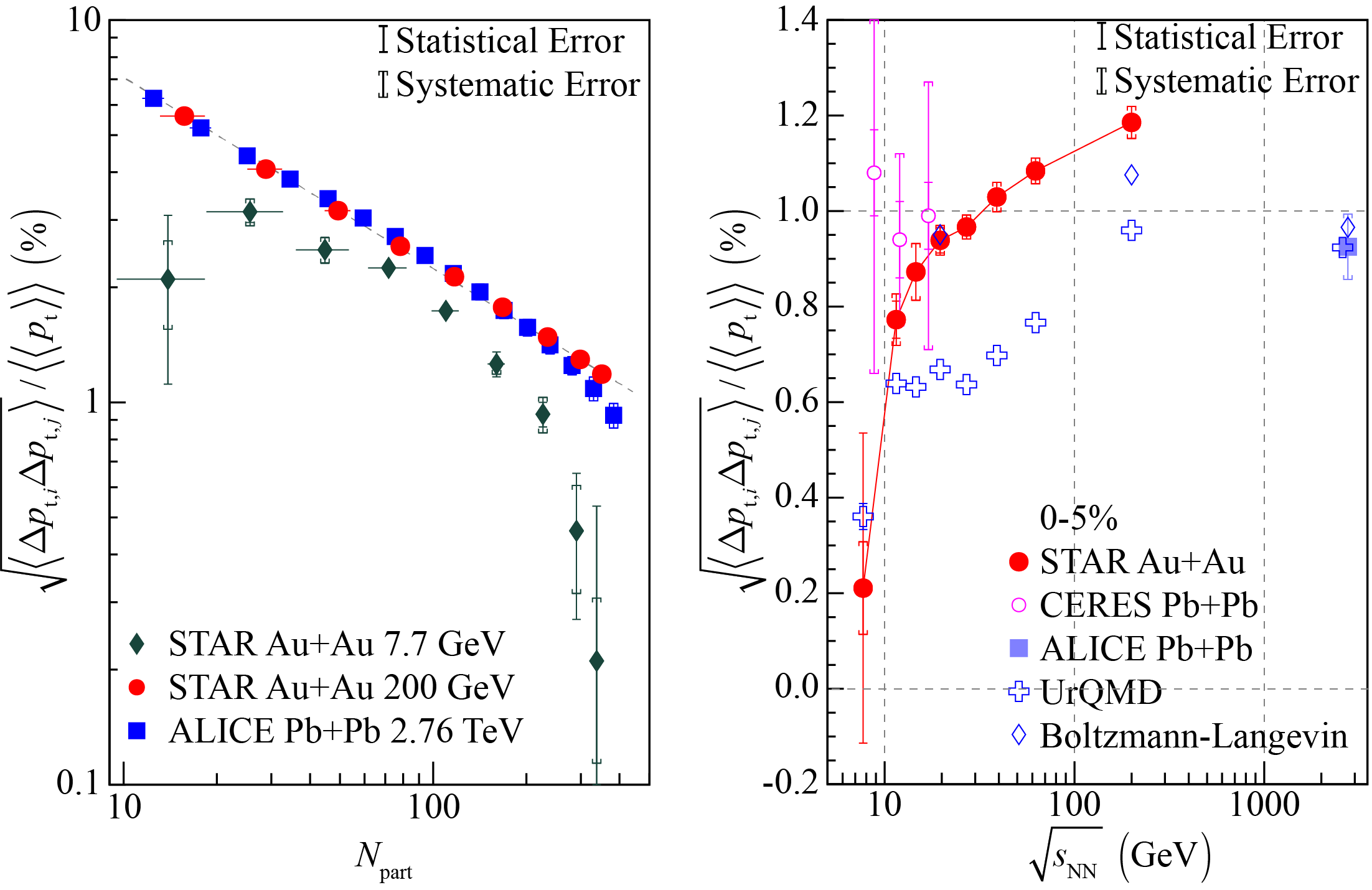
|
|
Left: The relative dynamical correlation for 7.7 GeV and 200 GeV Au+Au
collisions compare with similar results fron 2.76 TeV Pb+Pb collision. The
dashed line represents a fit to the data at 200 GeV given by
22.3%/(Npart)1/2. Statistical and systematic errors are shown. Right: The
relative dynamical correlation for Au+Au collisions as a function of collision
energy for the 0-5% centrality bin along with results for Pb+Pb collisions
from ALICE along with UrQMD calculations and results from Boltzmann-Langevin
model calculations. The solid line is drawn to guide the eye. Statistical
and systematic errors are shown.
|
|
Posted April 29, 2018
Read more
|
|
|
STAR focus: STAR uses photons to probe the structure of gold nuclei
|
|
The STAR Collaboration has recently published “Coherent diffractive photoproduction
of ρ0 mesons on gold nuclei at 200 GeV/nucleon-pair at the
Relativistic Heavy Ion Collider,”
in Physical
Review C 96, 054904 (2017).
This paper reports on a special type of heavy-ion interaction, where the ions do
not physically collide, but interact via a long-range electromagnetic interaction,
whereby photons emitted by one nucleus probe the structure of the other nucleus. The
photons come from the electric and magnetic fields carried by the highly charged
nuclei. The electric fields radiate radially outward, while magnetic fields circle
the ion’s trajectory. The two fields are perpendicular, just like those of a photon,
and they can be treated as such.
In the reaction considered here, the photon may be thought of as briefly
fluctuating to a quark-antiquark pair, as allowed by the Heisenberg uncertainty
principle. Quark-antiquark pairs are mesons; this photon fluctuation acts like a
meson with the same quantum numbers (spin one and negative parity) as the photon.
These virtual (short-lived) mesons can scatter from the target nucleus, and emerge as
real mesons.
|
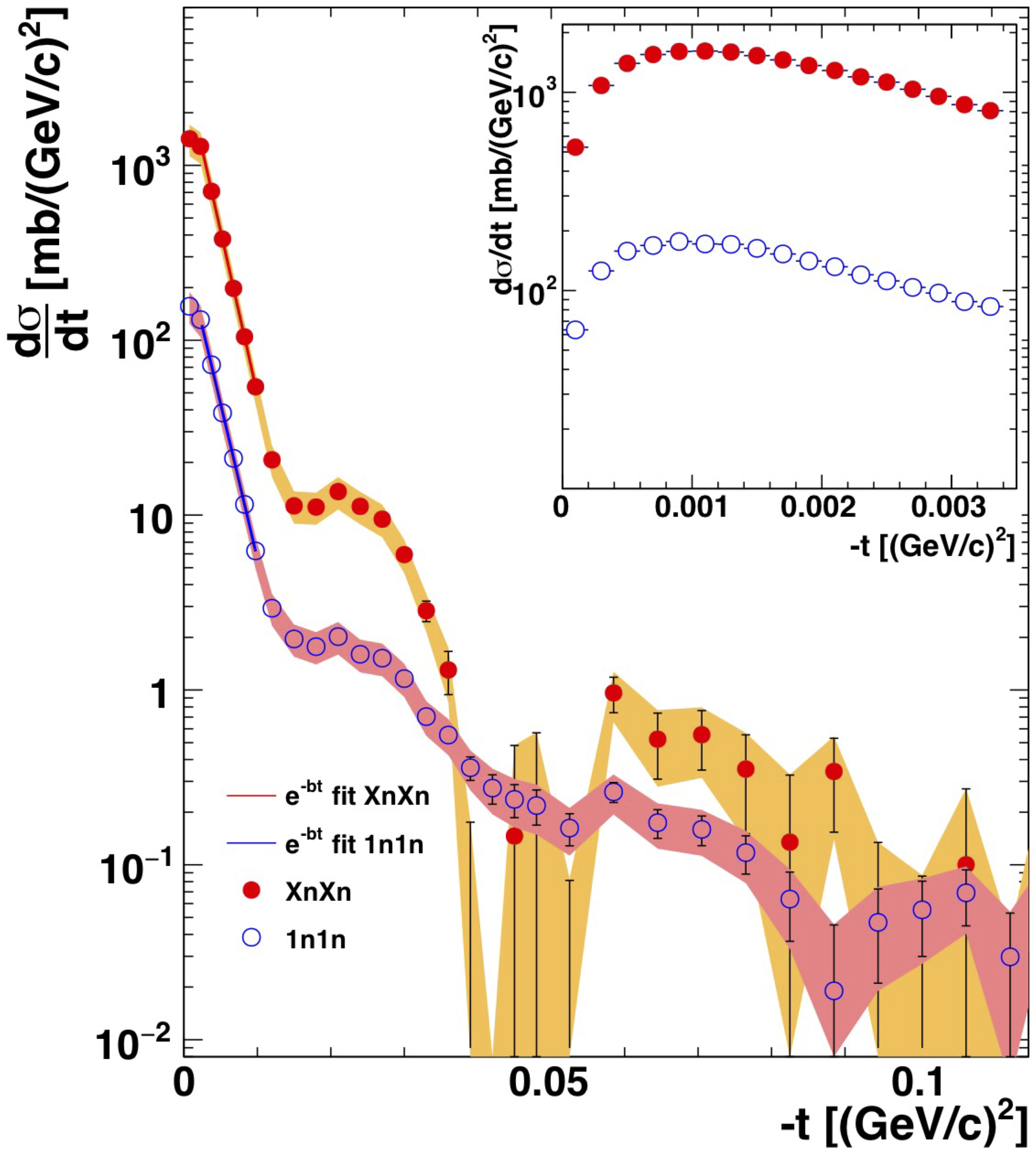
|
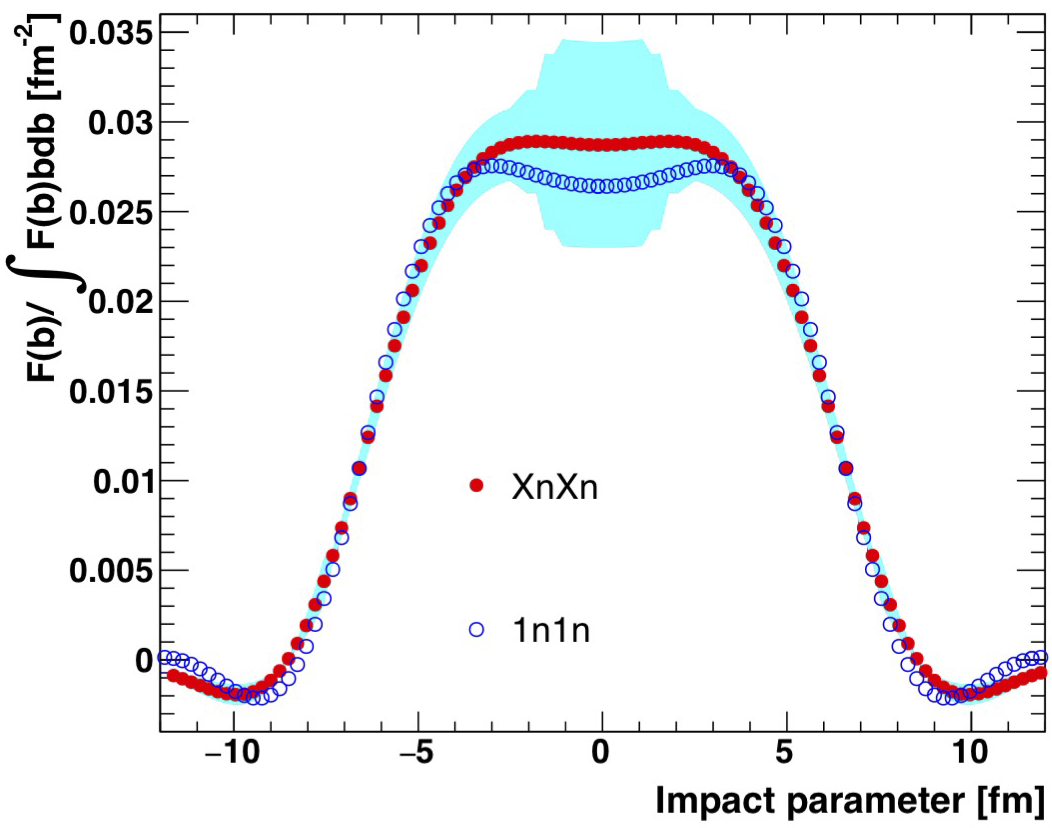
|
|
Left: The cross-section as a function of t, the squared momentum transfer
to the nucleus. The dips and peaks are a diffraction pattern, akin to the pattern
made by a 2-slit interferometer. ‘XnXn’ and ‘1n1n’ are two
different STAR data samples.The inset shows the distribution for very small momentum
transfers. Right: The two-dimensional Fourier transform of the left panel,
showing the density of the interaction sites in the nucleus, as a function of
transverse distance from its center. This is a map of where the mesons interacted in
the target. Although there is considerable systematic uncertainty (the blue region)
near the center of the target, the edges of the nuclei are well defined.
The photons scatter equally from protons and neutrons. But, we can’t tell which
proton or neutron an individual meson scattered from. In quantum mechanics, we add
the amplitudes to scatter from each target meson. The amplitude is a complex number
with a phase which depends on the meson momentum and the position of the target
nucleon. By studying how the scattering probability varies with the momentum transfer
to the nucleus, we can image the matter distribution in the target. The left panel
shows the scattering probability as a function of the square of the momentum transfer
(‘t’) for two different STAR data samples. The dips are due to diffraction, like the
fringes seen in the classic two-slit diffraction pattern, but with a circular
target.
The right panel show the two-dimensional Fourier-Bessel (Henckel) transform of the
left panel, mapping the interaction density within the target. The transform converts
a function of momentum to a function of position. The FWHM of the distribution is
12.34 ± 0.24 fm. Because of nuclear shadowing, this is not just the nuclear density
distribution; shadowing will alter the distribution from that of the density of a gold
nucleus; these corrections may also alter the apparent size of the nucleus. Unlike
electron scattering measurements, this analysis is sensitive to both protons and
neutrons.
|
|
Posted Jan. 9, 2018
|
|
|
STAR focus: A new approach to jet quenching measurements
|
|
The STAR Collaboration has recently published a
paper, Phys. Rev. C 96,
024905, presenting a novel approach to measurements of jet quenching, one of
the most important ways to study the Quark-Gluon Plasma (QGP) generated in
nuclear collisions at RHIC and the LHC.
High energy collisions generate "jets", which are correlated sprays of
particles arising from the decay of energetic quarks and gluons. In heavy ion
physics, jets provide self-generated tomographic probes of the QGP; they are
produced in the collisions itself and interact with the surrounding matter
before flying off to be observed in the detectors. This interaction between a
jet and the QGP modifies jet properties dramatically relative to those in vacuum
(“jet quenching”), and has produced some of the most striking measurements of
the QGP. Such jet measurements are challenging, however. Jet quenching was
initially discovered by STAR and PHENIX, in Au+Au collisions at RHIC, by
studying distributions of single high-momentum particles and their correlations,
which are indirect jet messengers.
|
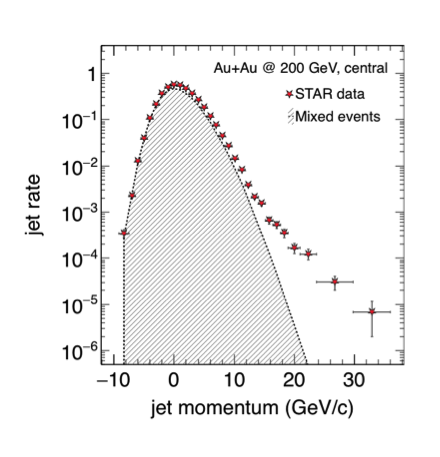
|
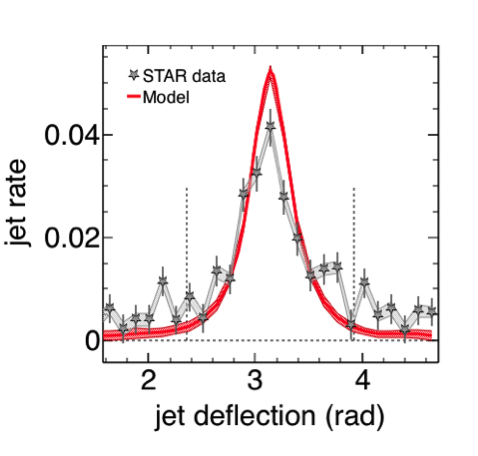
|
|
Left Figure: Measured jet rate (signal plus background) in head-on Au+Au
collisions (red points) and the "mixed event" background (grey
distribution). Right Figure: Azimuthal deflection of jets recoiling from a
trigger particle (data points), and a calculation including QCD effects but not
scattering in the QGP (red curve).
The new STAR paper utilizes the distribution of charged-particle jets
recoiling from a high momentum single-hadron trigger to study jet quenching. The
huge backgrounds underlying the reconstructed jet signal in Au+Au collisions are
measured using a sophisticated event-mixing technique. The contribution of
uncorrelated background is then corrected "statistically", i.e. on the measured
jet spectrum averaged over the entire ensemble of events, rather than attempting
to correct for background on an event-by-event basis. This
statistical-correction method enables jet measurements at RHIC over the complete
range of jet momenta - including very low momentum - in all collision systems,
for large jet-cone radius. This approach enables qualitatively new ways of
studying jet quenching.
|
|
Posted Sep. 12, 2017
Read more ...
|
|
|
STAR focus: Global Λ hyperon polarization in nuclear collisions
|
|
STAR has recently reported the first observation of global polarization of Lambda
hyperons in heavy ion collisions. The discovery has been published
in Nature
548, 62 (2017) as a cover story.
|
|
|
Due to the parity-violating nature of their weak decay, Lambdas reveal the
direction of their spin by preferentially emitting the daughter proton along that
direction. The average spin direction of a population of Lambdas is the
polarization. Lambdas at midrapidity were topologically reconstructed in the STAR
TPC, and the Beam-Beam Counters (BBC) at forward and backward rapidity were used to
estimate the direction of the total angular momentum of the collision. We
discovered that the polarization direction of the Lambdas was correlated at the
level of several percent with the direction of the system angular momentum in
non-central collisions at √sNN=7.7-32 GeV.
It has been well-established that the hot system created at midrapidity in the
system may be considered a fluid, and hydrodynamic calculations relate the
polarization of emitted particles is directly related to the vorticity - the curl of
the flow field - of the fluid. Using this relation, we estimate that the curl of the
fluid created at RHIC is about 9×10²¹ s-1, 14 orders of
magnitude higher than any fluid ever observed. Previous results have established the
system at RHIC to be the hottest and the least viscous (relative to entropy density)
fluid ever created. Our new result adds another record - collisions at RHIC produce
the most vortical fluid.
This first view of the rotational substructure of the fluid at RHIC
represents an entirely new direction in hot QCD research. It has
generated considerable theoretical activity in the field, and may
have important connections with the Chiral Magnetic and Chiral
Vortical Effects (CME and CVE). With increased statistics, there may
even be the opportunity to probe the magnetic field produced in heavy
ion collisions by measuring the difference in polarization of Lambda
and AntiLambda hyperons. Such studies are planned for the future.
|
|
Posted Aug. 16, 2017
Read more ...
BNL News
|
|
|
STAR focus: Evidence for Charm Quark Thermalization at RHIC
|
|
STAR has recently
published its
first paper to Phys. Rev. Letters on measurements enabled by the Heavy Flavor
Tracker (HFT) high-resolution silicon detector system. The results are the first
from a detector based on Monolithic Active Pixel Sensor (MAPS) technology in a
collider environment and are the first measurements of D0
elliptic flow, v2, in Au+Au collisions at
√sNN = 200
GeV.
Heavy flavor quarks, due to their large masses, are considered to offer unique
information about QGP dynamics in heavy-ion collisions. A measurement of heavy flavor
hadron v2, particularly in the low-to-intermediate pT region,
will provide us a better understanding of medium thermalization, and can help
quantitatively measure the heavy quark diffusion coefficient – one of the
intrinsic transport parameters of the QGP.
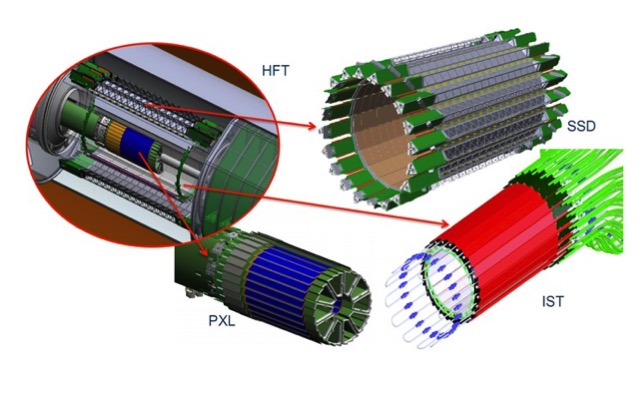
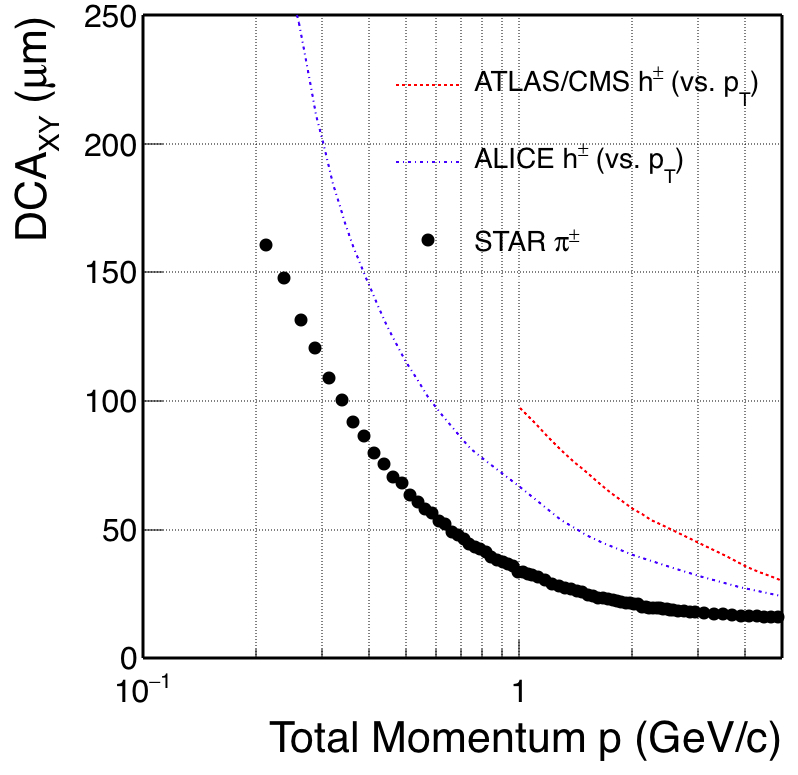
Figure 1. Left: The Heavy Flavor Tracker (HFT) system which consists of one layer of
Silicon Strip Detector (SSD), one layer of Intermediate Silicon Tracker (IST), and two layers of
PiXeL detector (PXL). Right: Pointing resolution in the transverse plane as a function of
particle momentum (or transverse momentum) at mid-rapidity from experiments at RHIC
and the LHC.
The HFT consists of three subsystems: one layer of
Silicon Strip Detector (SSD), one layer of Intermediate Silicon Tracker (IST) and
two layers of silicon PiXeL (PXL) detectors. The HFT-PXL detector is the first
application of the MAPS technology in a collider experiment. Its unique features
include fine pixel size and thin material budget which provides superior track
pointing resolution for charged particles over a broad momentum range. The HFT was
designed for precision measurements of charmed hadron production via topological
reconstruction of displaced vertices in heavy-ion collisions. The HFT was installed
and taken physics data during RHIC Runs 2014-2016. The dataset used in the PRL was
about 1.1B minimum-bias-triggered Au+Au 200 GeV events taken in
2014. Fig. 1 (right) shows the track pointing resolution in the transverse plane as
a function of particle momentum (or transverse momentum) at mid-rapidity from
experiments at RHIC and the LHC.
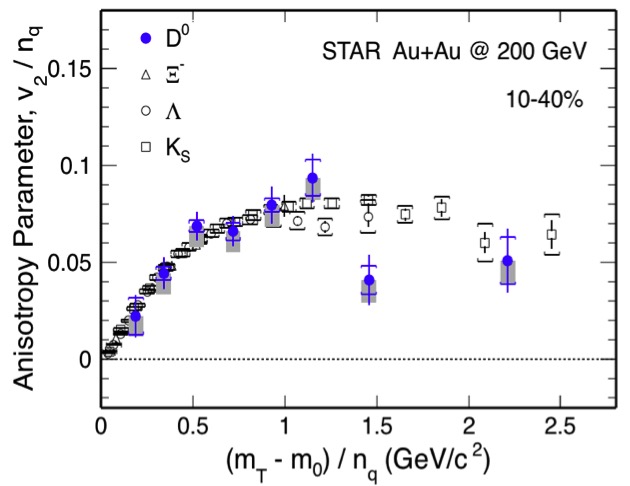
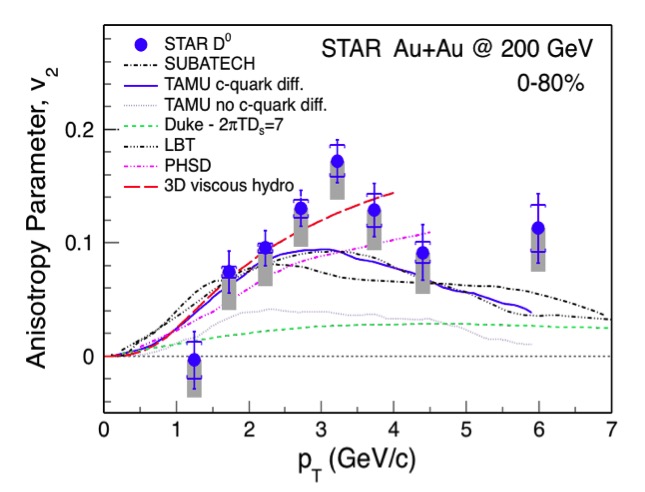
Figure 2. Left: v2 normalized by the
number-of-constituent-quarks (nq) as a function of transverse kinetic
energy (also normalized by nq) for D0 mesons and light hadrons
in 10-40% central Au+Au collisions at 200 GeV. Right: v2 as a
function of pT for D0 in 0-80% Au+Au collisions at 200 GeV
compared to various model calculations.
Fig. 2 (left) shows the v2
normalized by the number-of-constituent-quark (nq) vs. the transverse
kinetic energy (also normalized by nq) for D0 mesons
from this measurement and other light hadron results. With unprecedented precision,
the result shows that D0
v2 follows the same trend as light hadrons with this scaling. In the low
pT region, this indicates a clear mass ordering for light hadrons
and D0 mesons. In the intermediate pT region, the
magnitude of the D-meson v2 is the same as light mesons. This
result suggests that charm quarks have gained a similar amount of collectivity in
these collisions as light mesons.
Fig. 2 (right) shows
the D-meson v2 compared to various theoretical model
calculations. One interesting observation is that the
measured D-meson v2 can be well-described by a 3D viscous
hydrodynamic model calculation, which indicates that charm quarks may have reached
local thermal equilibrium. The precision of the current data allows us to
distinguish different models but there are non-trivial differences between different
models that need to be settled. One important physics goal, for the future, is to
constrain the temperature dependence of the heavy quark diffusion coefficient
parameter via joint investigations between theorists and experimentalists.
The D0 v2 results,
together with other heavy flavor results from STAR (e.g. the enhancement observed in
the Ds and ΛC production in
mid-central Au+Au collisions as well as the charm/bottom-separated
single-electron RAA measurements) have been reported and highlighted in
the recent Quark Matter 2017 conference in Chicago in February
[see Guannan's
contribution to
STAR
Newsletter February 2017 edition]. These measurements strongly suggest that
charm quarks may have reached thermalization in the Au+Au collisions at
RHIC energy.
The paper was made possible with significant
contributions from colleagues at BNL, CCNU, KSU, LBNL, MIT, Purdue, SINAP, UIC, USTC,
and UT Austin, with critical support from the STAR operation and computing teams as
well as the paper's GPC.
|
|
Posted Jun. 30, 2017
|
|
|
STAR focus: Jet-like
correlations with direct-photon and neutral-pion triggers at
√sNN = 200 GeV
|
|
|
The STAR experiment recently published “Jet-like correlations with direct-photon
and neutral-pion triggers at √sNN = 200 GeV” in .
Physics
Letters B 760 (2016) 689.
Direct photons are produced during the early stage of a
heavy-ion collision, through QCD processes such as quark-gluon Compton scattering
and quark-antiquark pair annihilation (at leading order). In these processes the
transverse momentum of the trigger photon approximates the initial transverse
momentum of the recoil parton. The away-side parton (resulting in a spray of
collimated hadrons called a “jet”) is expected to lose energy while traversing the
medium. Jet-like charged-hadron yields on the recoil side of the trigger photon
are calculated from the azimuthal angular correlation functions. The suppression
of these jet-like yields in central Au+Au collisions is then quantified by
comparing to the per-trigger yields measured in p+p collisions, denoting the ratio
of integrated yields IAA
It is also compelling to compare the suppression of jet-like yields on the
recoil side of direct-photon triggers with the suppression of jet-like yields on
the recoil side of neutral-pion (or hadron) triggers. Differences in the
suppression are expected from two effects. 1) There is a trigger bias for neutral
pions (since they are themselves subject to medium interaction and energy loss) to
be from the surface of the medium, maximizing the path length of the recoil parton
through the medium; whereas direct-photon triggers can originate from anywhere
within the medium (since the direct-photon mean-free-path is much larger than the
size of the medium). 2) The recoil side of direct-photon triggers is dominated by
quark jets, while the recoil of neutral-pion triggers can be either quark or gluon
jets. Both of these effects naively should result in a larger suppression, on
average, for the recoil jet-like yields associated with neutral-pion triggers than
those associated with direct-photon triggers. One would expect to get information
about both the path-length and the color-factor dependence of parton energy loss
through the comparison.
|
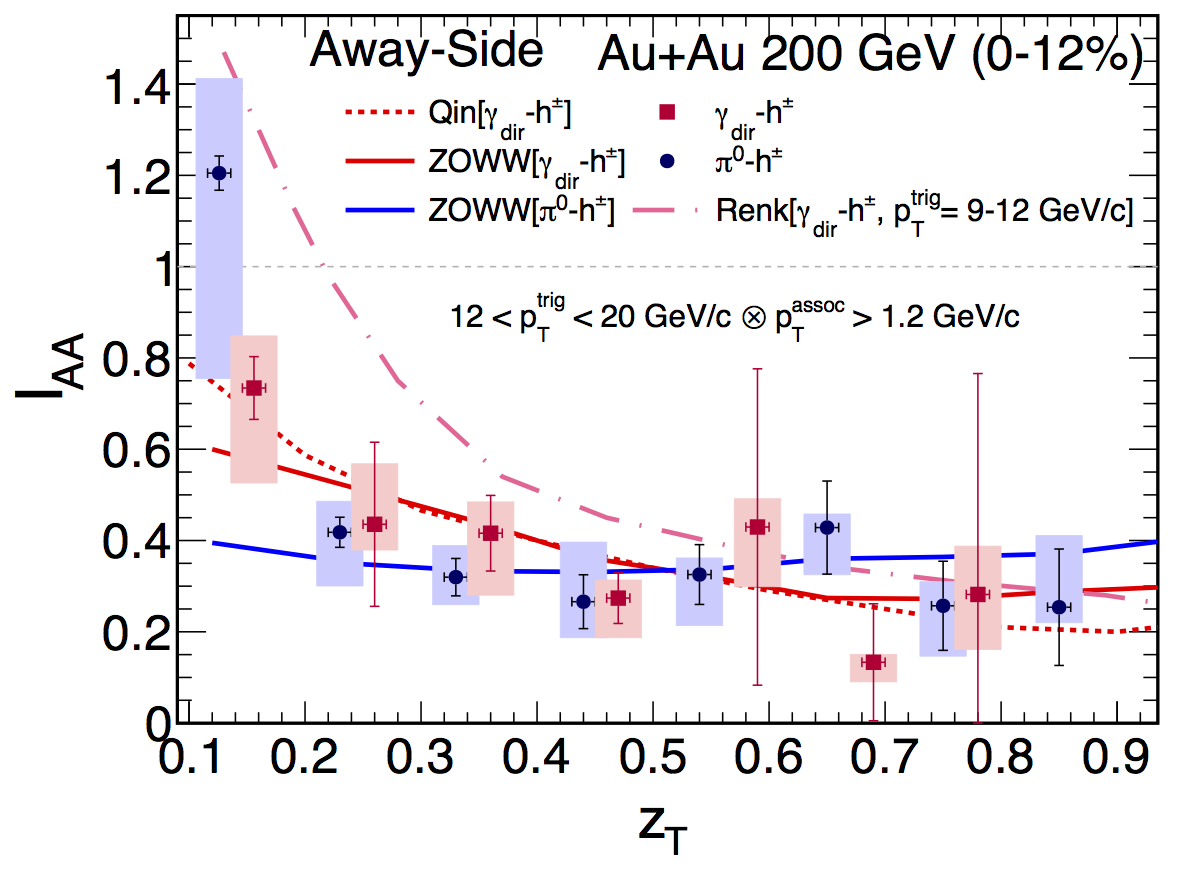 |
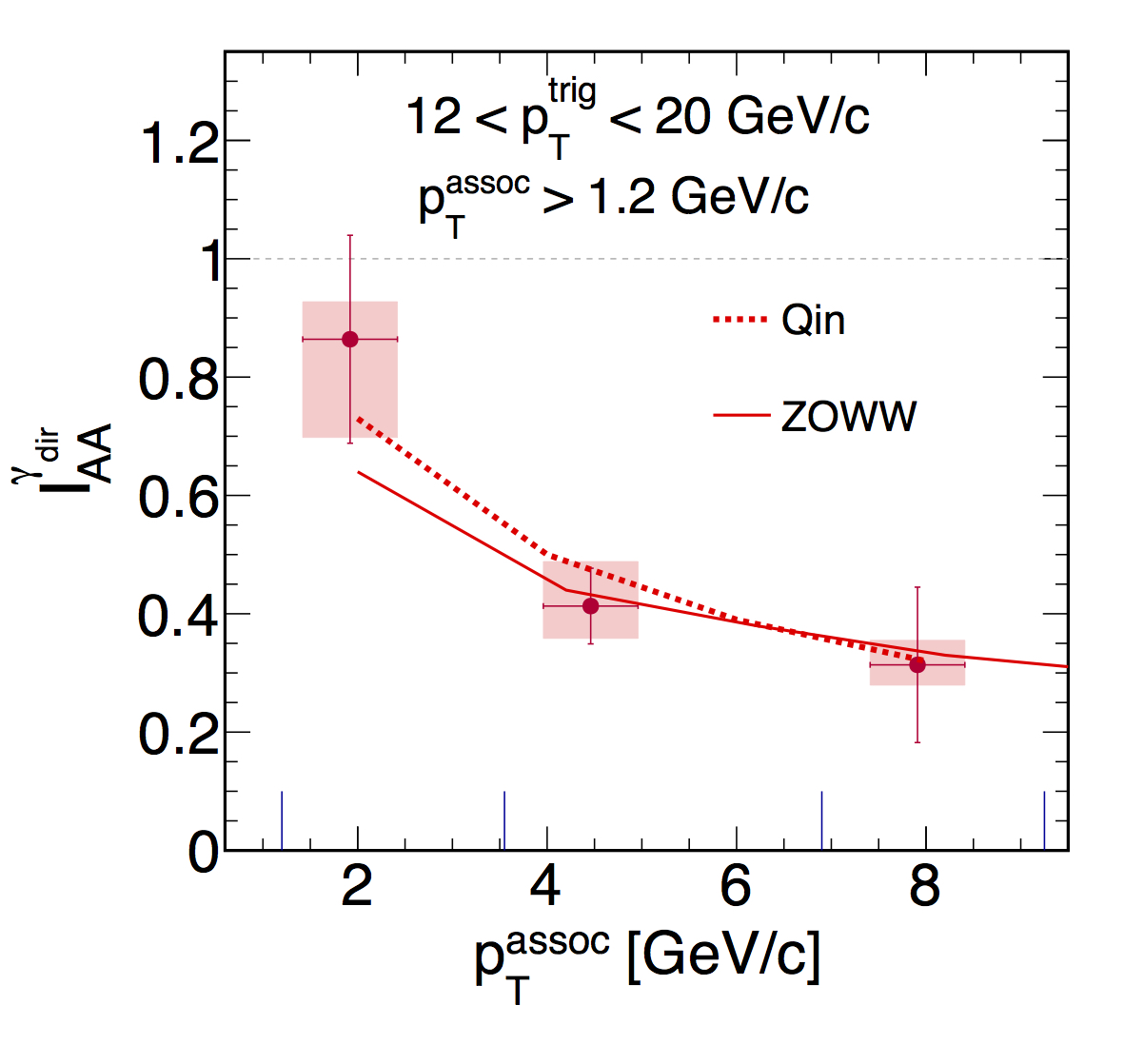 |
|
Left: The IAA for direct-photon and neutral-pion triggers are
plotted as a function of zT. The points for IAA for
direct-photon triggers are shifted by +0.03 in zT for visibility. Right:
IAA for direct-photon triggers as a function of transverse momentum of
the jet-like associated hadrons. The vertical lines represent statistical errors
and the vertical extent of the boxes represents systematic errors. The curves
represent different energy-loss models.
The IAA for direct-photon (red) and neutral-pion (blue) triggers are
plotted as a function of zT
= pTassoc/pTtrig or the
ratio of transverse momentum carried by the away-side hadron relative to that of the
trigger) in the left panel of the figure. The results suggest that for jet-like
associated hadrons, with transverse momentum greater than 1.2 GeV/c, the suppression
factor is similar for direct-photon and neutral-pion triggers, within measurement
uncertainties. The expected effects due to differences in path length and
color-factor are not observed, within uncertainties, within our kinematic range.
There is a hint of less suppression (for both types of triggers) at low
zT, but this effect is more significant when IAA is plotted as
a function of the transverse momentum of the jet-like associated
hadrons pTassoc (shown in the right panel of the
figure).
In contrast to these results, PHENIX
(Phys. Rev. Lett. 111
(2013) 032301) has measured an enhancement in jet-like yields (IAA >
1), at large angles, for zT = 0.1-0.25. In the PHENIX measurement, the
trigger photon has transverse momentum 5-9 GeV/c, and the associated hadrons have
transverse momentum as low as 0.5 GeV/c (compared to the 1.2 GeV/c lower cut in the
STAR measurement). Our measurement, in comparison with the PHENIX result, has led to
the important conclusion that the modified fragmentation function is not a universal
function of zT.
|
|
Posted Nov. 3, 2016
Previous STAR Focus Features
|
|
|
STAR focus: Measurement of interaction between antiprotons
|
|
|
The STAR Collaboration has for the first time directly measured the interaction
between antiprotons, as presented in a recent publication
Nature 527, 345–348(2015).
The interaction between two antinucleons is the basic
interaction that binds the antinucleons into antinuclei, and this has not been
directly measured previously. By applying a technique similar to Hanbury Brown and
Twiss intensity interferometry, the force between two antiprotons at short range
is found to be attractive. In addition, two key parameters that characterize the
corresponding strong interaction are reported, namely, the scattering length and
the effective range. The measured parameters are consistent within errors with the
corresponding values for proton–proton interactions. The results provide direct
information on the interaction between two antiprotons, one of the simplest
systems of antinucleons, and so are fundamental to understanding the structure of
more complex antinuclei and their properties. Of equal importance, one aspect of
the current measurement is a test of matter–antimatter symmetry, more formally
known as CPT—a fundamental symmetry of physical laws under the simultaneous
transformations of charge conjugation (C), parity transformation (P) and time
reversal (T).
|
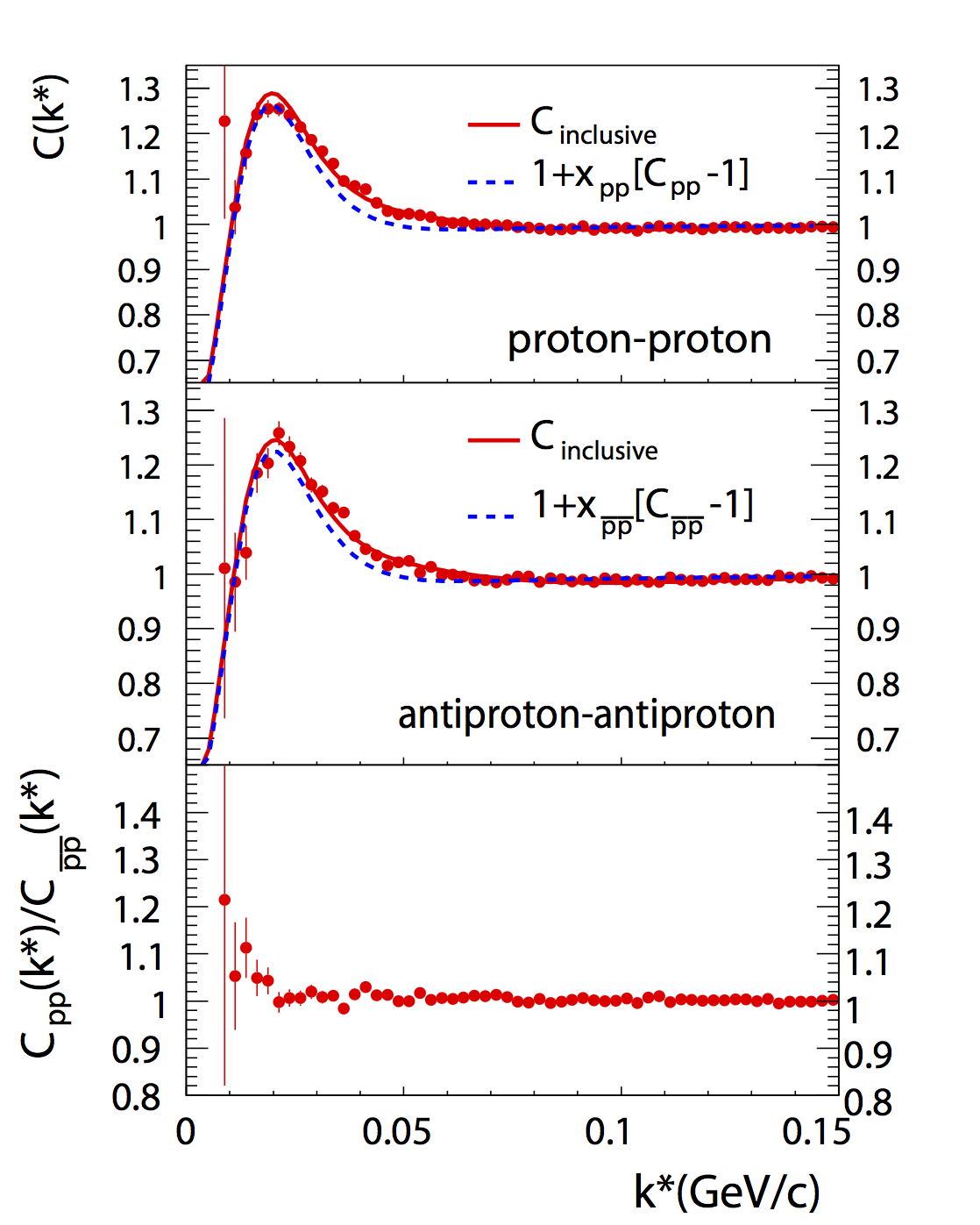
|
Left figure: Correlation functions and their ratio. Correlation functions for
proton–proton pairs (top) and antiproton–antiproton pairs (middle). The ratio of the
former to the latter is shown in the bottom panel. Errors are statistical
only. Cinclusive(k*), are plotted as solid lines, and
the term 1 + xpp[Cpp(k*; Rpp) −
1] is shown as dashed lines.
Lower right figure: d0 versus f0 for
(anti)nucleon-(anti)nucleon interactions.
|
|
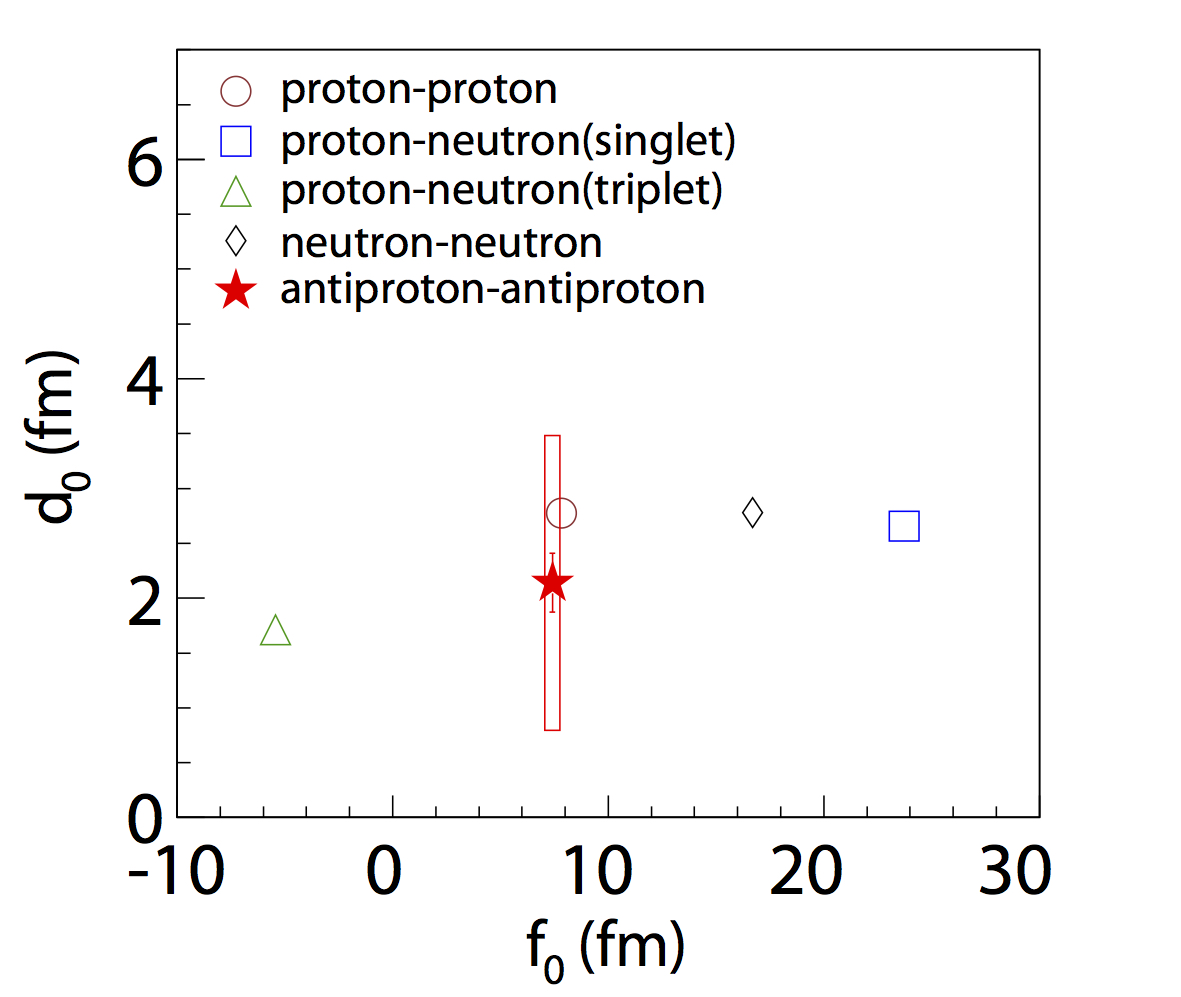
|
|
The singlet s-wave scattering length (f0) and the effective range
(d0) for the antiproton–antiproton interaction (red star) is
plotted together with the s-wave scattering parameters for other nucleon–nucleon
interactions.
|
|
Posted Nov. 5, 2015
BNL News Release
|
|
|
STAR
focus: Precision
Measurement of the Longitudinal
Double-Spin Asymmetry for Inclusive Jet
Production in Polarized Proton Collisions
at √s = 200 GeV
|
|
|
A long-standing puzzle in quantum chromodynamics asks how the
intrinsic spins and orbital angular momenta of the quarks, antiquarks, and gluons sum
to give the proton spin of ħ/2. Polarized deep-inelastic lepton scattering (DIS)
experiments have shown that the quark and antiquark spins account for less than
one-third of the total. The DIS measurements provide only very weak constraints on
the gluon spin contribution to the proton spin, and essentially nothing is known
experimentally about the orbital angular momentum contribution. The ability of
polarized proton collisions to probe gluon polarization was a primary motivation for
establishing the RHIC spin program.
In a recent publication,
Phys. Rev. Lett. 115, 092002 (2015), the STAR Collaboration presents
the first experimental evidence for positive gluon polarization in the
Bjorken-x region x > 0.05. The paper, which is highlighted as a PRL
Editors’ Suggestion, presents a measurement of the longitudinal double-spin
asymmetry, ALL, for midrapidity inclusive jet production in 200
GeV pp collisions. The data, which were recorded in 2009, provide nearly a
20-fold increase in the event statistics compared to previous STAR inclusive jet
ALL measurements, and the analysis features improved jet reconstruction
and correction techniques to reduce systematic uncertainties.
|
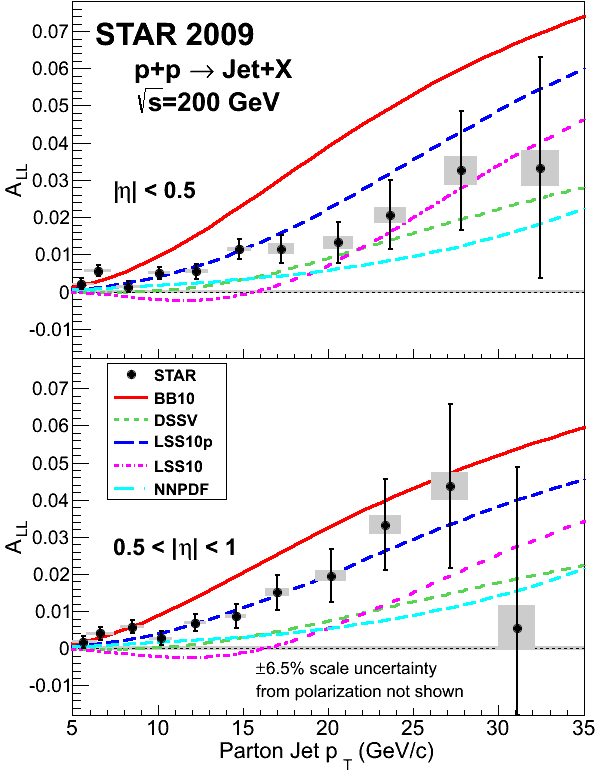
|
|
The measured inclusive jet ALL vs. parton
jet pT is compared to predictions from several recent NLO global
analyses of the polarized parton distributions. The error bars are statistical. The
gray boxes show the size of the systematic uncertainties. The uncertainty bands
associated with the NLO global analyses, which are of the order of or larger than the
spread among the model calculations, are omitted for clarity.
|
|
|
The figure shows the results compared to predictions from several recent
next-to-leading-order (NLO) global analyses of DIS, semi-inclusive DIS, and previous
RHIC pp data. The results draw a narrow road through the uncertainty bands
associated with those previous NLO global analyses, leading to substantially tighter
constraints on gluon polarization than were provided by the previous world data.
Very recently, these results have been included in new NLO global analyses by the
DSSV and NNPDF groups. Both groups find that the gluon polarization in the
Bjorken-x region x > 0.05 differs from zero by over 3σ, and
contributes approximately 40% of the total proton spin.
|
|
Posted Aug. 27, 2015
|
|
|
STAR
focus: Observation
of charge asymmetry dependence of pion
elliptic flow and the possible chiral
magnetic wave in heavy-ion collisions
|
|
|
The STAR collaboration has found supporting evidence for what’s called
a “chiral magnetic wave” rippling through the soup
of quark-gluon
plasma created in RHIC’s energetic particle smashups, as presented
in a recent publication,
Phys. Rev. Lett. 114,252302
(2015).
In the picture with a chiral magnetic wave, the strong magnetic field
created by the passing-by of spectators, with the presence of finite density of
electric charge, causes chiral charges to separate along the axis of the magnetic
field – a process called Chiral Separation Effect (CSE). The chiral separation
acts like a seed that, in turn, causes particles with different electric charges to
separate – in a process described as Chiral Magnetic Effect (CME). The evidence
supporting the existence of the latter has been previously presented by STAR and hotly
debated. The CSE and CME trigger each other and the process goes on like a wave. In
the end, these two effects together will push negative particles into the equator and
positive particles to the poles.
To look for this effect, STAR measured the collective motion of
positively and negatively charged pions, the most abundant particles produced in RHIC
collisions. It is found that the collective elliptic flow of negatively charged
pions—their tendency to flow out along the equator—was enhanced, while the
elliptic flow of the positive pions was suppressed, resulting in a higher abundance of
positive particles at the poles. Importantly, the difference in elliptic flow between
positive and negative pions increased with the net charge density produced in RHIC
collisions. This is exactly what is expected from calculations using the theory
predicting the existence of the chiral magnetic wave. The results hold out for almost
all energies at which a quark-gluon plasma is believed to be created at RHIC, and, so
far, no other model can explain them.
|
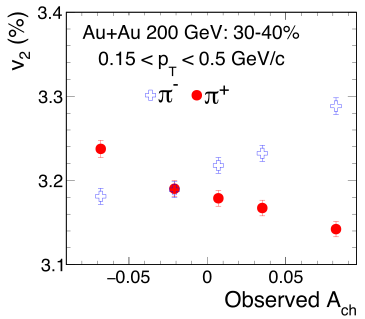 |
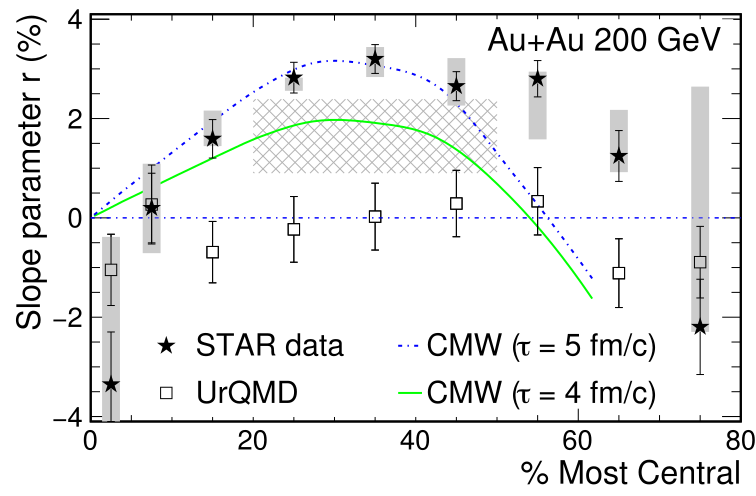 |
|
Left: Positive (negative) pion v2 linearly decreases
(increases) with the increasing charge assymetry, which is expected by a CMW
model. Right: The slope parameter, r, as a function of centrality for Au+Au
collisions at 200 GeV. Also shown is the UrQMD simulation, and the calculation with CMW
with different duration times. See paper for explanation for grey bands and cross-hatched
band.
|
|
Posted June 27, 2015
Read more
BNL Feature Story
|
|
|
|
STAR focus: ΛΛ Correlation Function in Au+Au collisions at √sNN = 200 GeV
|
| |
The STAR Collaboration published in Physical Review
Letters, Phys. Rev. Lett. 114,
022301 (2015), the first high statistics measurement of ΛΛ correlation
function in Au+Au collisions at √sNN = 200 GeV and it is also highlighted as
PRL editors' suggestion. This research pioneered the venue of using RHIC as a hyperon factory to
investigate hyperon-hyperon interactions. The STAR measurement can provide precious data for the
understanding of hyperon-hyperon interaction which is an important input to various
baryon-baryon interaction potential model as well as for the study of equation of state for
neutron stars. The ΛΛ interaction is also closely related to the existence of the
H dibaryon, one of the most searched for exotic hadrons in nuclear collisions.
|
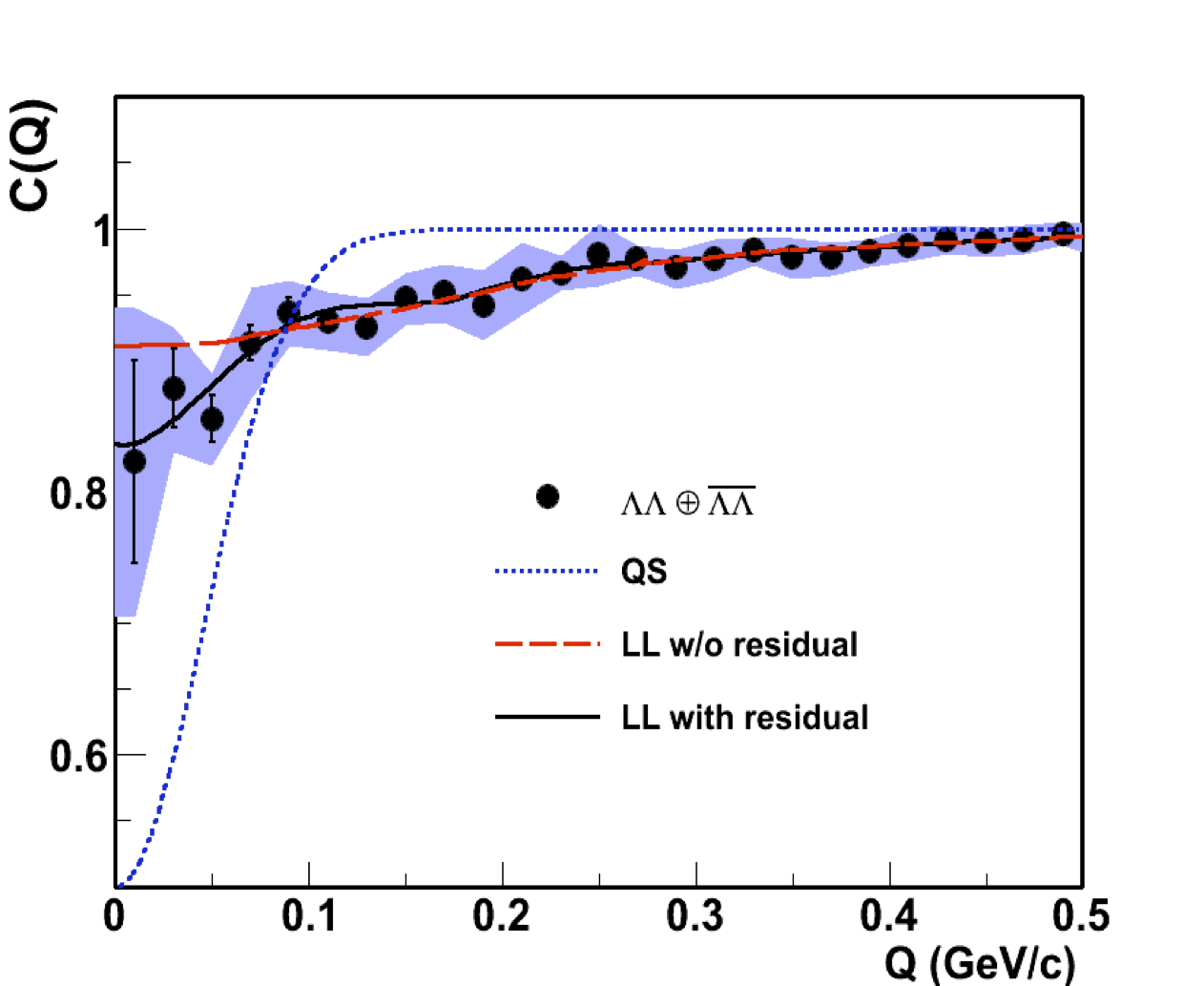 |
Left Fig. The combined ΛΛ and anti-Λ anti-Λ correlation function for
0-80% centrality Au+Au collisions at √sNN = 200 GeV. Curves correspond to fits
using the Lednicky and Lyuboshitz analytical model with and without a residual correlation
term. The dotted line corresponds to Fermi statistics with a source size of 3.13 fm. The shaded
band corresponds to the systematic error.
|
|
|
The Lednicky and Lyuboshitz analytical model is used to fit the experimental correlation
function and the resulting parameters suggest that the strength of the ΛΛ
interaction is weak. The measured ΛΛ correlation shows deviation from unity as
well as the free correlation expected from Fermi statistics. The correlation measurement also
allowed extraction of an upper limit for possible production of the H dibaryon in Au+Au
collisions at 200 GeV which is significantly lower than theoretical predictions based on
coalescence calculations.
|
|
Posted Jan. 28, 2015
|
|
|
STAR focus: Electroweak bosons provide new probe of proton spin structure
|
| |
The proton is composed of two up and one down flavor quarks that are bound
together by the strong force. The strong force is mediated by gluons which
in turn can spawn virtual quark and antiquark pairs known as sea quarks.
Since the masses of the up and down (anti)quarks are small and nearly
identical, it was expected that their number densities would also be very
similar. However, experiments in the 1990s observed a significant asymmetry
in the number of down and up antiquarks in the proton. Theories that
successfully explained this asymmetry inspired predictions of even larger
asymmetries in the polarized sector, generating renewed interest in
determining the spin orientation of the proton’s antiquarks. The data from
the STAR experiment, reported in this paper, Phys. Rev. Lett. 113,
072301 (2014), provide new constraints on these antiquark polarizations
and shed light on the origin of the proton’s sea quarks.
|
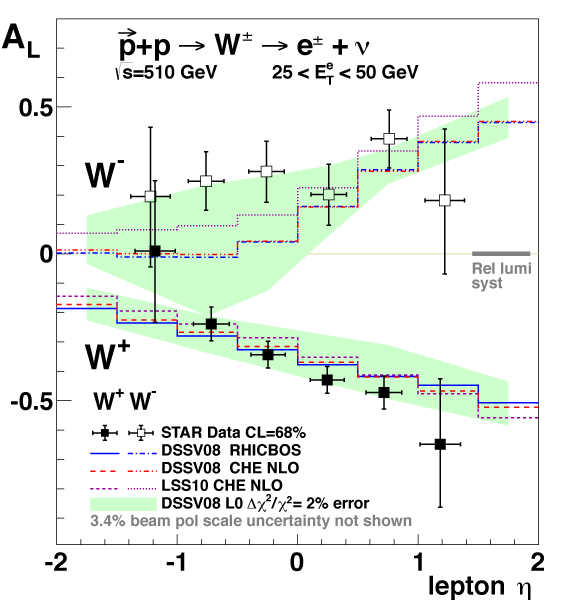 |
Left Fig. The asymmetry in the production cross section for
W± bosons in proton collisions
with a positive (negative) proton beam helicity,
σ+(σ-), defined as
AL=(σ+ -
σ-)/(σ+ + σ-) is
shown as a function of the W boson’s decay lepton pseudorapidity.
The filled(open) points correspond to the
W+(W-) asymmetries, in comparison to
predictions from different polarized parton distribution functions.
|
|
|
In this measurement, the STAR experiment at the Relativistic Heavy Ion
Collider (RHIC) studied longitudinally polarized proton collisions at a
center of mass energy of 0.5 TeV. W bosons are produced in these collisions
by the annihilation of a quark and an antiquark. The quark flavors in the
interaction can be determined by the charge of the W boson produced. The
analysis by the STAR collaboration reports a significant asymmetry in the
number of W bosons produced with a positive vs. negative helicity proton
beam (shown in the figure above), and the data prefer a sizable, positive up
flavor antiquark polarization in the kinematic range covered at RHIC.
|
|
Posted Aug. 13, 2014
|
|
|
STAR
focus: Energy Dependence of
Moments of Net-proton Multiplicity Distributions at RHIC
|
| |
In the phase diagram of Quantum Chromodynamics (QCD–theory of strong
interactions), it is conjectured on the basis of theoretical calculations
that there will be a critical point (CP) at high temperature and non-zero
baryonic chemical potential region. Experimental confirmation of the QCD
Critical Point will be an excellent test of QCD theory in the
non-perturbative region and the milestone of exploring the QCD phase
diagram. This is one of the main goals of the Beam Energy Scan (BES) Program
at the Relativistic Heavy Ion Collider (RHIC). Due to the high sensitivity
to the correlation length of dynamical systems and directly connected to the
susceptibility in the Lattice QCD, higher moments of net-proton
distributions have been applied to search for the QCD Critical Point in the
heavy-ion collision experiment at STAR. The results were recently published
in Phys. Rev. Lett. 112,
032302 (2014).
In this article, we report
the beam energy (√s = 7.7 - 200 GeV) and collision centrality
dependence of the mean (M), standard deviation (σ), skewness (S), and
kurtosis (κ) of the net-proton multiplicity distributions in Au + Au
collisions. The measurements are carried out by the STAR experiment at
mid-rapidity (|y|< 0.5) in the first phase of the BES at RHIC.
|
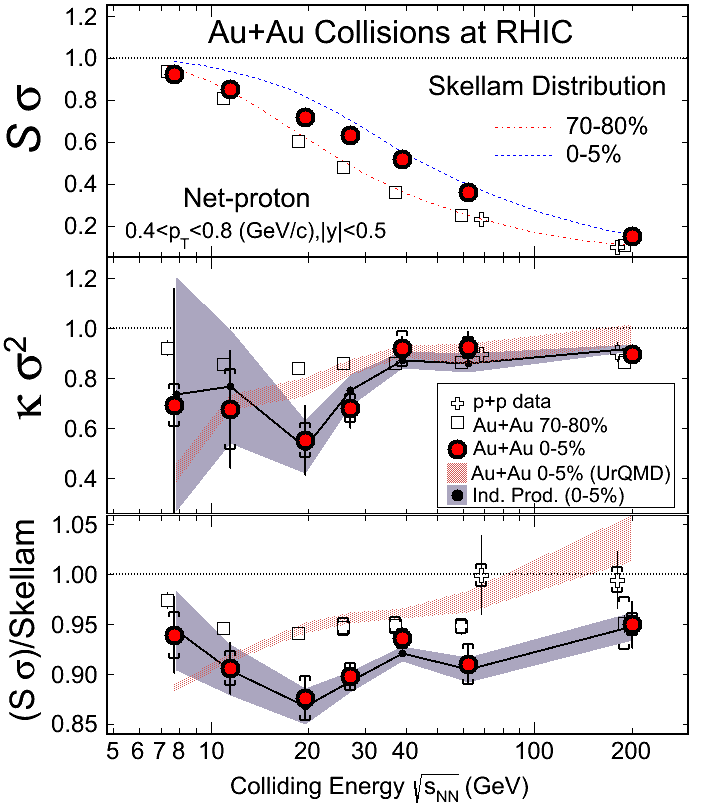 |
Left Fig. The products of moments (Sσ and
κσ2) in 0-5% Au+Au collisions are found to have
values significantly below the Skellam expectation and have largest
significance of deviations (the difference between data and Skellam
baseline divided by the errors) for 19.6 and 27 GeV, with values of 3.2
and 3.4 for κσ2 and 4.5 and 5.6 for Sσ,
respectively. These observables are not reproduced by either a non-CP
transport model or by a hadron resonance model. The measurements are
reasonably described by assuming independent production of proton and
anti-protons, indicating that there are no apparent correlations between
the protons and anti-protons for the observable presented. However at the
lower beam energies, the net-proton measurements are dominated by the
shape of the proton distributions only.
|
In summary, measurements of the higher moments of
the net-proton distributions in Au+Au collisions over a wide range of
μB have been presented to search for a possible CP. For
√s > 39 GeV, Sσ and κσ2
values are similar for central, peripheral Au+Au collisions and p+p
collisions. Deviations for both Sσ and
κσ2 from HRG and Skellam expectations are
observed for √s < 27 GeV. Higher statistics data for √s
< 19.6 GeV will help to quantitatively understand the energy
dependence of Sσ and κσ2. The conclusions
on the existence of CP can be made only after comparison to QCD
calculations with CP behavior which include the dynamics associated
with heavy-ion collisions.
|
|
|
Posted Jan. 25, 2014
|
|
|
STAR
focus: Observation of an Energy-Dependent Difference
in Elliptic Flow between Particles and Antiparticles in Relativistic Heavy
Ion Collisions
|
|
We present elliptic flow (v2) measurements for identified
particles at mid-rapidity in Au+Au collisions, measured by the STAR
experiment in the Beam Energy Scan at RHIC at √sNN= 7.7-62.4
GeV. A beam-energy dependent difference of the values of v2
between particles and corresponding anti-particles was observed. The
difference increases with decreasing beam energy and is larger for baryons
compared to mesons. This implies that, at lower energies, particles and
anti-particles are not consistent with the universal
number-of-constituent-quark (NCQ) scaling of v2 - one of the
evidences in support of the sQGP formation at √sNN = 200
GeV. The results were recently published
in Phys.
Rev. Lett. 110, 142301 (2013).
|
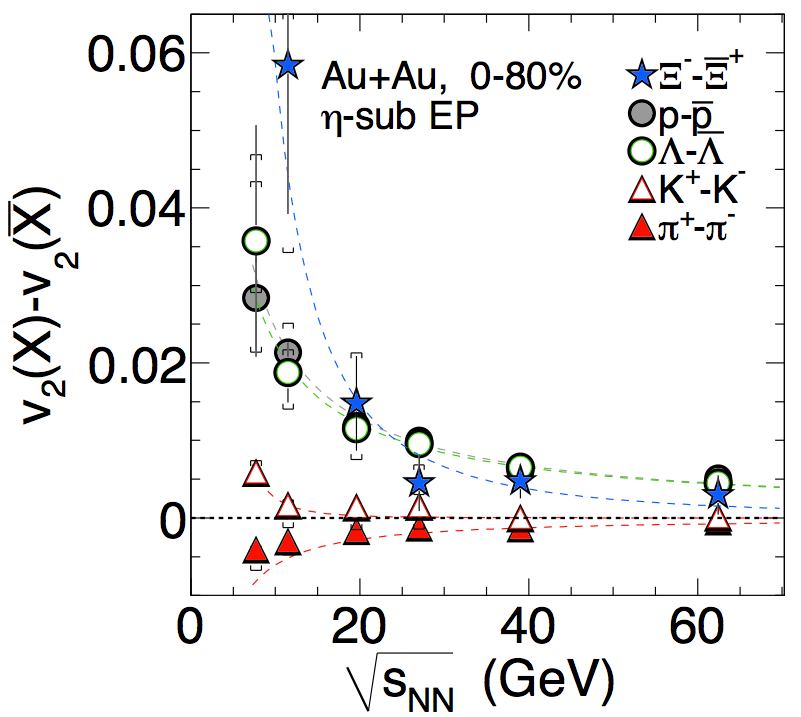 |
Left figure: The difference in v2
between particles X and their corresponding
anti-particles X
(see legend) as a function of √sNN for 0-80% central
Au+Au collisions. The dashed lines in the plot are fits with a
power-law function. The error bars depict the combined statistical
and systematic errors. The difference in the v2 values
for particles and anti-particles increases with decreasing beam
energy. The energy dependence in shape and magnitude is similar
for all baryons. Baryons show a larger difference compared to
mesons. |
The
v2(mT-m0) and possible NCQ scaling
were investigated for particles and anti-particles separately, as
shown in the lower figure. The baryons and mesons are clearly
separated for √sNN = 62.4 GeV at
(mT-m0) > 1 GeV/c2. While the
effect is present for particles at √sNN = 11.5 GeV, no
such separation is observed for the anti-particles at this energy in
the measured (mT-m0) range up to 2 GeV/c2
. The lower panels of the figure depict the difference of the
baryon v2 relative to a fit to the meson v2
data with the pions excluded from the fit. The anti-particles at
√sNN = 11.5 GeV show a smaller difference compared to the
particles. |
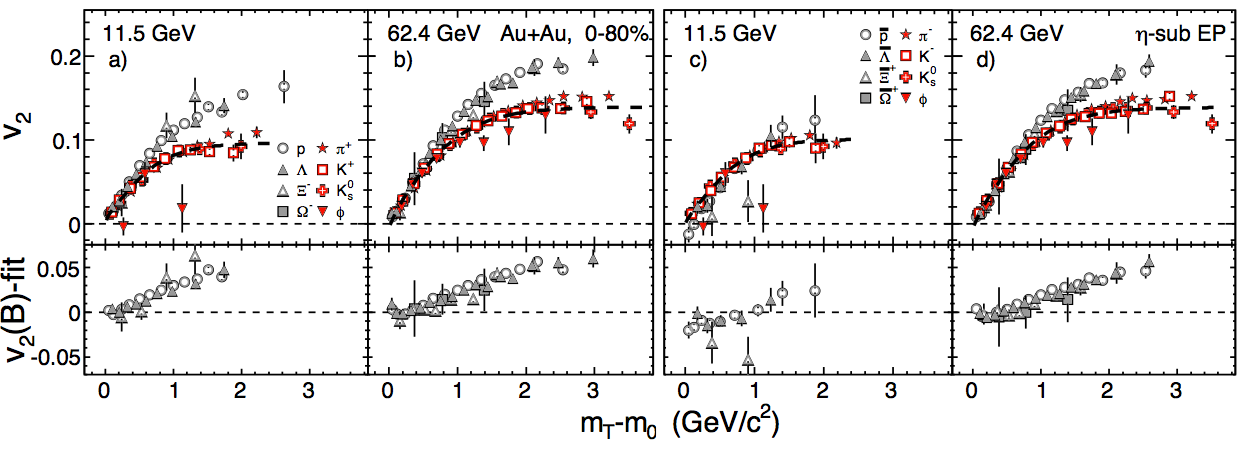 |
|
|
In summary, the first observation of a
beam-energy dependent difference in v2(pT) between particles and
corresponding anti-particles for minimum bias √sNN = 7.7-62.4 GeV Au+Au
collisions at mid-rapidity is reported. The difference increases with decreasing beam
energy. It is apparent that, at the lower energies, particles and anti-particles are no
longer consistent with the single NCQ scaling that was observed for √sNN = 200
GeV. However, for the group of particles the NCQ scaling holds within
±10% while for the group of anti-particles the
difference between baryon and meson v2 continues to decrease to lower
energies.
|
|
Posted Apr. 16, 2013
|
|
|
|
STAR focus: Identified hadron compositions in p+p and
Au+Au collisions at high transverse momenta at √sNN = 200 GeV
|
We report identified particle pT spectra
at mid-rapidity up to 15 GeV/c from p+p and Au+Au collisions at √sNN = 200
GeV. The NLO pQCD models describe the π± spectra but fail to reproduce the K and
p(pbar) spectra at high pT. The measured anti-particle to particle ratios are
observed to decrease with increasing pT. This reflects differences in scattering
contributions to the production of particles and anti-particles at RHIC. At pT ≥ 8
GeV/c, a common suppression pattern is observed for different particle species. Incorporating
our p+p data in generating the flavor separated fragmentation functions in the same kinematic
range will provide new inputs and insights into the mechanisms of jet quenching in heavy ion
collisions. These results have been published at Phys. Rev. Lett. 108, 072302
(2012). |
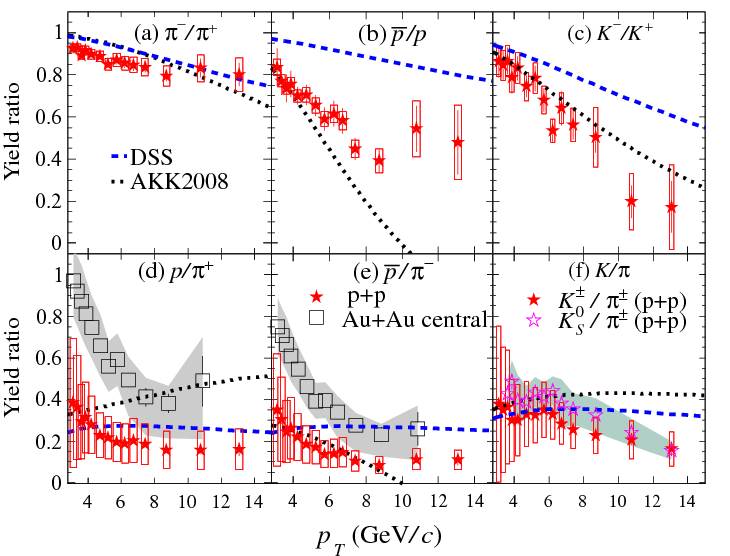 |
Left: Yield ratios π-/π+, pbar/p, K-/K+,
p/π+, pbar/π-, and K±,
K0S/π± versus pT in p+p collisions, and nominal
NLO calculations with AKK and DSS fragmentation functions without theoretical uncertainties. The
open squares in panels (d) and (e) are the p/π+ and pbar/π- ratios
in central Au+Au collisions with updated uncertainties at high pT, and all other data
points are from p+p collisions. Bars and boxes (bands) represent statistical and systematic
uncertainties, respectively. |
Right: (a) RAA of K±+p(pbar), K0S,
ρ0, and π± in central Au+Au collisions as a function of
pT. The curves are the calculations for K0S RAAwith
and without jet conversion in medium. Bars and boxes (bands) represent statistical and
systematic uncertainties, respectively. The height of the band at unity represents the
normalization uncertainty. (b) The ratios of RAA[K±+p(pbar),
ρ0] to RAA(π±) and RAA(K-+pbar) to
RAA(K++p). The boxes and shaded bands represent the systematic
uncertainties for RAA(ρ0)/RAA(π±) and
RAA[K±+p(pbar)]/RAA(π±), respectively. The
systematic uncertainties for RAA(K-+pbar)/RAA(K++p)
are 2%-12% and left off for clarity. |
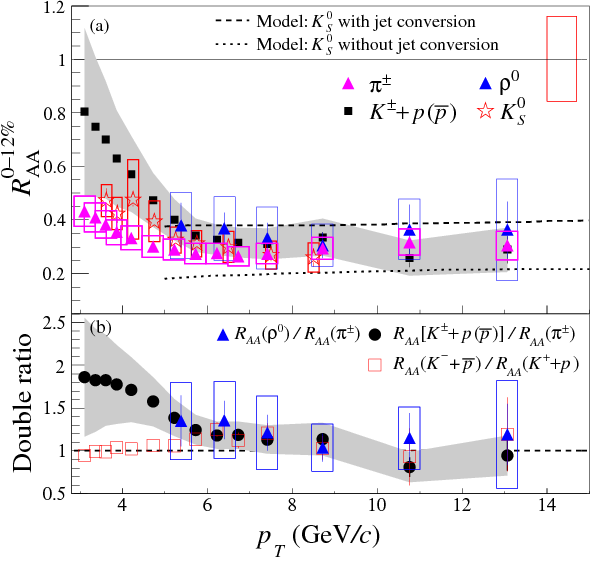 |
| Read more... | Posted Mar. 20, 2012 |
|
|
|
|
star focus:
Highlights from the STAR paper: Observation of the antimatter helium-4 nucleus
Scientists have discovered the heaviest antimatter nucleus: antihelium-4, which contains two antiprotons and two antineutrons. The new discovery is published online by Nature
|
High-energy nuclear collisions create an energy density similar to that of the universe microseconds after the Big Bang. In both cases, matter and antimatter are formed with comparable abundance. Thus, a high energy accelerator of heavy nuclei is an efficient means of producing and studying antimatter. The antimatter helium-4 nucleus (4He),which known as the anti-α (α), has not been observed before. Although the α particle was identified a century ago by Rutherford and is present in cosmic radiation at the 10% level. The STAR Collaboration reports the observation of the antimatter helium-4 nucleus, the heaviest observed antinucleus. In total 18 4He counts were detected in 109 recorded Au+Au collisions at center-of-mass energies of 200 GeV and 62 GeV per nucleon-nucleon pair. The yield is consistent with expectations from thermodynamic and coalescent nucleosynthesis models, providing an indication of the production rate of even heavier antimatter nuclei and a benchmark for possible future observations of 4He in cosmic radiation.
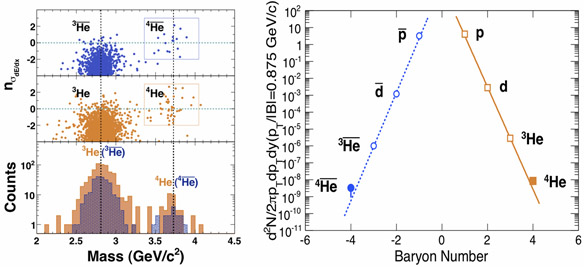
Left: The top two panels show the <dE/dx> in units of multiples of σdE/dx, nσdE/dx , of negatively charged particles (first panel) and positively charged particles (second panel) as a function of mass measured by the TOF system. The masses of 3He (3He) and 4He (4He) are indicated by the vertical lines at 2.81 GeV/c2 and 3.73 GeV/c2, respectively. The horizontal line marks the position of zero deviation from the expected value of <dE/dx> (nσdE/dx = 0) for 4He (4He). The rectangular boxes highlight areas for 4He (4He) selections : −2 < nσdE/dx < 3 and 3.35 GeV/c2 < mass < 4.04 GeV/c2 (corresponding to a ±3σ window in mass). The bottom panel shows a projection of entries in the upper two panels onto the mass axis for particles in the window of −2 < σdE/dx < 3. The combined measurements of energy loss and the time of flight allow a clean identification to be made in a sample of 0.5 × 10¹² tracks from 109 Au+Au collisions.
Right: Differential invariant yields as a function of baryon number B, evaluated at pT /|B| = 0.875 GeV/c, in central 200 GeV Au+Au collisions. Yields for (anti)tritons (3H and 3H) lie close to the positions for 3He and 3He, but are not included here because of poorer identification of (anti)tritons. The lines represent fits with the exponential formula ∝ e−r|B| for positive and negative particles separately, where r is the production reduction factor. Analysis details of yields other than 4He (4He) have been presented elsewhere. Errors are statistical only. Systematic errors are smaller than the symbol size, and are not plotted.
Read more...
| Posted April 25, 2011
|
|
|
|
|
star focus:
Highlights from the STAR paper:
Measurement of the parity-violating longitudinal single-spin asymmetry for W± boson
production in polarized proton-proton collisions at
√s = 500GeV
Accepted by Physical Review Letters
|
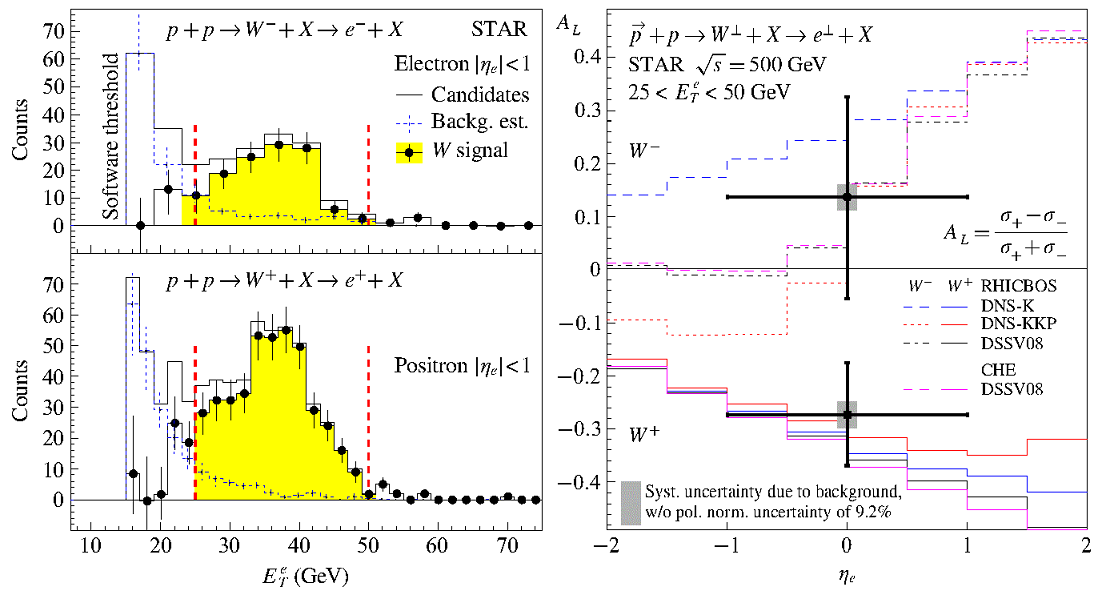
High energy polarized p + p collisions at √s = 200-500 GeV at RHIC provide a unique way to probe the proton spin structure and dynamics using hard scattering processes.
The data taking period in 2009 of polarized p + p collisions at √s = 500 GeV opens a new era in the study of the spin-flavor structure of the proton based on the production
of W±. W± bosons are produced predominantly through u + d (u + d)
collisions and can be detected through their leptonic decay.
The production of W bosons in polarized proton collisions allows for the observation of purely weak interactions, giving rise to large, parity-violating, longitudinal single-spin asymmetries.
We report the first measurement of the parity violating single-spin asymmetries for midrapidity decay positrons and electrons from W+ and W- boson production
in longitudinally polarized proton-proton collisions at √s = 500 GeV by the STAR experiment at RHIC. The measured asymmetries,
AW+L = -0.27 ± 0.10 (stat.) ± 0.02 (syst.) ± 0.03 (norm.) and
AW-L = 0.14 ± 0.19 (stat.) ± 0.02 (syst.) ± 0.01 (norm.),
are consistent with theory predictions, which are large and of opposite sign. These predictions are based on polarized quark and antiquark distribution functions constrained by polarized DIS measurements.
At midrapidity, W± production probes a combination of the polarization of the u and d
(d and u) quarks, and AW+(-)L
is expected to be negative (positive). The measured AW+L is indeed negative at the 2.7 sigma level, which is a direct consequence of the positive u
quark polarization. The central value of AW-L is positive as expected with a larger statistical uncertainty at the 0.7 sigma level. Our
AL results are consistent with predictions using polarized quark and antiquark PDFs constrained by inclusive and semi-inclusive pDIS measurements,
as expected from the universality of polarized PDFs. Future high-statistics measurements at midrapidity together with measurements at forward and backward pseudorapidities
will focus on constraining the polarization of d and u quarks. The Run 11 data set will allow to expand the first W measurement at midrapidity to higher precision.
The installation of the Forward GEM Tracker in summer 2011 provides the needed extension of the tracking capability in front of the STAR Endcap Electromagnetic Calorimeter.
Read more...
| Posted January 5, 2011
|
|
|
|
|
star focus:
Baryon Number Fluctuations to look for the QCD
Critical Point
Highlights from the STAR paper:
Higher Moments of Net-proton Multiplicity Distributions at
RHIC
Published in Physical Review Letters 105 (2010) 022302
|
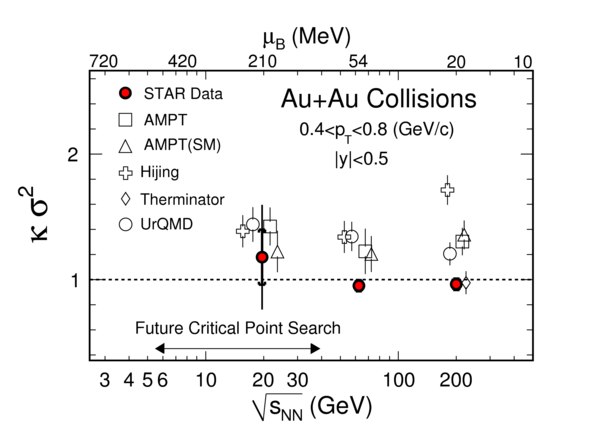
A recent paper from the STAR Collaboration published in
Physical Review Letters
proposes using the higher moments of
net-proton multiplicity distributions
produced in high energy heavy-ion collisions
as an observable for locating the QCD Critical Point. It
has been shown that a careful choice
of the products of the moments of the net-proton
distributions form observables that can be related to the
ratios of various order baryon number susceptibilities
computed in QCD (basic theory of strong interactions)
calculations.
Thus the measurements provide a way for comparisons of
heavy-ion collision data to
first principle QCD calculations on lattice. Since
susceptibilities diverge at critical
point, these products of moments of net-proton
distributions are also expected to take up
larger values at the critical point. Thus the measurements
reported provide a unique and new observable to search for
landmark QCD critical point in QCD phase diagram of
Temperature vs. Baryon chemical potential,in high energy
heavy-ion collisions.
The measurements (product of kurtosis times
the variance of net-proton distribution is
shown in the figure) carried out at three
different beam energies have been used to rule out the
presence of QCD critical point below 200 MeV baryon
chemical potential in the QCD phase plane. In high energy
heavy-ion collisions the moments of net-protons, related to
baryon number susceptibilities, have been shown to be
independent of the system volume. QCD calculations on
lattice have shown such a case happens when the system
undergoes a cross over transition between hadronic and
quark-gluon phases. In the near future these measurements
(as indicated by the arrows at the bottom of the figure)
will be carried out at varying collision
energies or baryon chemical potential at the Relativistic
Heavy Ion Collider to locate
the QCD critical point. This is one of the
physics goals of the RHIC Beam Energy Scan Program, moving
towards that direction the
STAR experiment has collected a good
data set at beam energies of 7.7, 11.5
and 39 GeV this year.
Read more...
| Posted August 20, 2010
|
|
|
|
|
star focus:
Observation of an Antimatter Hypernucleus
Scientists report discovery of heaviest known antinucleus and first antinucleus containing an anti-strange quark,
laying the first stake in a new frontier of physics
|
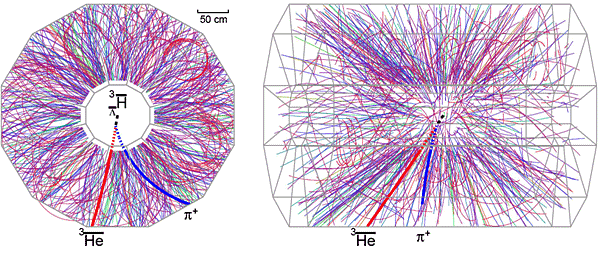
Nuclear collisions recreate conditions in the universe microseconds after the Big Bang.
Only a very small fraction of the emitted fragments are light nuclei,
but these states are of fundamental interest.
We report the observation of antihypertritons—comprised of an antiproton,
antineutron, and antilambda hyperon—produced by colliding gold nuclei at high energy.
Our analysis yields 70 ± 17 antihypertritons
( ) and 157 ± 30 hypertritons
( ) and 157 ± 30 hypertritons
( ).
The measured yields of
() and 3He (3 ).
The measured yields of
() and 3He (3 )
are similar, suggesting an equilibrium in coordinate and momentum space populations of up, down,
and strange quarks and antiquarks, unlike the pattern observed at lower collision energies. The production
and properties of antinuclei, and nuclei containing strange quarks, have implications spanning
nuclear/particle physics, astrophysics, and cosmology. )
are similar, suggesting an equilibrium in coordinate and momentum space populations of up, down,
and strange quarks and antiquarks, unlike the pattern observed at lower collision energies. The production
and properties of antinuclei, and nuclei containing strange quarks, have implications spanning
nuclear/particle physics, astrophysics, and cosmology.
Read more...
| Posted July 22, 2010
|
|
|
|
|
star focus:
Long range rapidity correlations
Highlights from the STAR papers:
Long range rapidity correlations and jet production in high energy nuclear collisions
and
Growth of Long Range Forward-Backward Multiplicity
Correlations with Centrality in Au+Au Collisions at
sqrt(sNN) = 200 GeV
.
Submitted for publication to Physical Review C and Physical
Review Letters respectively.
|
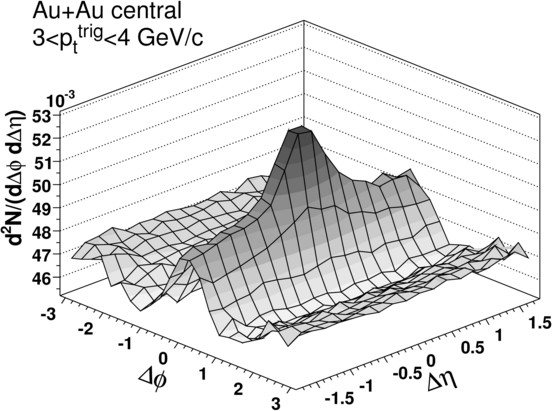
The STAR experiment has now reported two interesting
results on long range correlations
in rapidity. One of the experimental observation
is from a correlation study in azimthal angle and
pseudorapidity for produced charged hadrons with
respect to a particle with larger transverse momentum. Such
studies revealed a jet-like
correlation at small pair phase space separation
(in azimuth and pseudorapidity - near side) which
seems to be unmodified in central Au+Au
collisions relative to d+Au and a significant
correlated yield in central Au+Au collisions at
large pair separation in pseudorapidity (the
RIDGE). The ridge is observed in Au+Au collisions
and not observed in d+Au collisions (See figures).
|
|
|
|
|
|
|
star focus:
Photon multiplicity measurements at forward
rapidity
Highlights from the STAR paper:
Center of mass energy and system-size dependence of photon
production at forward rapidity at RHIC.
Submitted for publication to Physics Letters B.
|
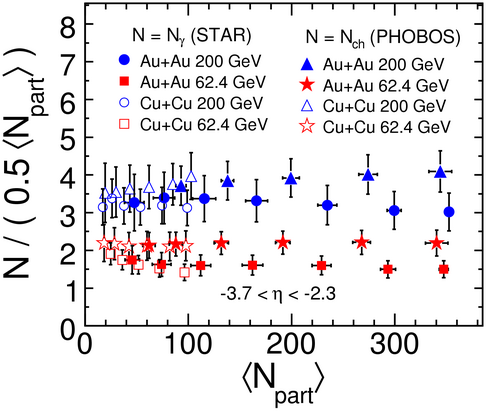
Several interesting features of the dependence
of particle density in pseudorapidity have been
observed in Au+Au collisions from the experiments
at the Relativistic Heavy-Ion Collider (RHIC).
Particle production is found to follow a unique, collision
energy independent, longitudinal
scaling in p+p and d+Au, as well as in heavy-ion
collisions. Such longitudinal scaling is also
found to be independent of collision centrality
for photons. The total charged particle
multiplicity (integrated over the full
pseudorapidity range) per average number of
participating nucleon (< Npart >) pair is found
to be independent of collision centrality by
PHOBOS experiment. However, at mid-rapidity
(|eta| <1), the PHENIX experiment showed that
charged particle multiplicity per < Npart > is
observed to increase from peripheral to central
collisions. The charged particle production
scales with a combination of < Npart > and average
number of binary collisions < Nbin >. These clearly
indicates that the mechanism of particle
production could be different in different
pseudorapidity regions. It is believed that
the scaling of particle multiplicity with
< Npart > indicates the dominance of soft
processes in particle production, whereas
scaling with average number of binary collisions
(< Nbin >) indicates the onset of hard processes
(pQCD jets).
|
|
|
|
|
|
|
star focus:
J/Psi production at high transverse momentum
Highlights from the STAR paper:
J/psi production at high transverse momentum in p+p and
Cu+Cu collisions at sqrt(sNN) = 200 GeV
Submitted for publication to Physical Review Letters.
|
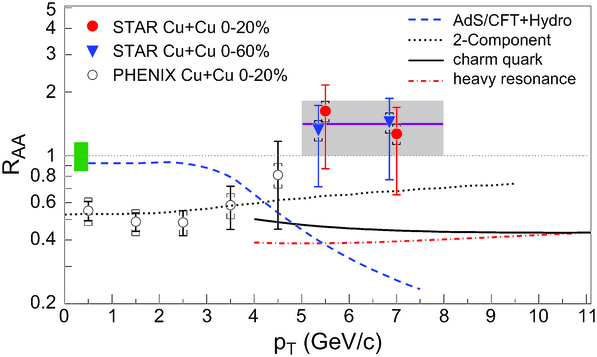
Suppression of the c-cbar bound state
J/Psi meson production in relativistic
heavy-ion collisions arising from J/Psi
dissociation due to screening of the c-cbar binding
potential in the deconfined medium has
been proposed as a signature of Quark-Gluon
Plasma (QGP) formation. Measurements of high
transverse momentum J/Psi production in A+A
collisions relative to p+p collisions (Nuclear
modification factor) can tell us which of
the following physical scenario is possible:
(a) If nuclear modification factor is less
than one it could be due partonic energy loss
in dense matter, here the J/Psi formation then
likely proceeds through a channel carrying
color.
|
|
|
|
|
|
|
star focus:
K/pi Fluctuations at Relativistic Energies
Highlights from the STAR paper:
K/pi Fluctuations at Relativistic Energies
.
Submitted for publication to Physical Review Letters.
|
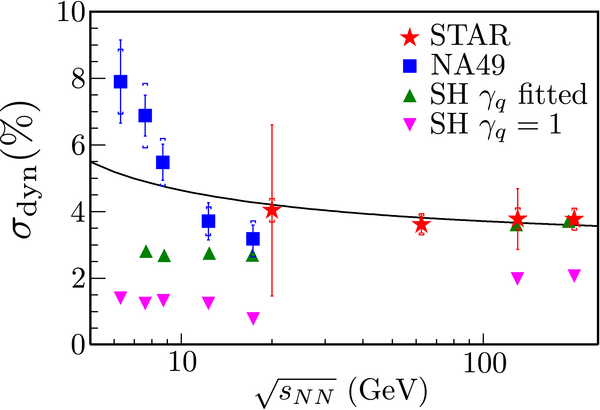
Strangeness enhancement has been predicted to be one
of the important signatures of the formation of the quark
gluon plasma (QGP). The study of dynamic fluctuations in
event-by-event K/pi ratio may produce information
concerning
QCD phase transitions and may lead to the observation of
the critical point in the QCD phase diagram. Studying
fluctuations
of particle ratios has few advantages, it has been argued
that
considering fluctuations of the multiplicity ratio
eliminates
the effect of volume fluctuations, further fluctuation of
the
particle ratio like K/pi could be sensitive to the particle
numbers at chemical freeze-out and not at kinetic
freeze-out.
STAR experiment has recently reported the results on beam
energy dependence of event-by-event K/pi ratio fluctuations
at RHIC.
|
|
|
|
|
|
|
star focus:
D* meson in jets
Highlights from the STAR paper:
Measurement of D* Mesons in Jets from p+p Collisions at
sqrt(s) = 200 GeV.
Submitted for publication to Physical Review D Rapid Communications.
|
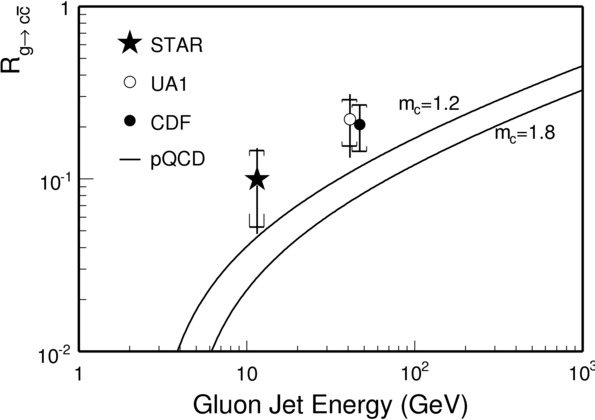
Studies by the ALEPH, L3 and OPAL Collaborations
of the D* +/- meson content in jets show that
the production from Z0 decays in e++e-
collisions is dominated by D* mesons that carry
large fractions of the jet momenta, consistent
with the jets being produced from primary c
(anti-)quarks. In pbar + p collisions at 630 GeV
and 1.8 TeV, the UA1 and CDF Collaborations have
observed D* +/- mesons in jets with transverse
energies larger than 40 GeV. Their fractional
momenta are found smaller, consistent with a
different production mechanism in which the D*
mesons originate from gluon splitting into c cbar
pairs.
At top RHIC energy, heavy quarks can still be
produced via gluon splitting. Perturbative QCD
suggests that these contributions are small, and
that the majority of the heavy quarks originate
from gluon-gluon fusion. These expectations,
however, have not until now been confronted with
data at RHIC. The STAR experiment presents the
first measurement of charged D*
mesons in
inclusive jets produced in p + p collisions at
a center of mass energy of 200 GeV at RHIC which
addresses the above issue. The charged D*
andidates were identified through the decay
sequence D*+ --> D0 pi+, D0 --> K-pi+ and
its charge conjugate. The D*+ and D*- yields of
184 +/- 44 and 169 +/- 45 were obtained in inclusive
jets with 11.5 GeV mean transverse energy.
|
|
|
|
|
|
|
star focus:
Observation of Two-source Interference in
STAR
Highlights from the STAR paper:
Observation of Two-source Interference in the
Photoproduction
Reaction Au Au -> Au Au rho0.
Submitted for publication to Physical Review Letters.
|
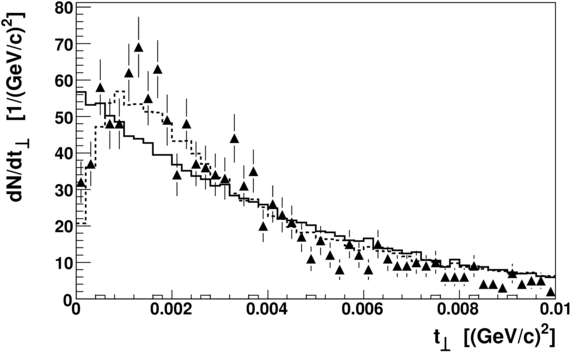
In ultra-peripheral relativistic heavy-ion collisions, a
photon
from the electromagnetic field of one nucleus can fluctuate
to a
quark-antiquark pair and scatter from the other nucleus,
emerging as
a Rho0. The Rho0 production occurs in two well-separated
(median impact parameters of 20 and 40 fermi for the cases
considered
here) nuclei, so the system forms a 2-source
interferometer.
At low transverse momenta, the two amplitudes interfere
destructively, suppressing Rho0 production. The produced
Rho0s decay almost immediately
at two well-separated points, so any interference must
develop
after the decay, and involve the pi(+) pi(-) final state.
Since
the pions go in different directions, this requires an
entangled
pi(+)pi(-) wave function which cannot be factorized
into separate pi(+) and pi(-) wave functions; this is an
example
of the Einstein-Podolsky-Rosen paradox (for more details on
this
paradox look at reference below).
The figure shows the the uncorrected midrapidity minimum
bias
Au+Au 200 GeV dN/dt spectra as a function of t(perp) =
(pT*pT).
These data are compared simulations based with and without
interference. The measured dN/dt spectrum is roughly
exponential,
but with a significant downturn for t(perp) < 0.0015
GeV*GeV,
consistent with the predicted interference (dashed
histogram).
The no-interference histogram is almost exponential (solid
histogram), dN/dt ~ exp (-kt(perp)), where k is related
to the
nuclear radius.
|
|
|
|
|
|
|
star focus:
Phi Meson and Strangeness Enhancement at RHIC
Highlights from the STAR paper:
Energy and system size dependence of phi-meson
production in Cu+Cu and Au+Au collisions.
Submitted for publication to Physics Letters B.
|
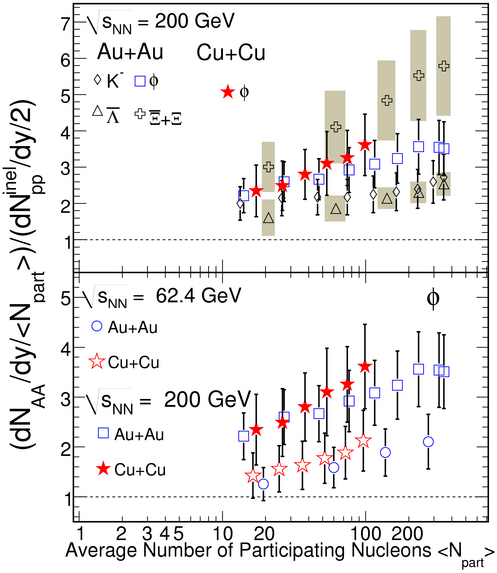
In a Quark-Gluon Plasma, thermal s and sbar
quarks can be produced by gluon-gluon interactions. These
interactions could
occur very rapidly and the s-quark abundance
would equilibriate. During hadronisation, the s
and sbar quarks from the plasma coalesce to form
phi-mesons. Production by this process is
not suppressed as per the OZI (Okubo-Zweig-Izuka)
rule. This, coupled with large abundances of
strange quarks in the plasma, may lead to a
dramatic increase in the production of phi-mesons
and other strange hadrons relative to non-QGP
p+p collisions.
Alternative ideas of canonical suppression of
strangeness in small systems as a source of strangeness
enhancement in high energy
heavy-ion collisions have been proposed for
other strange hadrons (e.g Kaon, Lambda,
Cascade, Omega). The strangeness conservation laws require
the production of an sbar-quark for
each s-quark in the strong interaction. The main
argument in such canonical models is that the energy and
space time extensions in smaller systems may not be
sufficiently large.
This leads to a suppression of strange hadron
production in small collision systems. These
statistical models fit the data reasonably
well. According to these models, strangeness
enhancement in nucleus-nucleus collisions,
relative to p+p collisions, should increase with
the strange quark content of the hadrons.
This enhancement is predicted to decrease with increasing
beam energy.
|
|
|
|
|
|
|
star focus:
STAR readiness for proposed Beam Energy Scan
Program : Results from Au+Au collisions at 9.2 GeV
Highlights from recent data taken by STAR with the lowest
beam
energy collisions at RHIC - Au+Au collisions at 9.2 GeV.
These were presented for the first time at the
International Conference
on Strangeness in Quark Matter, 2008, Beijing China.
|
One of the main aim of high energy heavy-ion collisions
is to map the QCD phase diagram. The goal being to locate
the QCD phase boundary (separating matter with hadronic
degrees of freedom from matter with quark gluon degrees of
freedom) and the QCD critical point (where
the first order phase transition ends). The phase
diagram is plotted as temperature versus baryon chemical
potential. These quantities can be changed by varying the
colliding beam energy to map the phase diagram. The
temperature
and baryon chemical potential can be measured from the
produced
particle spectra and ratios. Then one looks for signatures
for different phases and for the QCD critical point. In
addition
STAR also would like to study the beam energy which
corresponds
to onset of several interesting observations seen at top
RHIC
energy (Au+Au 200 GeV) : Number of constituent quark
scaling of
elliptic flow parameter for produced hadrons, enhanced
correlated yields at large delta_eta for delta_phi ~ 0
(Ridge)
and the suppression of high transverse momentum hadron
production
in heavy ion collisions.
In order to achieve the above goals STAR has proposed a
beam
energy scan program at RHIC spanning beam energies from
5 GeV to 50 GeV. As a first step towards achieving this
goal,
recently STAR collected data from a test run for Au+Au
collisions
at 9.2 GeV. The events for this test run was collected at a
rate
of 0.7 Hz. The first results were presented at the SQM2008.
Here
we discuss only a small subset of the results.
|
|
|
|
|
|
|
star focus:
Hadronic resonance measurements in d+Au collisions
Highlights from the STAR paper
Hadronic resonance production in d+Au collisions at 200 GeV
at RHIC accepted for publication in
Physical Review C.
|
The particle identification capability of
the Time Projection Chamber in STAR and
its large acceptance enables us to measure many
hadronic resonances produced in the high energy collisions.
Resonances are strongly decaying particles with lifetimes x
velocity of light that are of the order of the size of the
hot and dense medium produced in heavy-ion collisions. The
in-medium effects related to the high density
and/or high temperature of the medium can modify the
properties of short-lived resonances, such as
their masses, widths, and even their spectral shapes. STAR
experiment has recently reported the
measurement of the following resonances for colliding beam
energy of 200 GeV. These are
reconstructed from their hadronic decay channels using
invariant mass technique in d+Au
collisions - rho(770), K*(892), Delta(1232)++, Sigma(1385),
Lambda(1520).
One interesting feature was observed in the
transverse mass distribution of these resonances
measured at midrapidity. As shown in the figure,
they seem to follow a generalized scaling in
d+Au collisions between transverse mass range of 1 - 2
GeV/c2. Such a scaling could be envisaged
within the idea of saturation of gluon density
in the nucleus for high energy collisions. However such
scaling has been observed in p+p
collisions at ISR, SppbarS, RHIC energies. Also
the resonances in d+Au collisions do not show any
difference in the shape of the transverse mass distribution
between baryons and mesons at higher transverse mass.
Differences were earlier
observed for non-resonant particles along
baryon-meson lines.
|
|
|
|
|
|
|
star focus:
Identified hadron measurements in STAR using the Time Projection Chamber
Highlights from the STAR paper
Systematic Measurements of Identified Particle Spectra in
p+p, d+Au and Au+Au Collisions from STAR submitted
recently to Physical Review C.
|
STAR experiment has recently reported systematic
measurements of identified particle spectra in
pp, d+Au and Au+Au collisions. Along with
reporting several interesting results for the
above collision systems at different energies we
have also presented in detail the particle
identification procedure in STAR Time Projection
Chamber and the various correction factors
associated with the extraction of the yield and
shape parameters for the transverse momentum
spectra of produced hadrons.
In this focus article we present two results from
this work. For Au+Au collisions,mean pT, which
characterizes the slope of the transverse
momentum spectra are found to increase
significantly with increasing collision
centrality or decreasing impact parameter of the
collision. The trends are similar at 62.4 GeV,
130 GeV, and 200 GeV, and mean pT qualitatively
agree with each other at the same dNch/dy.
This suggests that the kinetic freeze-out
properties in Au+Au collisions are rather
energy independent for the measured collision
energies.
|
|
|
|
|
|
|
star focus:
Transverse Single Spin Asymmetries measurements in RHIC
Highlights from the STAR paper Forward Neutral Pion
Transverse Single Spin Asymmetries in p+p Collisions at sqrt(s)=200 GeV submitted recently to Physical Review Letters.
|
The production of particles with high transverse
momentum from polarized proton collisions at high
energies is sensitive to the quark and gluon
spin structure of the proton.
One challenge to theory has been to understand
the sizable azimuthal asymmetry of particles
produced in collisions of transversely polarized
protons, known as analyzing power (AN) or
transverse single spin asymmetry (SSA) for
inclusive pion production in polarized p + p
collisions over a broad range of collision energies and in
semi-inclusive deep inelastic
scattering (SIDIS) from transversely polarized
proton targets.
Spin-correlated transverse momentum dependent
(TMD)distribution functions (Sivers effect),
in conjunction with initial- or final-state color-charge
interactions, can explain large AN.
These functions describe parton orbital motion
within the proton, and so are important to
explore to understand the structure of the
proton.
|
|
|
|
|
|
|
star focus: Beam-Energy and System-Size Dependence of Dynamical Net Charge at RHIC
Highlights from the STAR paper Beam-Energy and System-Size Dependence of Dynamical Net Charge submitted recently to Physical Review C.
|
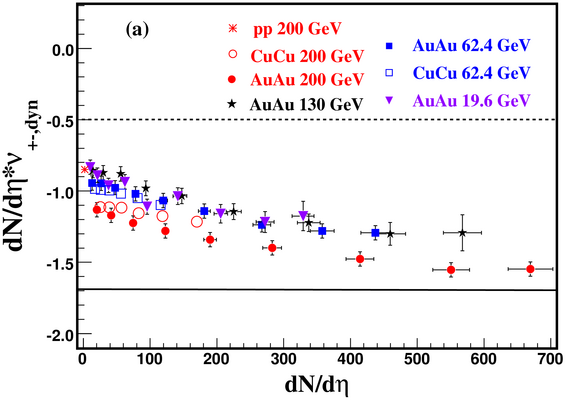
Anomalous transverse momentum and net charge event-by-event
fluctuations have been proposed as indicators of the
formation of a quark gluon plasma (QGP) in
high-energy heavy ion collisions.
In particular, Koch et
al. [1] have estimated that entropy conserving
hadronization of a plasma of quarks and gluons should
produce a final state characterized by a dramatic reduction
of the net charge fluctuations relative to those observed in
a hadron gas. Published STAR measurements indicate the
fluctuations observed in Au + Au collision at center of
mass energy of 130 GeV are little suppressed relative to
those observed in p + p collisions [2]. STAR found the
measured fluctuations in this collision system and energy
are in qualitative accord with expectations based on hadron
gas models. It is thus interesting to study the magnitude of
the fluctuations as a function of the colliding system size
by varying both collision centrality and colliding nuclei.
There is also a possibility that final state interactions
may partly wash out the expected suppression through
collision and diffusion processes [3].
Best conditions to
observe the predicted suppression may not be at 130 GeV.
It is,therefore, of great interest to carry out a study of
the system size,
and beam energy dependence of the net
charge fluctuations.
|
|
|
|
|
|
|
star focus: System-size independence of directed flow at RHIC
Highlights from the STAR paper System-size independence of directed flow at the Relativistic Heavy-Ion Collider submitted recently to Physical Review Letters.
|
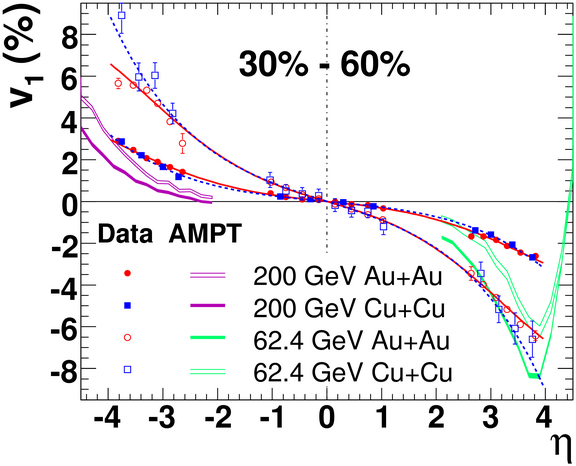
Directed flow refers to collective sidewards
deflection of particles and is characterized
by a first-order harmonic (v1) of the Fourier
expansion of particle's azimuthal distribution
w.r.t. the reaction plane in heavy-ion collisions.
STAR has recently submitted to Physical Review
Letters multiple differential measurements of v1
for Au+Au and Cu+Cu collisions at center of mass energies
of 200 and 62.4 GeV as a function of pseudorapidity (eta),
transverse momentum, and collision
centrality. We find that directed flow violates
the "entropy-driven" multiplicity scaling which
dominates all other soft observables. STAR has
reported an intriguing new universal scaling of
the phenomenon with collision centrality.
Neither Boltzmann/cascade nor hydrodynamic models
are able to explain the measured trends.
|
|
|
|
|
|
|
star focus: Charmed hadron production at low transverse momentum at RHIC
Highlights from the STAR paper Charmed hadron production at low transverse momentum in Au+Au collisions at RHIC submitted recently to Physical Review Letters.
|

Charm quarks are likely to be produced only in
the early stages and can be a unique tool to
probe the partonic matter created in relativistic
heavy-ion collisions at RHIC energies. Studies of
the number of binary collision (calculated using
Glauber model) scaling of the total charm cross
section from d+Au to Au+Au collisions can be used
to test if charm production is exclusively at the initial
impact of colliding heavy ions.
The total charm production cross section is also
an important input in models of J/Psi production
via charm quark coalescence in a Quark Gluon
Plasma.
|
|
|
|
|
|
|
star focus: indication of conical emission at RHIC
Highlights from the STAR paper Indications of Conical Emission of Charged Hadrons at RHIC submitted recently to Physical Review Letters.
|
|
Experimental observation of jet-quenching studies in STAR
revealed: on the away side of a high transverse momentum
(pt)
trigger particle the correlated yield is strongly
suppressed
at pt > 2 GeV/c while at lower pt the yield is enhanced
and
the correlated hadrons appear to be partially equilibrated
with the bulk medium and are broadly distributed in
azimuth.
|
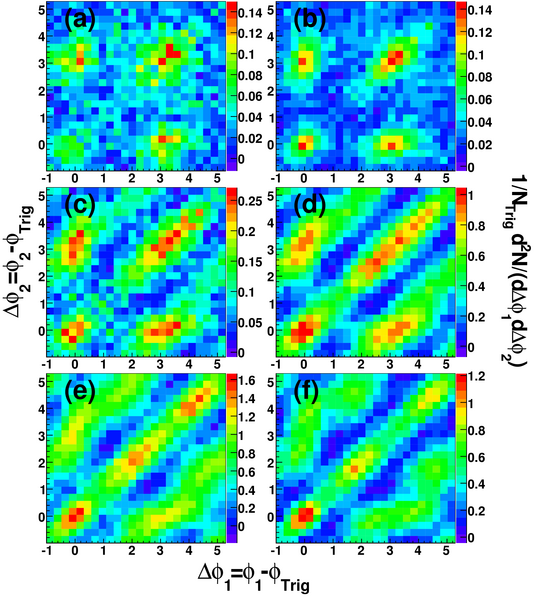
|
|
|
|
|
|
|
star focus: Half-Day Symposium: STAR Highlights and Future, Brookhaven National Laboratory, May 5th, 2008
|
At this event we celebrate Tim Hallman’s leadership as Spokesperson of the STAR experiment at RHIC for the past six years. We chronicle the experiment’s success, and look forward towards its bright future.
Sponsored by the Department of Physics, Brookhaven National Laboratory
|
|
Posted Apr 25, 2008
|
|
star focus: jets in nuclear collisions
Part 1 of a series on STAR analysis topics
|
|
In high energy p+p collisions, the hard scattering of quarks and gluons early in the collision
leads to the production of jets,
narrow streams of particles that allow physicists
to detect and understand the scattering. In nuclear collisions at RHIC,
jets instead
serve as a penetrating probe of the extremely dense nuclear matter formed in the collision.
Comparing characteristics of jets in nuclear collisions to jets in p+p
collisions has uncovered special properties of dense nuclear matter at RHIC.
Read more...
| Posted Aug 3, 2006
|
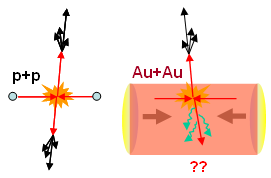
|
|
|
star focus: beamtime!
|
STAR's preparations are underway for the 2006 RHIC beamtime, thanks to
special
funding for this year's experimental operations. This year's "beamtime" is
the sixth annual RHIC run, with
about 15 weeks of colliding polarized proton beams scheduled to begin in early
March. STAR collaborators come to BNL during the experiment to serve weekly
shifts as part of six-member shift teams, and each member has specific tasks
to perform while on shift.
More...
RHIC '06 operations plan
| Posted Feb 2, 2006
|
|
|
|
star focus: quark matter 2005
|
The 18th International Conference on Nucleus Nucleus Collisions
(Quark Matter 2005)
was held in Budapest, Hungary,
August 4-9. STAR presented new results on several fronts,
summarized in two experimental
summary talks on the conference's
first day and a special focus
talk on the last day. STAR contributed 15 parallel talks and
many posters.
STAR at QM 2005
| Posted Aug 11, 2005
|

|
|
|
star focus: let's meet in warsaw
|
This summer, STAR will hold its semi-annual collaboration meeting
in Warsaw, Poland, preceeding the Quark Matter 2005 conference in Hungary.
The collaboration meeting will be hosted
by Warsaw University of Technology (Politechnika Warszawska), a STAR member institute.
Meetings before major conferences give collaboration members the chance to review
results, share posters and practice talks.
Meetings away from BNL also allow institutions to open their
doors to fellow collaborators.
Read more...
| Posted May 31, 2005
|

|
|
|
star focus: rhic lessons
|
As part of a joint venture between BNL and JINR (Dubna) called the
Online Science Classroom, a series of
RHIC Lessons
have been created by STAR Collaborators in Dubna. These lessons introduce many
aspects of the research carried out by STAR, from the process of colliding different
beams of particles to the challenges of studying the formation of a quark-gluon
plasma. The lessons require Macromedia Flash Player.
RHIC Lessons
| Posted March 5, 2005
|
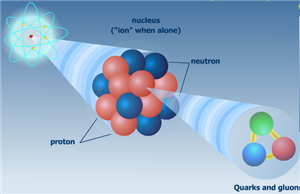
|
|
|
star focus: graduate students
|
One of the primary missions of STAR is to provide rigorous training for
graduate students, who account for much of the hands-on detector and analysis
efforts for the experiment. As a result, STAR has produced an impressive number of graduate
degrees over a wide range of thesis topics. Click here for a list of graduate thesis titles, with links
to many thesis files.
Read more...
| Posted January 21, 2005
|

|
|
|
star focus: physics results
|
Nearly four years have passed since STAR's
first publication,
on the observation of evidence for
strong early expansion in Au+Au collisions at RHIC, appeared in Physical Review Letters.
Since then, 23 other Physical Review Letters have followed, more than any
nuclear physics experiment in history. A growing list of brief summaries of our
publications is available on our website.
Physics results summaries
| Posted November 19, 2004
|
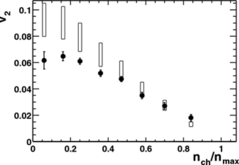
|
|
|
star focus: star and the data grid
|
As the amount of data recorded by the STAR Experiment accumulates, the data storage
and data processing needs grow as well. STAR is an active participant in the
Particle Physics Data Grid, a project to manage
and distribute data and data analysis tasks across a large network of computing
facilities around the country.
Read more...
| Posted September 24, 2004
|

|
|
|
star focus: regional meetings
|
STAR Collaborators comprise a community of scientists and technicians from
13 countries on four continents, and getting everyone together isn't always
an easy task. That's one reason behind STAR Regional Meetings, smaller
gatherings of STAR members a bit further from RHIC than the BNL physics building.
Regional Meetings were held in China and Russia in 2003. Next up: Bhubaneswar, India,
in October.
Read more...
| Posted August 1, 2004
|

|
|
|